Dissimulation et apparence
Les liaisons dangereusesDissimulation et apparence names a governing tension in the novel: people use the forms of sincerity, friendship, virtue, and feeling to conceal or redirect their intentions. The preface identifies the consequence for the correspondence as a whole: because many expressed sentiments are feigned or concealed, the letters invite curiosity more readily than emotional identification. Yet their variety of styles and scattered observations also reveal how people perform themselves—and how readily that performance can become a means of corrupting or controlling others.
Appearance as a Deliberate Construction
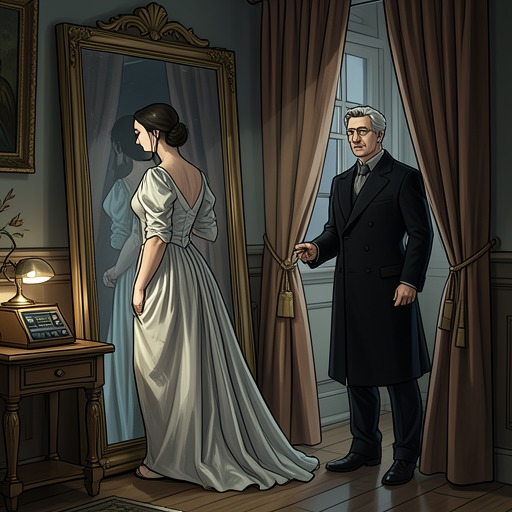
The clearest practitioner is the Marquise de Merteuil, who treats disguise not as an isolated trick but as a coordinated arrangement of setting, clothing, writing, and speech. To surprise her lover, she first claims a headache and goes to bed in the eyes of her household. Alone with Victoire, she changes into a maid’s clothes while Victoire disguises herself as a footman. A hired carriage waits at the garden gate, and Merteuil prepares an outfit that conceals while inviting speculation. The scene is organized to make the encounter appear spontaneous and emotionally overwhelming, although every stage has been arranged in advance.
Her control extends to the lover’s journey and his interpretation of it. A doorkeeper refuses him entry and reports that Merteuil is ill; a note, deliberately not in her handwriting, redirects him to a meeting place. There Victoire, still disguised, leads him on to the house. The surprise, the prepared supper and bed, and the carefully adorned boudoir culminate in Merteuil’s performance of remorse: she presents her apparent ill temper as a temporary veil over affection and offers love as its expiation. The episode makes the gap between feeling and appearance material. What seems like an emotional reversal has been rehearsed through false illness, borrowed identities, a planted message, and a staged apology.
The performance is prepared intellectually as well as physically. While Victoire attends to the remaining arrangements, Merteuil reads a chapter of the Sopha, a letter from Héloïse, and two tales by La Fontaine to rehearse different tones. Her understanding of dissimulation includes the need to vary style according to the effect sought. A convincing appearance is not simply a lie told in words; it is a whole scene whose details cooperate to make the lie feel true.
Letters, Style, and the Appearance of Feeling
The novel’s letter form makes self-presentation unusually visible. In the preface, the editor-like speaker observes that the collection’s many correspondents produce a diversity of styles, while the feigned or concealed sentiments within the letters limit the kind of interest they can command. Each writer gives an account from a particular position and for a particular recipient; a letter can disclose a feeling, but its language and arrangement can also betray an effort to manufacture one.
The Marquise de Merteuil makes that distinction explicit when she criticizes the Vicomte de Valmont’s letter-writing to the Présidente de Tourvel. In her view, a writer who does not feel what he professes may reuse the expected words but cannot arrange them with convincing spontaneity. Valmont’s letter, she argues, is too orderly, and its polished sequence exposes the artifice it is meant to hide. She contrasts writing with speech: a practiced voice, tears, the expression in the eyes, and the disorder of conversation in a beloved person’s presence can make an appearance of feeling more persuasive. Her analysis is itself a lesson in performance, locating credibility not in declarations alone but in their timing, medium, and apparent lack of control.
Merteuil applies a related distinction when writing to the Chevalier Danceny. She rebukes him for using the flattering language of love when he means to express friendship, insisting that each sentiment has a language appropriate to it. She presents her own manner as frank and plain, contrasting it with conventional phrases that have become mere social protocol. Yet her letter also lets irritation and jealousy show through: she objects to Danceny’s interpretation of her words and invokes the possibility that he prefers Cécile Volanges to her. The claimed plainness is therefore not a neutral escape from performance; it is another position from which Merteuil can shape how Danceny reads her.
Innocence, Instruction, and Managed Sincerity
Merteuil’s account of Cécile Volanges shows how appearance can make another person easier to manipulate. She describes Cécile as lacking established principles and experience, yet possessing a natural capacity for falsity that is concealed by a face suggestive of candor and innocence. Cécile’s curiosity and changing reactions—laughter, vexation, tears, and requests for instruction—amuse Merteuil, who recognizes the distance between what the young woman wants to know and what she understands about her own desires.
Merteuil cultivates Cécile’s confidence while managing its consequences. She first appears severe, then accepts Cécile’s poor arguments as though they had persuaded her. Cécile is left believing that her own eloquence won permission to write and speak of love. On the very day permission is granted, Merteuil arranges a private meeting between Cécile and Danceny without Cécile’s knowledge of the arrangement. What looks to Cécile like the success of an honest appeal is, in Merteuil’s account, a carefully managed concession. The episode shows dissimulation operating through another person’s self-image: Cécile believes herself to have achieved something by persuasion, while Merteuil has determined the terms of the apparent victory.
Social Respectability and Contested Intentions
The Présidente de Tourvel’s letters expose a different pressure: the difficulty of maintaining a respectable appearance when another person controls access, correspondence, and public interpretation. She lists Valmont’s persistence in speaking of a feeling she refuses, his exploitation of her good faith or timidity to deliver letters, and the compromising manner in which he sent the latest one. She asks him to leave the château, explaining that his continued presence could expose her to the judgment of a public quick to think ill of women who admit him into their society. Her concern is not only what she feels, but what his conduct may make others believe about her.
When she later explains why she continues to answer, Tourvel distinguishes the permission she gave from the conditions under which she gave it. She acknowledges that this is already her third reply, even though Valmont’s conduct has given her reason to end the correspondence. Her continued response could resemble consent to an intimacy she rejects; she instead presents it as an effort to preserve a possible friendship, provided he abandons the language of love. The letter makes the appearance of a relationship contested ground: Tourvel tries to define what her replies mean, while Valmont’s appeals threaten to assign them a different meaning.
Valmont, for his part, frames his response to Tourvel’s demand for distance as a choice between her unhappiness and his own, and presents himself as willing to sacrifice himself. He also challenges her fears, suggesting that they derive from unfavorable impressions others have given her. This shift recasts her attempt to protect herself as evidence of prejudice and treats the danger she names as something to be argued away. His self-description as a suffering, affectionate man thus sits beside her account of unwanted persistence and compromised confidence. The contradiction is central to the novel’s use of appearance: a letter can present the writer as tender and wronged while the recipient describes conduct that makes trust difficult.
Merteuil’s account of her widowhood offers a final example of respectability used as a form of freedom. She says she has declined advantageous remarriages so that no one would have the right to criticize her actions; she insists that the issue was not whether she could continue to do as she pleased, but whether another person would have grounds to complain. When Valmont objects to finding Danceny at her house, she refuses the assumption that he has a husband’s claim over her. She offers two possible explanations—chance or intention—and turns his jealousy into the problem under discussion. Her defense exposes the difference between being answerable to social appearances and being bound by the private obligations another person tries to impose.
Narrative Significance
Dissimulation et apparence links intimate manipulation to the novel’s larger moral argument. The preface presents the letters as a disclosure of the methods by which people of bad conduct corrupt those of good conduct; the episodes involving Merteuil, Cécile, Valmont, and Tourvel show those methods in distinct forms. A disguise can orchestrate an encounter, an orderly letter can betray insincerity, an apparent concession can conceal control, and a declaration of tenderness can compete with the recipient’s account of injury.
Because the story is told through correspondence, readers encounter conduct through competing acts of self-presentation rather than through a single, neutral account. The letters disclose information, but they also reveal the writers’ attempts to manage interpretation. Appearance is consequently both the instrument characters wield against one another and the problem the reader must continually assess: what a correspondent claims to feel, what their language makes plausible, and what their described actions allow that claim to conceal.