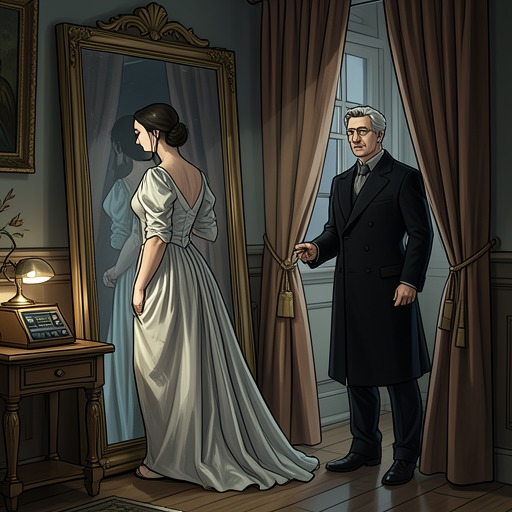
Dissimulation et apparences sociales
Les liaisons dangereusesDissimulation et apparences sociales names a governing practice of the novel’s correspondence: characters present a credible public self while using private letters to disclose, plan, or revise what that self conceals. Courtesy can mask pressure, virtue can serve as a persuasive costume, and apparent repentance can open a route back to someone who has refused contact. The gap between what a character says and what that character is trying to accomplish makes the letters both records of events and evidence of competing performances.
Appearances and the frame of the correspondence
The opening editorial framing turns the language of social respectability into a question. A prefatory voice claims that the bad conduct attributed to some characters could not belong to its own supposedly enlightened age, when men are said to be honest and women modest. It argues that the events must belong to another time or place. The editor, meanwhile, explains that the published collection is only a selection from a larger correspondence: letters have been cut as unnecessary, arranged mostly by date, and supplemented with occasional notes. The reader therefore encounters private self-presentations through an already selected and ordered record, rather than through a neutral, complete archive.
This structure makes appearance more than a personal trait. A character’s account is a performance directed at a particular recipient, while the surrounding letters may expose its omissions or purpose. The reader is repeatedly positioned to compare public declarations with private explanations, and to notice how easily respectable conduct can be invoked as a defense even when the letter-writer’s own account reveals calculation.
Merteuil’s public virtue and private strategy
The Marquise de Merteuil’s letter to Madame de Volanges after her encounter with M. de Prévan exemplifies the protection offered by a composed public account. She presents herself as a respectable woman distressed by the attention the incident has brought upon her. She recounts meeting Prévan in company, joining an outing to the French theatre, receiving his visits, and then responding to what she regarded as excessive familiarity with a formal invitation and cool behavior at supper. In her account, his later entrance into her apartment is an unforeseen violation of the decorum she had tried to maintain; she says that she rang for help. The sequence establishes her version of events for a trusted correspondent and foregrounds her outward reserve.
In a separate letter to the Vicomte de Valmont, Merteuil describes the moral advice she gave Madame de Volanges about her daughter’s marriage in a different light. She acknowledges that her language of virtue and restraint was useful precisely because it sounded austere. Her private account says she praised Madame de Volanges while also seeking to shame her inwardly, and that hostility toward the Comte de Gercourt strengthened her willingness to speak well of him. The contradiction is deliberate: Merteuil’s moral authority in one letter is revealed as a tool in another, where she describes tailoring her counsel to her own designs.
Her management of appearances also depends on friendship. She welcomes Madame de Volanges’s confidence and presents her advice as deferential, even while steering the decision about Cécile Volanges’s future. The surface of respectful counsel makes the intervention harder to recognize as manipulation. In Merteuil’s own explanation, flattering her correspondent and invoking conventional virtue help make her argument effective without requiring her to share its principles.
Marriage, virtue, and competing advice
Madame de Volanges’s deliberation shows that not every appeal to virtue is a disguise. Concerned that her daughter loves the Chevalier Danceny, she questions whether keeping her promise to the Comte de Gercourt would place Cécile in a marriage against her inclination. She considers withdrawing that promise, or at least delaying the decision, and weighs the possible harm of forcing a match against the financial and social advantages of Gercourt. Her letter treats maternal authority as a responsibility, not simply a right to command: she would rather risk weakening her authority than compromise her daughter’s virtue or conceal the situation from the prospective husband.
Merteuil answers in the idiom of prudence and duty. She argues that a mother must distinguish what pleases a daughter from what is suitable for her, and rejects intense passion as a reliable basis for changing a marriage arrangement. She presents restraint as the safeguard of principles and Cécile’s sheltered upbringing as grounds for confidence. Yet her later admission to Valmont shows that this carefully argued defense of convention also serves her designs against Gercourt. The contrast does not make Madame de Volanges’s own motives simple; it shows instead how the same vocabulary of responsibility can be used sincerely by one correspondent and instrumentally by another.
Keys, letters, and the managed appearance of consent
The correspondence surrounding Cécile makes the material means of secrecy visible. Valmont proposes that she help obtain a duplicate of the key to her room, which could facilitate private letters and meetings. Cécile refuses. She explains that the substitute might not match the original, that her mother notices details, and that discovery could ruin her; she also feels that making a duplicate would be wrong. Her caution gives her position a clarity that Valmont’s subsequent account tries to overcome through others’ influence and through the meaning he assigns to the key.
Valmont reports that he wrote to Danceny about Cécile’s refusal, after which Danceny pressed her to grant the request. Valmont then uses the key to enter her room at night. In recounting what followed, he describes preventing her from calling for help and invoking the fact that she had provided the means of entry as a reason she might not be believed. His account presents her eventual submission as the outcome of his stratagem; it does not establish free agreement. The episode exposes how an appearance of complicity can be manufactured from secrecy, a vulnerable position, and fear of the consequences of disclosure. A key meant to enable private correspondence becomes a means by which Valmont controls what can be safely said about his presence.
Repentance as performance and the costs of exposure
Valmont’s appeal to Father Anselme likewise uses the forms of respectable conduct to seek access. He writes that he possesses important papers concerning the Présidente de Tourvel, who has refused correspondence with him, and asks the priest to convey his new resolutions and request a private meeting. He presents this meeting as an opportunity to apologize and destroy the remaining evidence of a wrong, then asks for spiritual guidance toward a different path. He also authorizes Father Anselme to show the letter to Tourvel, describing her as the person through whom his soul was returned to virtue. The language of humility and religious purpose makes his request appear compatible with the no-contact boundary he acknowledges, even as it is designed to reopen communication.
In another account to Merteuil, Valmont describes using calculated emotional display during an encounter with Tourvel. When tears fail, he changes his performance, using alarm and declarations of despair to intensify her response; he then pretends to leave and reports that she stopped him. The account’s strategic self-commentary makes the scene a stark instance of appearance replacing candor: he narrates his gestures as tactics and Tourvel’s distress as evidence that the tactics worked. Read beside his letter to Father Anselme, the contrast complicates any straightforward account of conversion. Religious language and apparent emotional sincerity cannot be taken at face value when his own letters disclose the work of persuasion behind them.
The social protections afforded by performance do not prevent consequences. After the illness that leaves the Marquise de Merteuil disfigured, she loses her lawsuit unanimously. The court awards costs, damages, and the return of profits to the minors; the remaining portion of her fortune is consumed and exceeded by the expenses. She leaves alone at night, taking her diamonds, silver, and other possessions, while leaving nearly 50,000 livres in debt. The report describes her departure as adding to the scandal surrounding her. Her fall gives the concept a material as well as reputational ending: the cultivated management of appearances may shape how events are first received, but it cannot guarantee control over the public record, the judgment of others, or the financial consequences that follow.