Italian Comedy Theatre
Les liaisons dangereusesThe Italian Comedy Theatre is the setting for a decisive public reversal in the Marquise de Merteuil’s fortunes. Its performance ends not with the ordinary dispersal of an audience but with a scene in the adjoining salon, where the crowd’s gestures make social condemnation visible and place M. de Prévan in striking contrast to her.
Setting and Layout
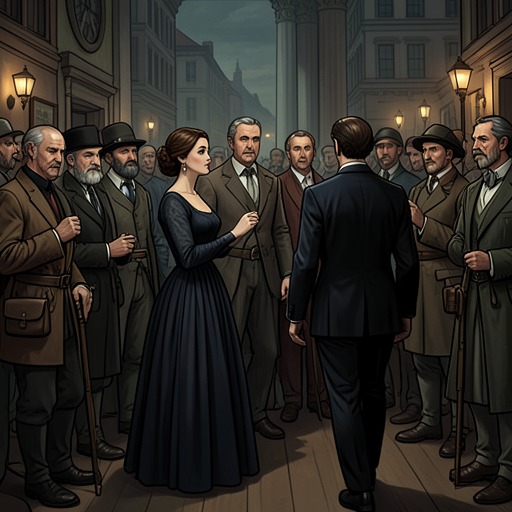
The Marquise arrives from the countryside on a Thursday and takes her accustomed box, alone. During the performance no man comes to see her, a conspicuous absence that the later account presents as an early sign of her altered standing. Afterward, she enters the small salon, already full of people. The passage thus moves from the relative enclosure of her box into a shared public space where the audience can observe and respond to her.
The Salon’s Public Rebuke
At first, a murmur rises in the salon, though the Marquise apparently does not understand that it concerns her. When she spots an empty place on a bench and sits down, the women seated there rise together, leaving her isolated. The men applaud this coordinated display of indignation; murmurs grow louder and reportedly reach the point of boos. The rebuke is delivered through collective movement as much as speech: the empty seat becomes a visible mark of exclusion.
M. de Prévan’s Reception
The scene sharpens when M. de Prévan enters. He had not appeared in public since his earlier scandal with the Marquise, but here men and women gather around him and applaud. The crowd effectively carries him in a circle toward her, placing the two at the center of a public contrast: she is left alone and condemned, while he is welcomed. The report says she seemed not to see or hear the reaction and did not change expression, while allowing that this detail may be exaggerated. Her departure, when her carriage is announced, brings a renewed outburst of boos. That same evening, officers from M. de Prévan’s corps receive him warmly, and his return to his position and rank is expected.
Reputation and the Reported Scene
The episode makes the salon a social tribunal. The audience’s response translates reputation into visible acts—vacating a bench, applauding, gathering around one figure, and jeering at another—and turns the theatre’s public into an instrument of judgment. The account reaches the reader indirectly: a correspondent says an acquaintance who witnessed the scene supplied the details. That reported, partly qualified account conveys both the force of the humiliation and the uncertainty attached to claims about the Marquise’s composure. The Italian Comedy Theatre matters not simply as a venue, but as the place where her changed standing is staged before a crowd and M. de Prévan’s rehabilitation appears to begin.