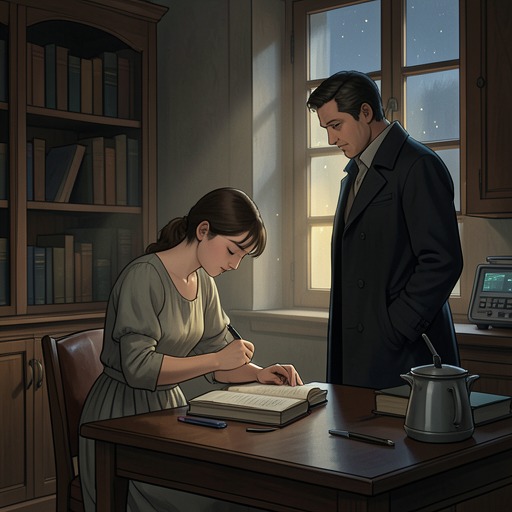
La harpe de Cécile
Les liaisons dangereusesLa harpe de Cécile is at once a household instrument and a covert channel: Chevalier Danceny hides a letter among its strings, and Cécile Volanges later uses the same hiding place to answer him. The harp’s significance lies in this double use. In the presence of family and visitors it belongs to ordinary music-making; once Cécile is alone, its strings conceal a correspondence she believes she ought not to begin. A familiar object becomes the practical means by which affection crosses the boundaries imposed on her.
A domestic instrument
The harp first belongs to Cécile’s daily routine and social world. While anticipating a visit from Madame de Merteuil and Chevalier Danceny, she notes that she must play the harp before dressing. Her thoughts about the instrument sit beside her growing concern with appearance: she wants to be well coiffed and has lately become more eager to look pretty. Music, grooming, and company therefore share the same domestic scene, in which Cécile is preparing to be seen and heard by people she loves.
The instrument also accompanies her established contact with Danceny. She recalls singing with him as usual, while Madame de Merteuil was present. After they finish, Danceny puts the harp away in its case. When he returns its key, he asks Cécile to play again that evening, as soon as she is alone. The request appears to concern music; Cécile says she suspects nothing and agrees only because he presses her. The ordinary sequence of song, storage, and returning the key prepares the harp to serve another purpose without attracting attention.
The hidden letter
Once Cécile has retired to her room and her maid has left, she goes to take up the harp. Among its strings she finds a folded, unsealed letter from Danceny. The hiding place has made the instrument a messenger: the letter is neither formally delivered nor handed over in company, but positioned where Cécile will find it in private. Its placement also binds the message to the music they have just shared, extending their familiar singing into a confidential exchange.
Cécile describes the letter’s effect through repeated acts of reading and recollection. She reads it four times in succession, puts it away in her writing desk, and finds that she has memorized it. In bed she repeats its contents so insistently that she cannot sleep; after waking early, she retrieves it and reads it again at leisure. She carries it into bed and kisses it, while wondering whether she has done wrong. The harp has delivered a written declaration, but the letter continues to occupy her after it is removed from the strings: the concealed object initiates a private emotional life that persists beyond the instrument’s immediate use.
The harp as a return channel
Cécile initially thinks she should not reply. She fears both doing wrong and worsening Danceny’s sadness, and waits for advice from Madame de Merteuil, whom she regards as a trusted friend. When that advice is unavailable, she faces Danceny in the family room while her mother is present. He cannot speak freely. He asks whether he should fetch the harp, and later returns it after tuning it. His brief, sorrowful address and Cécile’s distress are visible to her, but the actual message must remain concealed from Madame de Volanges.
When a visitor arrives, Cécile stops playing and asks Danceny to put the harp away. He returns to the room rather than leaving, and she catches his eyes; seeing him cry, she feels unable to bear his sadness. She slips out, writes a promise on a scrap of paper with a pencil, and places the note among the harp’s strings, where his letter had been. The exchange reverses the first delivery: the same instrument that carried Danceny’s words now carries Cécile’s. She returns to the room feeling calmer, then asks for the harp again after the visitor has departed. Danceny brings it and positions himself so that Madame de Volanges cannot see him take Cécile’s hand. Their brief contact follows the hidden note, giving the instrument’s second use an immediate consequence in the room.
Narrative and thematic significance
The harp’s importance comes from its repeated, precise function rather than from any explicit symbolic explanation. It is first part of a visible routine—singing, playing, putting the instrument away—and then becomes a hiding place inside that routine. Music offers a plausible reason for Danceny to handle the instrument and for Cécile to request it again; the strings make an unobtrusive space for messages that cannot be exchanged openly while her mother is present. The same object thus links the public scene to the private one without requiring a change of setting.
Its role also clarifies the difference between Cécile’s intentions and the consequences of her actions. She regards the initial letter as a source of pleasure but worries that answering it would violate propriety. Her note is framed as a promise meant to relieve Danceny’s unhappiness, not as a deliberate rejection of the rules she has been taught. Yet it establishes a reciprocal channel: she has now sent a message of her own, and Danceny responds with a concealed gesture of affection. The harp records that small but decisive shift from receiving a secret declaration to participating in secret communication. It is not merely present when their correspondence begins; its ordinary, public usefulness is what makes their private exchange possible.