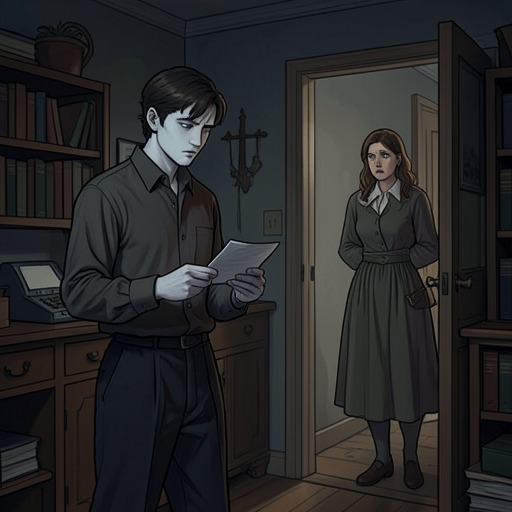
Madame de Rosemonde
Les liaisons dangereusesMadame de Rosemonde, Vicomte de Valmont’s eighty-four-year-old aunt, is a gracious host whose country home briefly offers the Présidente de Tourvel a refuge from Parisian society. Her warmth toward her nephew and her guests also makes her an unwitting presence in Valmont’s courtship of Tourvel. In the later correspondence, she becomes a moral intermediary: she advises Madame de Volanges about Cécile Volanges’s future, receives Chevalier Danceny’s letters, and communicates the final news about Marquise de Merteuil. Her affection and good faith do not make her immune to deception, but they give the novel one of its clearest voices of care and restraint.
Identity and Place in the Household
The Présidente de Tourvel describes Madame de Rosemonde as a woman of eighty-four whose age has not diminished her memory or gaiety. In her account, age belongs chiefly to Madame de Rosemonde’s body; her mind remains lively. That description establishes more than her years: she is an alert, socially generous companion, not merely a remote elder. Tourvel has come to the countryside while her husband is away and expects to remain there to enjoy Madame de Rosemonde’s company.
Madame de Rosemonde’s household brings Tourvel together with Valmont, her nephew, who has agreed to spend several days there. Tourvel initially knows him by reputation and expects little from the acquaintance. Away from the distractions of Paris, however, he presents himself as reasonable and unusually candid about his faults. Tourvel says she responds by admonishing him, and imagines that his stay may at least interrupt his usual conduct. Her account makes Madame de Rosemonde’s home a setting in which Valmont can appear, for a time, to be a more promising man than his reputation suggests.
Hospitality and Valmont’s Courtship
Madame de Rosemonde’s affection for Valmont is evident in his account of returning to the household after aiding a poor family. She has heard the story from a servant and relates it with admiring attention; Valmont portrays her as speaking warmly of the deed and then welcoming him with an embrace. His narration is self-interested, since he interprets the scene through his pursuit of Tourvel, but it also shows the ease and intimacy of the family relationship.
The same episode reveals how her hospitality becomes entangled with Valmont’s designs without her apparent knowledge. After the women visit the family he has helped, Madame de Rosemonde returns to her own apartment, leaving Tourvel and Valmont together. He presents the resulting privacy as an opportunity created by the household’s ordinary movements, not by any plan of hers. The contrast matters: the kindness and trust that make her home welcoming also provide cover for a suitor who is managing the circumstances around Tourvel.
When Valmont later leaves, Tourvel reports that Madame de Rosemonde spends the morning praising him and expressing how much she regrets his departure. Tourvel listens rather than contradicting her, partly because she recognizes the distress caused by the separation and feels responsible for it. Madame de Rosemonde’s attachment is therefore not a passing courtesy; his absence troubles her enough to shape the household’s mood. She also invites Madame de Volanges to visit, hoping that the visit will bring her and Cécile together sooner. Her hospitality connects the older woman’s household to the wider circle of relationships on which the novel’s correspondence depends.
Counsel on Cécile’s Future
In her later letters to Madame de Volanges, Madame de Rosemonde takes up the painful question of Cécile’s future with caution. She urges her friend not to oppose the vocation Cécile has expressed and to let her remain at the convent while she prepares to carry out that choice. At the same time, Madame de Rosemonde distinguishes a freely chosen religious life from a state imposed on someone who is not called to it. Her advice is not that convent life should be forced on a young woman, but that a choice already made should not be overridden simply because it grieves her mother.
That counsel has an immediate consequence for Cécile’s proposed marriage to the Comte de Gercourt: Madame de Rosemonde recommends that Madame de Volanges break the arrangement rather than compel her daughter to proceed. The advice follows an earlier crisis in which Madame de Volanges weighs her promise against Cécile’s attachment to Danceny. Madame de Rosemonde supports the principle that maternal authority should not become a means of sacrificing a daughter’s virtue or happiness to an arrangement she does not want. Her position gives practical force to the idea that a parent’s duty includes listening to a child’s inclination, even when doing so means withdrawing a promise and accepting social or personal disappointment.
The emotional cost of that advice is part of its force. Madame de Rosemonde recognizes that her recommendation will distress her friend and presents it as the result of serious reflection, not indifference. Yet she also sets a limit on what she will disclose about the surrounding events. She asks Madame de Volanges not to question her further about them and counsels submission to Providence when the reasons for events cannot be fully understood. Her reserve is deliberate: she offers guidance and care without turning painful knowledge into further conversation.
Letters, Evidence, and the Final News
Madame de Rosemonde’s role as correspondent becomes especially important after the revelations concerning Marquise de Merteuil. She tells Madame de Volanges that information has reached her unexpectedly and that she possesses numerous proofs, while refusing to recount the details. The letter establishes her as a recipient and holder of evidence, but also as someone unwilling to circulate every damaging fact. Her restraint contrasts with the appetite for exposure that has driven much of the intrigue.
Chevalier Danceny sends Madame de Rosemonde a packet containing Cécile’s letters. He explains that he no longer loves Cécile, yet does not want material that could harm her to become known. He also explains why he waited before complying with Madame de Rosemonde’s wishes: while he feared consequences from his own affair, he did not want his discretion to appear an attempt to purchase her indulgence. His request that she judge whether he has met his obligations places her in the position of a trusted moral witness. The packet makes private correspondence both evidence of manipulation and a possible danger to the young woman whose letters it contains.
Madame de Rosemonde also relays the later consequences for Marquise de Merteuil. She reports that the lawsuit has been decided unanimously against her and that the award to the minors includes costs, damages, and restitution of profits. The judgment consumes, and exceeds, the portion of Merteuil’s fortune not already implicated in the case. Still ill, Merteuil leaves alone at night, taking her valuables and leaving debts of nearly fifty thousand livres; the report says that she is believed to have gone toward Holland. Madame de Rosemonde distinguishes what she can report as fact from what remains hearsay, noting that she has not seen Merteuil herself.
Narrative Role and Significance
Madame de Rosemonde is neither the architect of the novel’s schemes nor a figure untouched by them. Her household provides Tourvel and Valmont a shared setting; her affection for her nephew helps sustain a favorable view of him; and her ordinary acts of hospitality give his pursuit opportunities he can exploit. The account of those scenes comes through Valmont, whose perspective is strategic, so his interpretation of her actions cannot simply be treated as hers. What remains clear is the distance between her intentions and the use he makes of the circumstances around her.
As the correspondence turns toward consequences, her function shifts from hostess to adviser, custodian, and reporter. She urges a mother to respect her daughter’s chosen path, receives letters that could expose Cécile, and refuses to make every painful detail public. Her repeated preference for discretion does not erase the damage done; it marks an alternative response to it. In a novel where letters can manipulate, betray, and ruin, Madame de Rosemonde’s correspondence is also an instrument of judgment and protection.