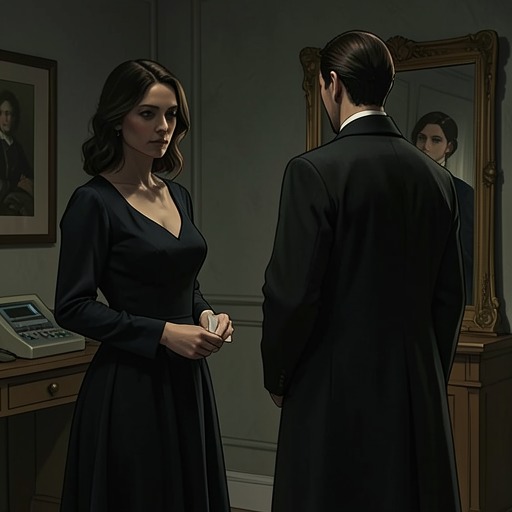
Valmont's Breakup Letter to Madame de Tourvel
Les liaisons dangereusesValmont's Breakup Letter to Madame de Tourvel is a carefully borrowed message whose emotional force comes from the distance between its polished excuses and its devastating reception. The Marquise de Merteuil first presents it inside a story aimed at the Vicomte de Valmont; he copies the model and sends it to the Présidente de Tourvel. Its repeated disavowal of responsibility makes the letter more than a declaration that the affair is over: it converts a relationship she had believed meaningful into a source of shame and remorse.
Origin as a story and a warning
The letter first appears within an anecdote that the Marquise de Merteuil offers the Vicomte de Valmont after reproaching him for withholding news of his important affairs and for showing a decided preference for another woman. Rather than answer his question about whether they still have a common interest, she tells him about an unnamed man entangled with a woman who brings him little credit. He recognizes, at intervals, that the affair will damage him, but cannot bring himself to end it. His predicament is sharpened by his boasts to his friends that he is entirely free: he risks becoming ridiculous both through the affair and through his attempts to deny its hold on him.
In the anecdote, the man's female friend considers exposing him publicly in his infatuation. She instead chooses what she describes as a final remedy, and delivers the breakup message without explanation. The story allows Merteuil to make her point indirectly. Its unnamed figures and their circumstances echo Valmont's attachment to Tourvel and his posture of independence, while the letter embedded in it gives him a usable script. Merteuil also postpones telling him the effect of this last attempt and promises a later account, tying the model's supposed outcome to the unresolved terms of her own relationship with him.
The letter's argument and voice
The message presents departure as an impersonal consequence of nature rather than a choice for which its writer should answer. It claims that boredom is universal, applies that claim to an affair said to have occupied him for four months, and treats the end of his love as no more surprising than the end of Tourvel's virtue. It then invokes a gendered contrast between male constancy and female obstinacy, before advising her to choose another lover because he has chosen another mistress. The closing returns to the same excuse: he says he took her with pleasure, leaves without regret, and might return.
The letter's repeated refusal of responsibility organizes its cruelty. Each stage supplies another reason the writer should not be blamed, even as the sequence makes plain that he is choosing to abandon her. Its breezy counsel and casual farewell deny the seriousness of the attachment that Tourvel has experienced. In Merteuil's story, that voice is first offered as a model of evasive conduct; once sent, it becomes Valmont's own instrument. The transition from embedded example to actual communication gives the words a double edge: they are both a performance of indifference and proof that Valmont has adopted the very message Merteuil prepared.
Copying and dispatch
Valmont tells Merteuil that he found both her story and its epistolary model effective. He says he copied the model without alteration and sent it to Tourvel the previous evening. He gives two reasons for acting promptly: he had promised to write that day, and he thought she would need the night to collect herself and reflect on the event. His account treats the dispatch as a practical operation, while his anticipation of her reply reveals that he is waiting for its effect.
By nearly midday the next day, no answer has arrived. Valmont says he will wait until three o'clock, then go to seek news himself; he describes the first step in that course as the only difficult one. He is also eager to learn whether the man in Merteuil's anecdote has reformed and whether his generous friend has forgiven him. The two correspondents thus discuss the letter both as an act already performed against Tourvel and as a test whose consequences remain to be disclosed. Its immediate suspense lies in the gap between dispatch and response: Valmont has sent the words, but does not yet know what they have done.
Tourvel's reception
Tourvel's letter to Madame de Rosemonde records how she understands the message. She says that the veil concealing the illusion of her happiness has been torn away; what she now sees is a death she believes near and certain, with shame and remorse marking its path. She sends the received letter without adding a separate explanation, and asks not for pity but for strength. Her response shows that she reads the breakup not as a temporary interruption but as the destruction of the meaning she had given the relationship.
She asks Madame de Rosemonde to leave her to her fate, forget her, and no longer count her among the living. She says that even friendship can intensify suffering when wounds are mortal, and that she intends to bury her shame in darkness. She reports that she has not wept since receiving the letter, and swears upon it that she will accept no further letters. The refusal is specifically attached to the written object: the same medium through which Valmont has ended the affair becomes, for Tourvel, something she attempts to shut out altogether.
A letter that continues to act
Tourvel's later illness makes the letter's consequences visible beyond her first response. At the convent, a further unmarked letter is brought for her. She initially refuses it, then becomes agitated, asking where it came from and who delivered it. After a quiet interval, she asks to see it; on reading it, she recognizes its sender as Valmont and calls for it to be taken away. She closes the curtains and orders everyone not to approach, but agitation and convulsions soon return. Madame de Rosemonde suspects Valmont sent this later letter, though the account does not establish its contents. It is distinct from the breakup letter Tourvel had already sent to Rosemonde, but the episode shows that correspondence associated with Valmont remains a source of crisis.
The earlier scenes of Tourvel's resistance had already joined emotional conflict to visible bodily distress: she had cried out for divine help during a moment of surrender, and later episodes brought terror, suffocation, and convulsions. The breakup message enters that history not as a neutral report but as a sudden reversal of the happiness she had imagined. In the novel's exchange of letters, a private message can travel farther than its writer's immediate presence: Merteuil's invented remedy becomes Valmont's copied act, Tourvel's answer becomes a record of despair, and the later letter renews the fear attached to his words. Its lasting force lies in this chain of writing, sending, interpreting, and refusing.