“Humans are animals”
Lessons in Chemistry“Humans are animals” is Madeline Zott’s concise answer to adults who separate human beings from the animal world. First delivered in a kindergarten dispute over a family-tree assignment, the phrase returns in a conversation with Reverend Wakely and is written beneath Madeline’s completed tree. Its meaning widens as it recurs: it is a claim about biological classification, but also a way of questioning whether a diagram of ancestry can contain the actual people who make a family. The phrase’s force comes from that double movement, from correcting a classroom distinction to making room for kinship that blood alone cannot define.
The classroom dispute
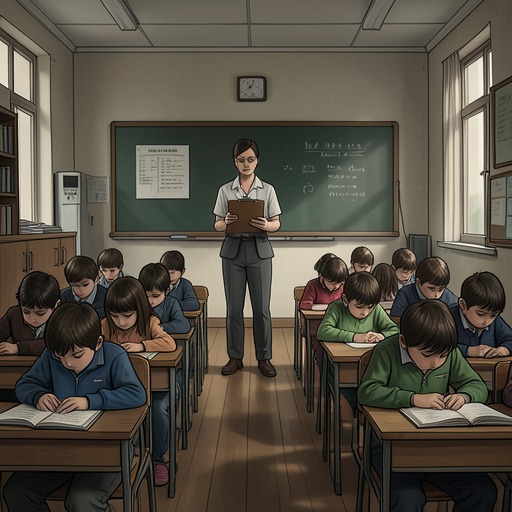
Mrs. Mudford explains that the children’s assignment concerns people, not dogs, bears, or television characters. When Amanda asks whether Lassie could appear on the family tree, Mrs. Mudford says that the assignment is not a doghouse. Madeline replies that people are animals. Mrs. Mudford rejects the statement, insisting that people are humans, and the class briefly veers toward Yogi Bear before Madeline repeats her point. The adults’ insistence on a boundary is matched by Madeline’s insistence that the boundary makes no biological sense.
The argument becomes comic but also exposes the narrowness of the assignment’s framework. Mrs. Mudford sharply tells Madeline to stop, then emphatically denies that people are animals. Tommy, who has been listening, starts jumping and yowling like a chimpanzee; half the kindergartners immediately join him. Madeline’s words produce a consequence beyond the original correction: the children enact, in their own disruptive way, the kinship with other animals that the teacher has tried to rule out. The scene does not make Madeline’s claim less precise. It lets the class’s response turn an abstract category into something physical and difficult to keep outside the room.
A family photograph that will not fit the tree
Madeline later brings Reverend Wakely what she calls the only family photograph in which they are all present. The picture is a clipping about Calvin Evans’s funeral, still damp with dog saliva. It shows Elizabeth Zott and Six-Thirty from behind as they watch Calvin’s coffin being lowered into the earth. Madeline explains the picture by pointing out that Elizabeth is her mother, that she herself is inside Elizabeth, and that Calvin is in the box. The photograph includes the family, but not in the conventional sense of a posed group assembled in one moment: it holds a pregnancy, a dog, a bereaved mother, and a father whose death preceded his daughter’s birth.
Wakely, affected by the child’s matter-of-fact account of loss, responds that families are not meant to fit on trees. He connects the inadequacy of the image to Madeline’s claim: people are not plants but belong to the animal kingdom. Madeline immediately recognizes this as the point she had tried to make to Mrs. Mudford. His agreement gives the phrase a new function. It is no longer merely a child’s rebuttal to a teacher; it supplies a way to understand why the family-tree assignment cannot adequately represent the relationships in the funeral photograph. Wakely then jokes that trees might make people wiser through their long lives, before realizing that this would imply Calvin had died young because he was not wise. The turn shows how the botanical metaphor, once treated as a harmless classroom convention, becomes painfully inadequate beside Calvin’s death.
Biology and the meaning of family
The phrase also resonates with Walter Pine’s disclosure to Elizabeth that Amanda is not his biological daughter. After learning the paternity-test result, Walter expected to feel cheated or devastated, but instead found that the result did not alter his understanding of his relationship with Amanda. He says that she is his daughter, that he is her father, and that he loves her wholeheartedly. The accompanying thought that biology is overrated does not erase the fact of biological difference; it refuses to treat that fact as the final authority on family. Read alongside Madeline’s insistence that humans are animals, the exchange holds two ideas together: human beings are biological creatures, and biology does not exhaust the meanings of their relationships.
Madeline’s own family tree makes the same tension visible in its details. Reverend Wakely reports that she has written that humans are genetically ninety-nine percent the same, underlining “Humans are animals” three times. The tree also includes an acorn labeled “Fairy Godmother.” These are not conventional entries in a lineage chart. Together, the inscription about shared human biology and the acorn’s place among family members make the tree a record of both relatedness and chosen inclusion. The repeated underlining gives Madeline’s classroom correction the emphasis of a principle she has carried into her account of family.
From classification to belonging
When Avery Parker wishes she could have known Calvin and asks to become part of Elizabeth’s family, Elizabeth welcomes her as family. She explains that Madeline had understood this earlier: the person Madeline put on the family tree was Avery, not Wilson. The exchange makes the tree’s limits and possibilities especially clear. It can fail when treated as a fixed diagram of biological descent, yet Madeline has used it to name a relationship of belonging that is not reducible to descent. The phrase “Humans are animals” does not itself declare who counts as family; its recurring role is to unsettle the supposedly natural categories that might decide the matter in advance.
Across these scenes, the phrase changes scale without losing its original clarity. In the classroom, it corrects a mistaken separation of humans from animals. At the funeral, it helps Wakely acknowledge that a family exceeds a plantlike structure of branches and ancestors. In the accounts of Walter and Amanda, and of Avery’s welcome into the Zott family, it sits beside a more intimate question: whether biology can define the full extent of love and kinship. Madeline’s answer is not to discard biology, but to refuse its monopoly over belonging.