Amanda’s nonbiological daughter status
Lessons in ChemistryAmanda’s nonbiological daughter status is a fact Walter Pine learns only after years of raising her as his child. The test confirms that they are not biologically related, but it does not undo their relationship: Walter remains Amanda’s devoted father, and the novel uses his response to distinguish family as lived care from family as a matter of DNA.
Discovery and Response
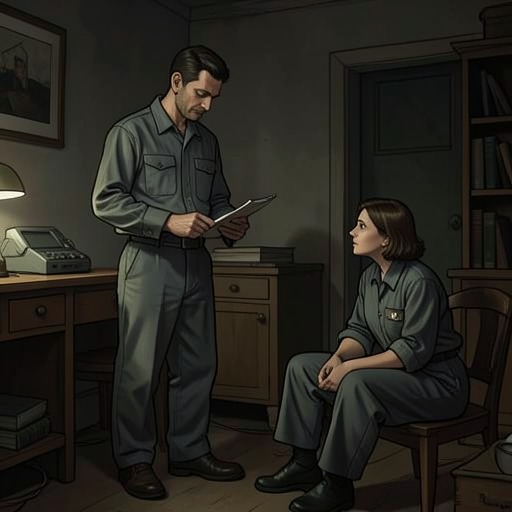
Walter’s former wife had repeatedly suggested that Amanda was not his biological daughter. He initially dismissed the claims as attempts to hurt him; although he and Amanda did not look alike, he believed their bond was real. When paternity testing became available, he provided a blood sample. Five days later, the results established that they were not biologically related, a truth he had learned only three weeks before disclosing it to Elizabeth Zott.
The result did not produce the betrayal or devastation Walter expected. He found himself unmoved by the test’s verdict because it did not alter what he knew from raising Amanda: she was his daughter, and he loved her. His account rejects the assumption that biological evidence must decide the emotional meaning of a parent-child relationship. The phrase “Biology was overrated” gives that reversal its bluntest expression.
The Family-Tree Assignment
The contrast between biological classification and actual family life becomes especially pointed when Amanda receives a family-tree assignment. The task asks for a current family photograph featuring her mother, though her mother is no longer in the picture, and emphasizes a biological bond that does not exist between Amanda and Walter. Walter plans to tell Amanda the truth about their lack of biological relation, while also acknowledging that the assignment’s assumptions do not describe the family she has lived in.
The assignment makes the problem more than a private uncertainty: a school exercise presents biological descent as the expected account of belonging. In the surrounding conversation, Walter has already described his own paternity test to Elizabeth, making clear that the discovery has not changed his commitment to Amanda. The tension lies between what a family tree can record and what its categories leave out.
A Wider Understanding of Kinship
Madeline Zott’s account of family provides a related challenge to the idea that kinship must fit a conventional diagram. She identifies Elizabeth, Six-Thirty, herself, and her deceased father, Calvin Evans, as the family represented in a funeral clipping. Reverend Wakely initially questions how the photograph can count as a family picture, then reflects with Madeline that families are not meant to fit on trees. Her matter-of-fact understanding supports the same distinction visible in Walter’s story: family includes relationships that a simple diagram or biological test cannot fully convey.
Later, Avery Parker asks to be included in Elizabeth’s family. Elizabeth welcomes her and explains that Madeline had already placed Avery, rather than Avery’s lawyer Wilson, on the family tree. That exchange extends the novel’s emphasis on family beyond biological connection or formal classification: Madeline’s recognition and Elizabeth’s welcome make room for a relationship through choice and inclusion.
Significance
Walter’s paternity revelation is consequential because it separates biological fact from paternal identity without treating either as false. The test answers whether Walter and Amanda are genetically related; his continuing love and care answer what their relationship means to him. The family-tree assignment exposes how social conventions can privilege the first answer, while Walter’s response and Madeline’s broader sense of family insist that it is not the only one.