Avery Parker
Lessons in ChemistryAvery Parker is the founder of the Avery Parker Foundation and the biological mother of Calvin Evans, whose search for him began only after she learned that the baby she had been told had died was alive and had been adopted. By the time she reaches Elizabeth Zott, that search has become a story of institutional deception, missed correspondence, and a family connection that Calvin never had the chance to discover. Her arrival does more than disclose Calvin’s origins: it brings Madeline Zott’s understanding of family beyond blood or a family tree into the lives of the people it names.
Identity and the Foundation
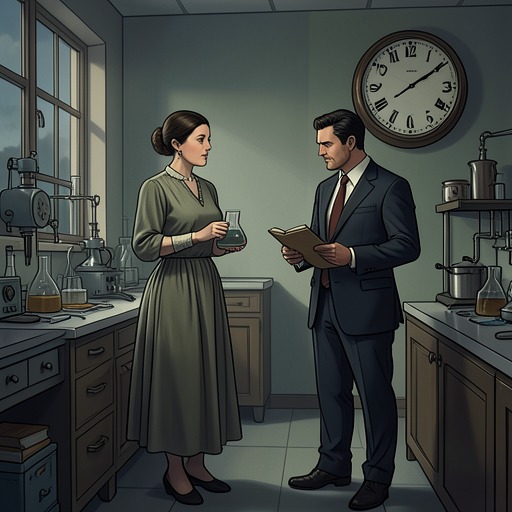
Avery enters the story at Elizabeth’s laboratory with Wilson, her lawyer and the public face of the foundation. She is described as about fifty, with hair that had once been blond and was gradually surrendering to age. Her bright blue suit is carefully tailored, but a cheap daisy brooch softens its formality. Carrying a clipboard, she introduces herself nervously and grips Elizabeth’s hand. Six-Thirty investigates her by scent; Avery greets him and explains that he probably recognizes the smell of her own dog, Bingo, whose enthusiasm for him she mentions with affection.
The foundation’s origins lie in Catholic causes, including churches, choirs, and orphanages, but Wilson explains that its mission is secular: to find people doing the best work on the most critical issues of the day. Seven years earlier, the foundation supported Elizabeth’s research into abiogenesis, and Wilson tells her that Elizabeth and Calvin were the reason it came to Hastings Research Institute in the first place. The institutional account is also personal: Avery’s later revelation shows that Calvin’s research and his parentage were connected in the foundation’s history, even though he did not know who she was.
Avery’s wealth does not give her independent control over the institution bearing her name. When Elizabeth asks why Wilson is its visible representative, Avery explains that she cannot even write a check without his cosignature. The arrangement makes the name on the foundation a poor guide to who exercises authority over its money. Her frank account of that constraint places her own position within the gendered limits that shape the lives of the women in Elizabeth’s story.
The Search for Calvin
Avery traces the beginning of her search to a disclosure made when she was twenty-seven. A nurse from the home for unwed mothers contacted her seeking money in exchange for the truth: the baby had not died, as Avery had been led to believe, but had been put up for adoption with the other babies. The nurse added that this child’s adoptive parents had died in an accident, then his aunt had died, and he had been sent to All Saints Boys Home in Iowa. Avery describes that moment as the beginning of her quest to find her son.
The route to that discovery was bound up with institutional falsehood. When she later saw Calvin on the cover of a scientific magazine, she called the Bishop of All Saints. He dismissed the name Evans as common and insisted that the resemblance was coincidence. Avery knew he was lying and intended to sue. Wilson persuaded her that public exposure could ruin the foundation and embarrass Calvin, and she abandoned the lawsuit. She cut off the foundation’s funding immediately, then wrote to Calvin several times. In those letters she explained what she could, asked to meet him, and offered to fund his research. No answer came. She can only imagine what the letters looked like to their recipient: a stranger suddenly claiming to be his mother.
Elizabeth recognizes the correspondence as the Sad Mother letters she had seen among Calvin’s papers. The signatures, once a source of bafflement, become clear when Avery’s identity is disclosed. Their recognition gives the unanswered letters a painful double meaning: Avery had been trying to reach her son, but Calvin did not learn who was writing before his death. The search had brought her close enough to leave a trace in his life, not close enough to meet him.
Motherhood, Biology, and Belonging
Avery’s disclosure to Elizabeth is direct: she is Calvin’s biological mother, and she would like, with Elizabeth’s permission, to meet her granddaughter. The request arrives with the force of a revelation, but it does not claim that biology alone makes a family. The distinction is already present in another conversation Elizabeth has had with Walter Pine. Walter tells her that a paternity test established he was not Amanda’s biological father; the result did not change his love or his understanding that Amanda was his daughter. Avery’s story gives the novel’s broader interest in kinship another form: a biological relationship can matter profoundly, while still not being the whole measure of a parent or a family.
Madeline has already challenged the idea that families can be adequately represented by a conventional family tree. When she brings Reverend Wakely a funeral clipping as the only picture in which her family appears together, she points out that Elizabeth is in the photograph, Six-Thirty is there, she herself is inside her mother, and Calvin is in the coffin. Wakely responds that people belong to the animal kingdom, not the plant kingdom, and that families need not fit on trees. Madeline recognizes the explanation as what she had been trying to tell Mrs. Mudford. The scene makes room for relationships that a diagram of descent cannot show: the living bonds among mother, daughter, dog, and a father remembered through absence.
Avery’s place in that expanded family is made explicit after she asks to belong to it. Elizabeth tells her to use her first name and assures her that she is family; Madeline, she says, had understood this long before. On Madeline’s family tree, Elizabeth explains, it is Avery—not Wilson—who has been included. The choice does not erase Avery’s years of separation from Calvin or turn her into someone who raised him. Instead, it recognizes her search and her relationship to the family Calvin left behind. Avery’s arrival closes a genealogical gap while also showing that acceptance, care, and the child’s own act of naming help give kinship its lived form.
Narrative Significance
Avery’s revelation reorganizes earlier details without undoing the loss at their center. Calvin’s history at All Saints Boys Home, the foundation’s approach to Hastings, and the unanswered letters converge in the knowledge that his mother had been searching for him. The story offers no reunion between mother and son: Calvin is dead, and the letters cannot be answered. Avery’s meeting with Elizabeth instead opens a possible relationship with the granddaughter she has never met, subject to Elizabeth’s permission and Madeline’s welcome.
Her character also complicates the apparent power of wealth. Avery can establish a foundation and seek to fund important science, yet she describes herself as unable to write a check without her lawyer’s approval. Her personal history likewise exposes the power institutions have exercised over women and children: a home for unwed mothers concealed her child’s survival, and the Bishop of All Saints then denied the connection Avery tried to establish. Against those imposed barriers, the final recognition is deliberately modest and consequential. Avery is not simply restored to a past she missed; she is named as family in the present.