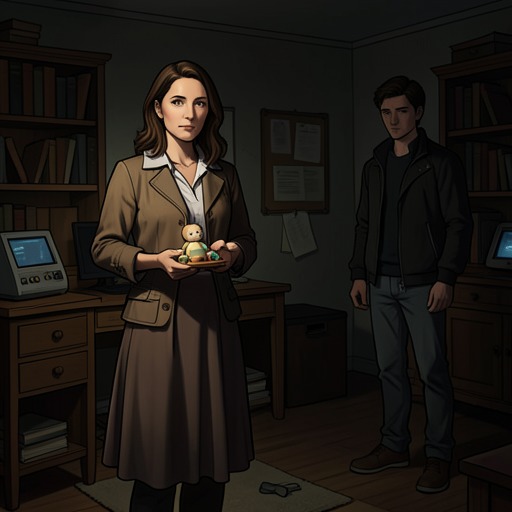
Avery Parker Reveals She Is Calvin’s Birth Mother
Lessons in ChemistryAvery Parker’s revelation that she is Calvin Evans’s birth mother recasts Calvin’s orphaned childhood and her own years of searching as the consequences of a deliberate deception. Told in the laboratory, her account reaches Elizabeth Zott not as a simple claim of kinship but as a history of forced separation, false information, missed encounters, and grief. The revelation ultimately opens the possibility of a family relationship that neither biology nor earlier misunderstandings had been able to secure on its own.
The Separation and the Secret
Avery explains that she became pregnant at seventeen after falling in love with a young man. Her prominent parents, ashamed of the pregnancy, sent her to a Catholic home for unwed mothers. The home pressured its residents to relinquish their babies for adoption, using threats against women who refused to sign the official form. Avery would not consent. When labor began, staff isolated her, and after the doctor intervened she was told that her baby had been stillborn. When she asked to see the body, she was told it had already been disposed of.
For years, Avery accepted the account that her child had died. A decade later, when she was twenty-seven, a nurse from the home contacted her and demanded money in exchange for the truth: the baby had not died but had been adopted. The unusual trail of the child’s life led from the deaths of his adoptive parents in an accident to the death of his aunt, after which he was sent to All Saints Boys Home in Iowa. Avery tells Elizabeth that learning this began her search for her son. She then makes the identity of that child explicit: he was Calvin.
The history connects the young Calvin’s placement at All Saints Boys Home to the earlier concealment of his birth and adoption. Avery’s story also explains why the truth arrived so late: she had been told that her baby was dead, while Calvin grew up without knowing who his birth mother was. The revelation does not undo those years apart, but it gives their separation a cause and a human history that neither Elizabeth nor Avery had previously been able to see in full.
The Search That Failed to Reach Calvin
Avery says she eventually sent Wilson to All Saints Boys Home after learning that her son might be alive. She did not go herself. She had been living with the certainty that her child was dead, and the sudden possibility that he had survived made her afraid to hope. She also knew what it was to be targeted by people claiming family connections, so she asked Wilson to investigate on her behalf. He went the very next day.
Wilson returned with the news that Calvin was dead. Avery describes how the home needed money and how the bishop saw an opportunity involving a memorial fund; the facts came back to Elizabeth in a detached rush. The account makes clear that Avery’s search did not simply end through delay or chance. The false claim that Calvin had died cut off the meeting she had hoped to pursue, adding a second mistaken death to the first deception: Avery had once been told her infant was stillborn, and later she was told her adult son was dead.
A separate clue had already brought Avery close to the truth. When Wilson found a copy of Chemistry Today featuring Calvin on its cover, Avery recognized the significance of the name and called the bishop. He insisted that Evans was a common name and that the match was coincidence. Avery intended to sue, but Wilson warned that publicity could damage the foundation and embarrass Calvin. She cut off the foundation’s funding instead. She then wrote Calvin several times, explaining what she could, asking to meet, and offering to fund his research. She never heard back. The letters’ signature, Avery Parker, is the key that lets Elizabeth recognize them as the messages Calvin had kept from the woman he knew only as Sad Mother.
The Revelation Reaches Elizabeth
Elizabeth initially receives Avery’s account with caution. Many people, she explains, had tried to take advantage of Calvin, including people who falsely claimed to be long-lost relatives. Her hesitation is not a denial of Avery’s pain; it reflects the history of deception surrounding Calvin and the difficulty of accepting a claim that could change the meaning of his past. She recalls his saved letters, and that remembered detail gives Avery’s story a concrete connection to Calvin’s own life.
Avery confirms that she was at Calvin’s funeral. She and Wilson stood several graves away. She had come both to bury her son for the final time and to speak with Elizabeth, but Elizabeth left before the service ended. Avery had wanted to believe that someone had loved Calvin, yet she left without hearing from the person who could have answered that question. Elizabeth responds by telling her plainly that she loved Calvin with all her heart. She describes him as brilliant, loving, kind, and interesting, and reaches for the language of chemistry to convey the bond between them. The word also carries particular force in a laboratory where Elizabeth and Calvin first met: their relationship, she insists, was no accident.
The exchange changes the scene from an investigation into a shared act of mourning. Elizabeth has been carrying the loss of Calvin; Avery has been carrying the loss of a son she believed dead and then discovered too late. Elizabeth’s declaration answers the question Avery had brought to the funeral, while Avery’s account gives Elizabeth a new understanding of the letters Calvin preserved. Elizabeth then rests her head on Avery’s shoulder and sobs in a way she had not before. The revelation does not restore Calvin, but it allows the two women to acknowledge their grief together rather than remain divided by what each had been led to believe.
From Birth Kinship to Family
Avery tells Elizabeth that she wishes she could have known Calvin and hopes she might know him through her. She asks to become part of Elizabeth’s family. Elizabeth invites her to use her first name and accepts her as family, pointing out that Madeline Zott had already included Avery in her understanding of the family tree. Madeline had not placed Wilson there; she had placed Avery. Elizabeth’s answer makes the child’s earlier recognition matter: the idea of kinship has been taking shape before Avery and Elizabeth meet.
Elizabeth calls Avery the acorn, recalling Madeline’s imaginative way of making room for family beyond a conventional tree of descent. Avery repeats the image to herself as the fairy-godmother acorn. The metaphor gives Avery a place within the family without pretending that the lost years can be repaired or that a newly discovered biological connection alone guarantees intimacy. Her place is offered and accepted in the present, through recognition and welcome.
The scene echoes the novel’s broader distinctions between biological relationship and lived parenthood. Walter Pine, for example, learns that Amanda is not his biological daughter but remains certain that he is her father because he loves and raises her. Madeline’s earlier family picture similarly includes Elizabeth, Six-Thirty, herself, and Calvin represented by his coffin; when Reverend Wakely struggles with how that could count as a family picture, their conversation challenges the assumption that family must fit a genealogical tree. Avery’s reunion with Elizabeth extends that idea: biological truth matters profoundly because it explains Calvin’s origins, but it does not by itself supply the years of care and shared life that were lost.
Before Avery leaves, Elizabeth proposes supper at six and describes a gathering at the home laboratory with Avery, Wilson, Madeline, Six-Thirty, Harriet Sloane, and Walter Pine; Reverend Wakely and Dr. Mason are to meet them at some point as well. Avery turns back, takes Elizabeth’s hands, and affirms the idea of the whole family. Her response marks the revelation’s immediate consequence: after years of searching, a false report of death, and letters that never brought Calvin home, she is no longer merely asking to be admitted. Elizabeth and the others have begun to make room for her.