Calvin Evans
Lessons in ChemistryCalvin Evans is a brilliant scientist whose life is revealed largely through the people and records he leaves behind. His childhood losses and years at All Saints Boys Home help explain the guarded, difficult man remembered by Elizabeth Zott and Reverend Wakely; his love for Elizabeth is grounded in intellectual respect as much as passion. His accidental death while running leaves Elizabeth bereaved and reshapes her choices, while his work and the history of his family continue to surface after he is gone.
Identity and Early Background
Calvin’s childhood was marked by the deaths of his parents and then his aunt. Those losses led to his placement at All Saints Boys Home, where priests abused him until he grew large enough to stop them. Elizabeth later finds his old diary among papers recovered from Hastings Research Institute. Its childish writing is sometimes hard to decipher, but its sorrow is clear to her. She also recognizes in it a lasting grievance against the father Calvin believed should have been dead, a resentment he carried through his life.
A recollection of his childhood at All Saints shows how precarious his position there was. Mr. Wilson arrived seeking a ten-year-old boy named Calvin Evans, said to have lost his family through a series of accidents. Mr. Wilson explained that relatives had recently learned Calvin existed and wanted him back; he planned to take the boy with him. The bishop, who had expected a wealthy visitor to make a donation, instead faced a request to locate Calvin. The episode presents Calvin not only as an orphan but as a child whose existence and possible family ties were being pursued by people beyond the institution.
Scientific Work and Ambition
Calvin’s scientific promise was recognized well beyond Hastings Research Institute. After Cambridge, he received offers for senior academic posts, pharmaceutical directorships, and positions involving substantial stakes in private companies. The offers were gathered in an accordion folder labeled Rowing, among the papers Elizabeth and Miss Frask took from Hastings. The Hastings offer promised a private laboratory, but so did the others; what distinguished it was a salary Elizabeth found insulting, and the signature of Dr. Donatti.
Years later, a representative of the Parker Foundation tells Elizabeth that the foundation funded her work on abiogenesis and that she and Calvin were the reason it came to Hastings Research Institute. Calvin’s work remains important to that history, even as its fate is uncertain: Mr. Wilson remarks that no one seems to know what became of it. The contrast between the range of positions once open to Calvin and the disappearance of his research underscores how easily scientific promise can be obscured by institutional decisions and loss.
Calvin’s interests also brought him into contact with Reverend Wakely. While studying at Harvard Divinity School, Wakely audited chemistry intending to learn how science explained creation and to refute it. Instead, the evidence of atoms, matter, elements, and molecules unsettled his religious certainty. At a panel of RNA researchers attended by Calvin, the young scientist offered religion as an example of an ineffective collision, then left. The exchange became part of the beginning of their connection: Calvin’s brief intervention challenged Wakely’s assumptions, while Wakely’s account shows how scientific argument could alter a life beyond the laboratory.
Relationship with Elizabeth Zott
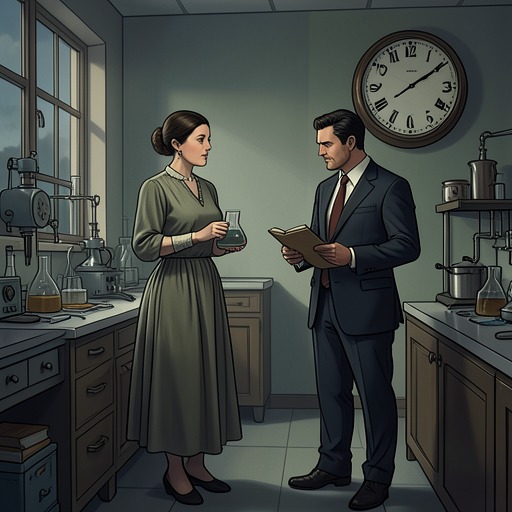
Calvin and Elizabeth meet through an accidental collision in a theater lobby. Elizabeth later describes their relationship to Roth as an unusually powerful meeting of minds and feelings. Their bond is more than attraction: each takes the other’s scientific abilities seriously, a form of respect Elizabeth says she rarely encountered among other chemists. She remembers Calvin as awkward and moody, but also as someone who recognized that she belonged in scientific work and treated her research as worthy of his own attention.
That respect makes Dr. Donatti’s theft of Elizabeth’s research especially consequential. Elizabeth tells Roth that Donatti knew she was onto something, published her work as his own, and prompted her to quit Hastings Research Institute the same day. Calvin’s importance to her is therefore bound up not only with their love but with the professional recognition they shared. In the same interview, she recounts his childhood and her own past, then takes responsibility for Calvin’s death. She connects that loss to later choices and failures, including abandoning research and becoming a performer, while making clear that she does not regard Phil Lebensmal’s heart attack as a failure.
Elizabeth’s account of their love is also her way of resisting an account of Calvin that reduces him to his scientific achievements. When Roth asks about him, she initially suspects that the interviewer is more interested in Calvin’s work than in her own experience. Her eventual description insists on the particularity of their relationship: Calvin mattered because he valued her as a scientist and because their partnership was both emotional and intellectual.
Death, Grief, and Remembrance
Calvin dies in a freak accident while running. Six-Thirty witnesses his death from a short distance and understands that Calvin is gone before the ambulance carries him away. The dog then turns to bring Elizabeth the news. The broken leash remains associated with the scene, a small object connecting Calvin’s familiar runs, Six-Thirty’s companionship, and the sudden end of their shared life.
Elizabeth’s response is shaped by grief and by an earlier memory of nearly drowning as a child. In the laboratory after Calvin’s death, she hears people speaking around her but is absorbed by that remembered moment and by the feeling that she should have stayed beneath the water. The novel thus places her immediate bereavement beside an older vulnerability without making Calvin’s death an isolated event in her life. Later, she tells Roth that she holds herself responsible and describes making a vow never again to hold anyone back. That vow becomes a lasting measure of how she interprets her decisions, even when the failures she associates with Calvin’s death have other causes.
The funeral gives grief an awkwardly practical form. Calvin owned no suit, so Elizabeth brings his rowing clothes to the funeral home, choosing what she believes he would have wanted. The funeral director passes them to an assistant, who sets them aside and selects a standard suit instead. Elizabeth’s personal choice is displaced by routine, while the clothes she chose preserve the connection between Calvin and rowing that mattered to her. Later, Six-Thirty avoids the place where Calvin died on the way to the cemetery. Seeing no groundskeeper, he slips through the back gate, takes fresh daffodils from another tombstone, and lays them at Calvin Evans’s grave. His repeated visits make remembrance a continuing act rather than a single funeral scene.
Legacy and Narrative Role
Calvin is present in the novel both through memory and through surviving evidence: employment offers, a diary, correspondence, and scientific work whose fate is questioned. These traces reveal different aspects of him. The offers show the scale of his professional prospects; the diary exposes grief and resentment that Elizabeth could not know simply from their life together; and his exchange with Wakely places his scientific confidence in tension with religious belief. His character is therefore assembled gradually, through documents and other people’s recollections, rather than presented only through a continuous account of his life.
His relationships also broaden the novel’s idea of family. Wilson’s search reveals that living relatives had learned of Calvin and wanted him returned, while Elizabeth’s later meeting with Avery Parker ends in an open expression of love for Calvin and grief over their lost connection. Elizabeth, speaking to Avery, insists that Calvin was the best thing that happened to her and describes what they shared as real chemistry. The scene does not undo his death; it allows two women whose understanding of his life has been incomplete to acknowledge their separate bonds with him.
Calvin’s absence continues to direct the living: Elizabeth measures her choices against her grief, Six-Thirty keeps returning to his grave, and the question of what became of Calvin’s research remains active. His significance lies in this double legacy. He was a scientist whose work helped draw the Parker Foundation to Hastings Research Institute, and a person remembered above all by those who experienced his intelligence, care, and capacity to recognize theirs.