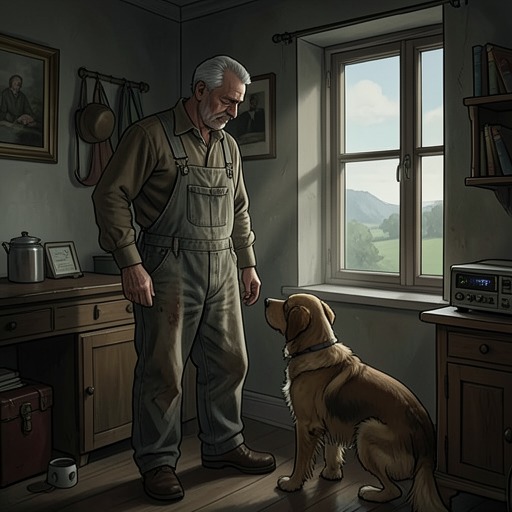
Calvin Evans and Six-Thirty’s close companionship
Lessons in ChemistryCalvin Evans and Six-Thirty’s close companionship is marked by steadfast attachment, witness, and remembrance. Six-Thirty is present when Calvin dies and becomes the one who carries the news to Elizabeth Zott; afterward, he returns to Calvin’s grave and continues addressing him. Their bond thus extends beyond shared presence in life: the dog’s grief and repeated acts of communication make companionship persist as a practice of memory.
Identity and Evidence of Their Bond
The evidence offers little account of how Calvin and Six-Thirty first came together, but it identifies Calvin as a friend and lover as well as a brilliant chemist and rower. Six-Thirty’s place in Calvin’s final scene supplies a different, intimate measure of their connection. From a short distance, the dog watches Calvin, wanting to reach him but unable to do so. The moment establishes attachment through Six-Thirty’s attention and helpless concern, without needing an account of their earlier history.
The snapped leash remains wrapped around Calvin’s wrist as he is taken away. That concrete detail places the two companions in the same scene even as death separates them: the leash, formerly a means of keeping them connected, is now associated with the finality of their parting. The passage does not explain how the leash broke, and its significance rests in what the scene shows—the dog left behind, Calvin carried away, and their physical connection no longer able to keep them together.
Calvin’s Death and Six-Thirty’s Role
Six-Thirty witnesses Calvin’s death and recognizes that he cannot prevent it. Though he wants to go to Calvin’s side, he remains at a distance. When the ambulance takes Calvin away, Six-Thirty turns from the scene, overcome with sorrow. His response is not only grief: he then goes to Elizabeth to give her the news. In the immediate aftermath, he becomes the link between Calvin’s death and Elizabeth’s knowledge of it.
This sequence gives the dog a consequential role in the human story without reducing his own experience to a mere instrument of it. Six-Thirty observes, understands the loss as it unfolds, and responds to it; the narrative stays close to his perception rather than presenting the death only through the people around Calvin. His inability to intervene contrasts with his ability to act afterward. He cannot change what has happened, but he can carry the news to the person who must hear it.
The Cemetery and Continuing Communication
The cemetery keeps Calvin’s death physically and emotionally present for Six-Thirty. Going there means passing the place where Calvin died, a route the dog finds especially difficult. The thought that failures ought to be remembered offers him no comfort: in his understanding, failure is already impossible to forget. The repeated passage through the death site therefore connects remembrance not with a chosen lesson but with an experience that remains unavoidable.
At the grave, Six-Thirty waits for the groundskeeper to leave before settling along the length of the buried casket. He greets Calvin and presses his nose into the grass to communicate that he needs to talk about Elizabeth. The scene makes their relationship active after Calvin’s death: Six-Thirty still directs words and concern toward him, and Elizabeth remains part of what he brings to their continued, one-sided conversation.
A later visit returns to the same pattern. Six-Thirty again explains something to the body beneath the grave. The evidence does not disclose the full content of that conversation, so its importance lies in the recurrence itself: the dog comes back and addresses Calvin as someone to whom he can still report and speak. The visits do not undo the separation. They give his attachment a repeated form, anchored to a particular place and sustained by memory.
Significance of the Relationship
The relationship is presented through acts of attention rather than through an account of its beginning: Six-Thirty watches Calvin die, carries the news to Elizabeth, remembers the place of death, and returns to speak at the grave. Together these actions show loyalty as something the dog continues to enact after the possibility of an answer has ended. The graveyard scenes also preserve his distinct perspective on loss. For Six-Thirty, the past is not an abstract story about Calvin but a place he must pass and a person he continues to address.
The bond consequently joins companionship with witness. Six-Thirty is present at Calvin’s death, but he also bears its immediate consequence to Elizabeth and carries Calvin’s memory into later visits. The snapped leash, the journey to deliver the news, and the conversations beside the grave mark different stages of the same attachment: physical connection gives way to care in action, then to remembrance. The relationship’s ending is therefore a separation, but not an erasure; Calvin remains the recipient of Six-Thirty’s attention, and Elizabeth remains central to what the dog wants to tell him.