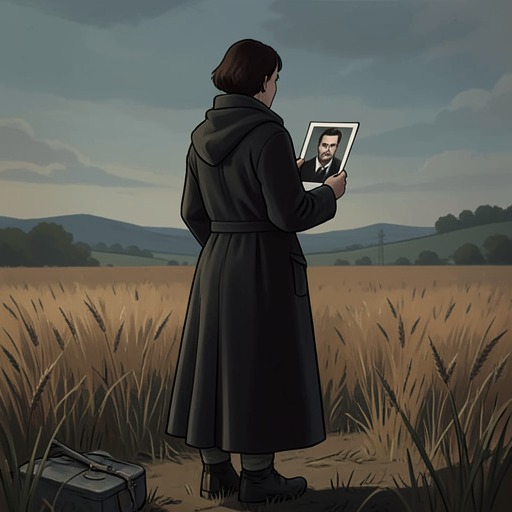
Calvin Evans funeral clipping
Lessons in ChemistryThe Calvin Evans funeral clipping is a yellowed newspaper article that Madeline Zott brings from her notebook to explain her family for a school assignment. Its importance lies not only in documenting Calvin Evans’s funeral, but in the way Madeline reads its photograph: although she is not visibly outside her mother, and Calvin appears only through his casket, she sees the picture as a complete family portrait. A piece of newsprint about a burial becomes evidence of belonging.
The Clipping and Its Discovery
The clipping protrudes from Madeline Zott’s notebook while Reverend Wakely is helping her with the question of her family. He notices it and asks whether it is another part of the assignment. Madeline explains that she has to bring a family photograph. This, she says, is the only picture in which they are all present. The paper is still damp with dog saliva, a small physical detail that ties the document to the household and to Six-Thirty, whose presence will be essential to Madeline’s explanation.
Madeline handles the clipping gingerly, as though it were an irreplaceable treasure, and passes it to Reverend Wakely. The contrast is quietly consequential: what he first sees as an old newspaper article is, to her, something precious enough to protect. It is both a public record of Calvin’s funeral and a private family keepsake. Its worn, damp material condition does not diminish its value for Madeline; if anything, the care she takes makes clear that its meaning exceeds the paper itself.
The Funeral Photograph
The clipping contains an article about Calvin Evans’s funeral and a photograph of Elizabeth Zott and Six-Thirty. They are shown from behind, watching as the earth covers the casket that Reverend Wakely had blessed. Their faces are hidden, but their devastation is unmistakable. The image records grief through posture and circumstance rather than facial expression: the figures stand facing the burial, and the grave itself occupies the decisive place in the scene.
Reverend Wakely recognizes the woman and dog, then experiences a wave of depression as he looks at the photograph. He has spent the preceding seven years consoling people, but the image’s force is not abstract. It returns him to a particular death and to the sight of Elizabeth Zott and Six-Thirty at Calvin’s grave. The clipping also contains an unexpected detail for him: his own hands are visible in the photograph. He is not only the person examining the family’s keepsake; he was physically present at the burial it preserves.
Madeline’s Family Portrait
When Reverend Wakely questions how a funeral photograph can serve as a family picture, Madeline identifies each member in turn. She points to Elizabeth Zott’s back as her mother, then to Six-Thirty as the dog. She locates herself inside her mother, because she was unborn when the photograph was taken, and identifies Calvin Evans as being in the casket. Her explanation makes no effort to disguise the death or to make the image resemble a conventional portrait. Instead, it accounts for the family members who are not separately visible.
The clipping therefore holds several kinds of presence at once. Elizabeth Zott and Six-Thirty are visibly there; Madeline is present through her place within her mother; Calvin is present through the casket and the fact of the funeral. The picture’s composition is shaped by loss, but Madeline’s reading refuses to let loss make the family incomplete. She treats the photograph not as a picture of the people who happened to be in front of the camera, but as a record of the relationships that make them a family.
Meaning and Narrative Role
The clipping gives Madeline a concrete answer to an assignment that asks for family to be represented visually. Its evidence is unusual: a newspaper report, a burial, two figures turned away from the camera, and a child who was still inside her mother. Yet Madeline does not present those circumstances as disqualifying. Her matter-of-fact identification makes the picture legible on her own terms, including the fact that her father is represented by the casket rather than by a living presence beside her.
For Reverend Wakely, the same object carries a different weight. He is struck by the clarity with which Madeline speaks about her loss, and the encounter depletes him despite his years of offering consolation. The clipping joins his remembered role at Calvin’s burial to Madeline’s understanding of her origins: his hands appear in the photograph, while her account supplies the family connections the image cannot show on its surface. In this way, the document is at once a funeral record, a trace of shared grief, and Madeline’s chosen proof that the people she names belong together.