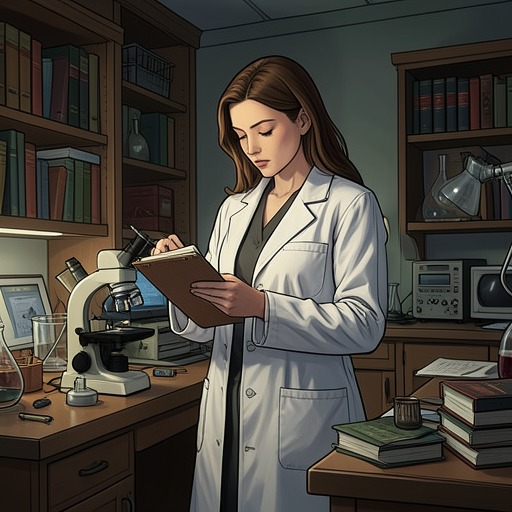
Calvin’s diamond ring
Lessons in ChemistryCalvin’s diamond ring is the startling discovery Elizabeth makes while sorting through Calvin Evans’s personal effects after his death. Hidden in a small blue box inside his lunchbox, the diamond turns an ordinary remnant of their shared life into an intensely private object: one Elizabeth conceals in her fist as Hastings discusses her bereavement leave and her status as a non-family member.
Discovery Among His Effects
Calvin’s notebooks have already been boxed and stored while Hastings waits to see whether a next of kin will claim them. Elizabeth, who understood his research and considered her bond with him greater than the word kin could express, is not recognized as someone entitled to claim them. What remains for her is a crate of personal effects: a snapshot of Elizabeth, Frank Sinatra records, throat lozenges, a tennis ball, dog treats, and, at the bottom, Calvin’s lunchbox.
The lunchbox seems at first to hold only the sandwich Elizabeth made for Calvin nine days earlier. Instead, when she opens it, she finds a small blue box, and inside it a diamond striking in its size. The ring emerges from an object associated with their ordinary routines, among belongings that preserve fragments of Calvin’s daily life. The discovery is not made in a formal exchange between the couple but after his death, amid the sorting and storage of what he left behind.
Concealment and Physical Presence
When Miss Frask enters to speak with Elizabeth, the ring is already buried in Elizabeth’s fist. Its smallness does not make it negligible: Elizabeth registers its coldness, and the sensation remains physically present as she listens to Hastings’s explanation of her leave. The ring is therefore both something she has found and something she must keep hidden in that encounter.
Hastings has awarded Elizabeth three extra days of bereavement leave, for five days in total, and presents this as unusually generous treatment for a non-family member. Elizabeth retches into the sink before she can stop herself. Miss Frask first interprets her distress as shock, then looks more closely and reacts as though she has understood something; the scene does not specify what she concludes. The ring’s concealed presence sharpens the contrast between Elizabeth’s private bond with Calvin and the institution’s narrow account of who counts as family.
Significance
The ring’s appearance joins intimacy to material evidence. Calvin’s notebooks, the work through which Elizabeth knew him as a scientist, are inaccessible to her; the personal-effects crate instead gives her objects from his everyday life, culminating in a gift whose significance is not explained aloud. The book presents the diamond not through a stated proposal or explicit account of Calvin’s intentions, but through its discovery, its cold touch, and Elizabeth’s effort to hide it.
As an object left among Calvin’s belongings, the ring carries the force of a private connection that outlasts the life and routines in which it was made meaningful. Its concealment during the bereavement-leave conversation makes that connection legible against Hastings’s bureaucratic language: the institution can classify Elizabeth as unrelated, while the ring and her response to it register a closeness its categories fail to contain.