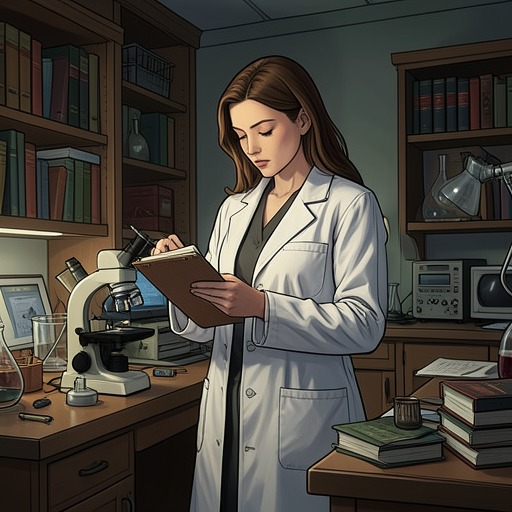
Calvin’s research archive
Lessons in ChemistryCalvin’s research archive is both a record of Calvin Evans’s scientific work and a contested collection: after his death, Hastings Research Institute boxed away his notebooks while waiting to see whether anyone who counted as next of kin would claim them. Elizabeth Zott, who understood his research and had shared a life with him, was not recognized by that category. The archive’s later recovery makes the papers available again, and their contents reveal not only Calvin’s work but also the institutional choices that shaped Elizabeth’s career.
Identity and Initial Removal
In the immediate aftermath of Calvin’s death, the room that had held his work was stripped of every trace of him. His notebooks had been boxed and stored, their custody left to an imagined next-of-kin claimant. The distinction was painfully practical: Elizabeth knew and understood the research better than anyone, yet the Institute’s expected definition of kinship did not include her. The archive was therefore not merely absent from the room; access to it had been made conditional on a relationship Elizabeth and Calvin had lived but that the institution did not formally recognize.
The notebooks must also be distinguished from the crate of Calvin’s personal effects. That crate held a photograph of Elizabeth, Frank Sinatra records, throat lozenges, a tennis ball, dog treats, and his lunch box. Elizabeth feared that the lunch box still contained the sandwich she had made him nine days earlier, but inside she found a small blue box containing a diamond. The contrast separates two kinds of surviving record: the archived papers preserved Calvin’s professional work, while the few effects left behind carried the intimate evidence of shared daily life. Neither collection, on its own, could encompass the relationship the Institute’s next-of-kin procedure excluded.
Recovery from Storage
The archive returned to Elizabeth through Miss Frask, who took her to a storage facility with small steel doors numbered from one to ninety-nine. She unlocked door forty-one and showed Elizabeth the sealed boxes. There were eight in all, and the recovery had to be completed before Miss Frask was required to return the keys at five o’clock. A dolly offered a practical way to move them; the time limit made the archive’s recovery a hurried act of retrieval rather than a settled transfer arranged by Hastings.
That scene gives the papers a material history. They were not immediately destroyed, but they had been removed, sealed, and placed behind a numbered door, accessible only with the right keys and a narrow window in which to act. Miss Frask’s help changed their status: what had been kept out of Elizabeth’s hands could again be read. The eight boxes also make clear that the archive was a substantial collection, not just a single notebook or isolated keepsake.
What the Papers Reveal
The notebooks had already mattered to Hastings’s account of Calvin’s career. After a newspaper story suggested that his difficult personality had prevented him from achieving worthwhile work, the Institute faced concern from its funders, including military services, pharmaceutical companies, private investors, and foundations. Management pointed to Calvin’s office, which had overflowed with notebooks and equations written in an indecipherable script, marked with exclamation points and heavy underlining. He was due to present a paper on his progress in Geneva the following month. The papers thus stood as evidence against the public impression that his work had amounted to little, even as the Institute’s defense of his achievements arose from its own need to reassure its funders.
A folder in box three, labeled for rowing, redirected Elizabeth’s understanding of one part of Calvin’s past. She had expected newspaper clippings about his Cambridge boat; instead, the folder contained employment offers he had received after Cambridge. They included chairs at major universities, directorships at pharmaceutical companies, and stakes in privately held concerns. Each offer promised a private laboratory, so that provision did not distinguish Hastings from the alternatives. The Hastings offer stood out for its salary, which was markedly lower than the others, and bore Dr. Donatti’s signature. The folder therefore turns the archive into a record of choices and negotiations as well as scientific thought: it shows Elizabeth the terms on which Calvin joined Hastings and identifies Donatti’s role in making the offer.
The Archive and Elizabeth’s Work
The papers also sit beside a consequential conflict over whose research counted as whose. When Elizabeth read an article by Dr. Donatti, she recognized it as a direct theft from her own files; Dr. Boryweitz was listed as a co-contributor. She confronted him, then went to Donatti’s office and accused him of lying and cheating. The archive is not identified as the source of Elizabeth’s stolen research, and the distinction matters. Rather, the episode shows that papers and research files at Hastings existed within a workplace where authorship and credit could be contested. Read alongside Calvin’s notebooks and employment folder, the theft makes the question of who controls scientific work part of the archive’s larger institutional context.
Elizabeth’s own project, abiogenesis, had received approval because an investor insisted on funding it after reading an older paper by Elizabeth Zott from UCLA. Hastings management recognized her progress while also receiving complaints about her refusal to make coffee, the way she voiced her opinions, and her insistence that her name appear on her own papers. That tension echoes the archive’s central problem of recognition: scientific work can be present and consequential without its creator receiving fair acknowledgment. Calvin’s stored papers help establish the seriousness of his work; Elizabeth’s experience makes visible how recognition and control remained vulnerable to institutional power.
Meaning and Limits
The archive cannot by itself stand in for Calvin’s whole life. Its notebooks and career documents preserve intellectual labor, but the personal-effects crate holds objects tied to ordinary routines, and Elizabeth’s response to both collections makes the difference concrete. Nor do the papers settle every question of family belonging. Later, Madeline Zott describes a funeral photograph as a family picture because it includes Elizabeth, Six-Thirty, Madeline before her birth, and Calvin in his coffin; Reverend Wakely responds that families need not fit on trees. The episode reframes kinship through lived attachment rather than a chart of descent, clarifying the human cost of the formal category that had denied Elizabeth a claim to the archive.
That broader understanding reaches the papers’ eventual place in a continuing family story. When Avery Parker asks to belong to the family, Elizabeth welcomes her and explains that Madeline had put Avery, not Wilson, on the family tree. The archive does not create these relationships, but its recovery helps restore Calvin’s work and past to the people who cared about him. Its significance lies in that double function: it preserves evidence of scientific labor while revealing that possession, authorship, and kinship are not guaranteed by what an institution records or recognizes.