City leash law
Lessons in ChemistryThe City leash law requires dogs to be kept on a lead, yet Elizabeth Zott and Six-Thirty are repeatedly seen walking together without one. Its appearances at a cemetery and in a neighbor’s reminder show the rule as an ordinary public regulation—and as one that Elizabeth and Calvin Evans’s household does not reliably observe.
Scope and Enforcement
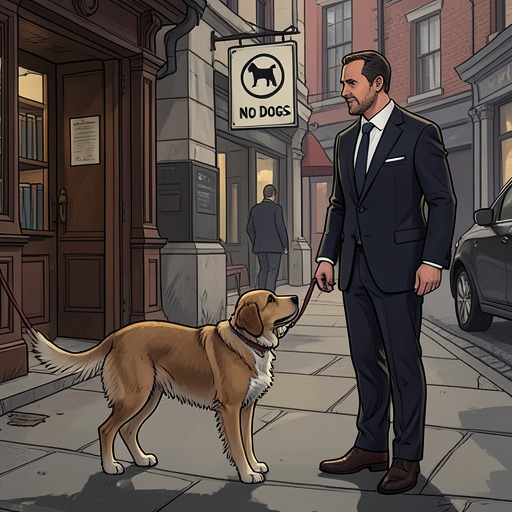
At Calvin Evans’s funeral, scientists notice Elizabeth at a distance with Six-Thirty beside her. The dog is not on a lead, despite the city’s new leash law. Cemetery signs impose a separate restriction: they prohibit dogs from entering at all. The two rules therefore apply independently, and the pair’s presence appears to breach both.
The scene presents the law through public observation rather than an account of penalties or enforcement. The scientists’ reaction—that this is familiar behavior—suggests the violation is not unprecedented. The narrator also reports their judgment that Elizabeth and Calvin acted as if rules did not apply to them; this is the crowd’s interpretation of the couple, not a description of any formal exception to the law.
A Neighbor’s Reminder
Elsewhere, a woman who lives across the street tells Elizabeth that a leash law is in effect after greeting Six-Thirty. When she says the word leash, Madeline cries. The moment interrupts the neighbor’s reminder and makes the regulation part of a domestic encounter, though the passage does not explain the child’s reaction.
Together, the two encounters establish a recurring contrast: the rule is plainly stated, but stating it does not ensure compliance. At the funeral, the cemetery’s posted dog ban adds a second, visibly distinct boundary, while the neighbor’s comment brings the city requirement into everyday conversation.
Rules and Their Wider Context
The novel places this public regulation alongside other rules whose force depends on how institutions interpret or apply them. At the Hastings Research Institute, Miss Frask invokes a written code of conduct when Elizabeth is dismissed, while Elizabeth distinguishes the employee manual from an unwritten rule. The exchange makes explicit a broader concern with the difference between documented requirements and conventions asserted as binding.
Administrative requirements also shape Elizabeth’s family life. To change Madeline’s legal name, Elizabeth would have to go to city hall and provide a marriage certificate and other details; she decides instead to use Madeline while leaving the legal name unchanged. These situations are not part of the City leash law, but they extend the book’s interest in the practical reach of rules. Against that wider pattern, the leash law is a small, concrete test of public compliance—and a recurring sign of how Elizabeth’s household meets regulations on its own terms.