Elizabeth Quits Supper at Six
Lessons in ChemistryElizabeth Quits Supper at Six is Elizabeth Zott’s on-air announcement that she is leaving the program to return to scientific research. Rather than treating the broadcast as a private career decision, she makes it a public reckoning with what she and her viewers have made together: two years of meals, scientific instruction, and encouragement for women to refuse the narrow roles assigned to them. The farewell closes Elizabeth’s work as a television host by restating the purpose that brought her to television in the first place: making scientific knowledge available to women and using it to expose limits that are socially imposed, not natural.
Background and Stakes
The decision to leave follows a career in which Elizabeth’s scientific ability has repeatedly been constrained by gender. At the Hastings Research Institute, Dr. Donatti insists that women do not continue working while pregnant and calls Elizabeth’s unmarried pregnancy disgraceful. Elizabeth answers that pregnancy is a normal human condition and points out that it requires a man’s sperm; when she asks whether Donatti would have fired Calvin Evans, she challenges the unequal standard behind his treatment of her. That earlier confrontation makes her later return to research significant: the television work has not replaced her scientific identity, and leaving the show is not a retreat from it.
Television, however, has given Elizabeth a different way to put scientific knowledge to work. She explains to Roth that she wanted to use Supper at Six to teach chemistry because understanding how things work can help women recognize the false limits built around them. Her choice of a cooking program as a classroom brings abstract concepts into ordinary experience without treating the women watching as incapable of understanding them. The show’s significance therefore lies not simply in Elizabeth’s visibility as a scientist on television, but in the audience’s participation as learners who can carry scientific reasoning into their own lives.
The Announcement
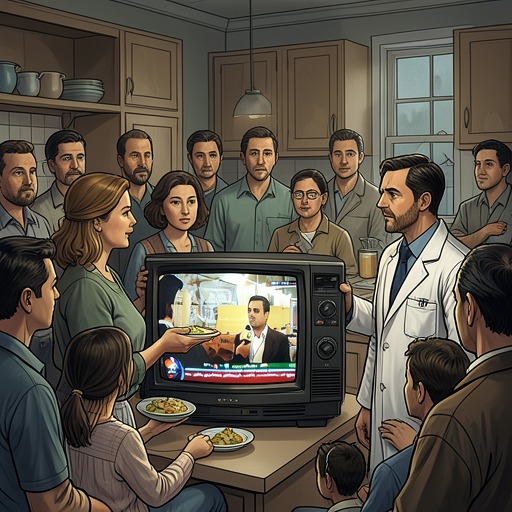
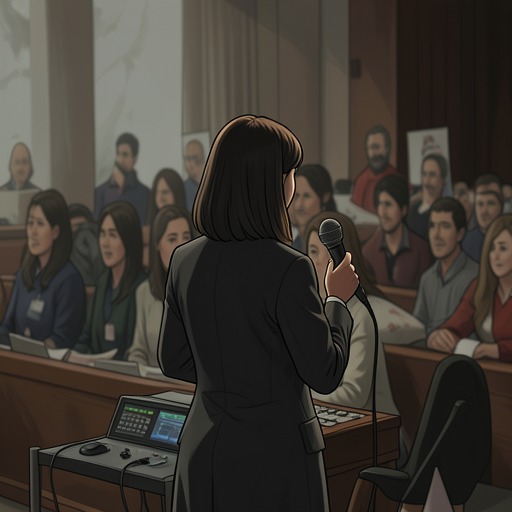
At the start of the broadcast, Elizabeth introduces herself and the program, then says she has an important announcement. She states that she is leaving Supper at Six effective immediately and confirms that this will be her last show. The studio audience reacts with disbelief; a viewer in Riverside drops a carton of eggs, and someone in the third row protests that Elizabeth cannot be serious. Elizabeth answers that she is always serious. The abruptness of the announcement gives the departure its force: the audience has not gathered for a retrospective, yet the final program becomes one as she explains what the work has meant.
From the producer’s chair, Walter Pine remembers meeting Elizabeth when she strode past his secretaries in a white lab coat, her hair pulled back and her voice clear. He recalls that her confidence, rather than her appearance, had stunned him: she seemed certain of who she was, and that certainty took root in others. His memory connects the farewell to the beginning of their professional relationship and shows how the quality he first recognized in Elizabeth has become part of the program’s effect on its viewers.
Elizabeth tells the audience that she has enjoyed hosting the show but has decided to return to scientific research. She thanks viewers not only for watching but for their friendship, and measures their shared work in the hundreds of meals they have made over two years. Then she adds that supper is not all they have made; they have also made history. The contrast enlarges the meaning of a domestic television format: meals are the visible work of the program, while the changed expectations and ambitions of its viewers are a less tangible achievement that Elizabeth insists deserves recognition.
Viewers, Work, and Change
The broadcast’s farewell recalls the exchange with Mrs. George Fillis, a viewer who had explained that the program’s chemistry lessons helped her think about her leg edema in terms of osmosis and hydraulic conductivity. She initially describes herself as merely a housewife, repeating her husband’s judgment that she is not especially bright, although her question demonstrates close attention to the science. Elizabeth rejects the assumption that any woman is simply a housewife and asks what else she does. In the final broadcast, Elizabeth returns to Mrs. Fillis’s story with news that she has completed her premedical studies in record time and been accepted to medical school. The woman who once voiced an ambition to become a heart surgeon is now identified as Marjorie Fillis, and Elizabeth congratulates her publicly.
Elizabeth uses Marjorie’s achievement to distinguish between the practical work of returning to school and the courage required to begin. At an easel, she writes that chemistry is change, then applies the lesson beyond the laboratory: she urges viewers not to hold themselves back or accept other people’s judgments about what they can achieve. Her appeal also rejects the use of sex, race, economic status, and religion as categories for confining people or dismissing their talents. The argument grows from the show’s specific teaching practice. Chemistry lets viewers examine how the world works; that knowledge, Elizabeth suggests, can help them question the social rules presented as if they were just as fixed.
The response makes clear that the farewell reaches beyond the studio. Women across the country rise from their sofas and pound on kitchen tables, reacting both to Elizabeth’s words and to the news that she is leaving. Their excitement and sorrow arrive together: the audience has been encouraged to act, but is losing the presenter who has helped make that action imaginable. Harriet Sloane also recognizes the emotional weight of the moment and draws Walter and Elizabeth close as she cries. Elizabeth then gives Harriet special thanks, locating the show’s history in a friendship as well as in the public bond between host and viewers.
The Final Lesson
Before the program ends, Elizabeth completes the chemistry lesson and dismisses the class. The sign-off makes the television farewell continuous with the educational work that has defined the show: viewers are not merely spectators being told that a program is over, but students being sent away with ideas to use. The ending therefore preserves Elizabeth’s central distinction between a role and a capacity. She is leaving the role of host, but the scientific teaching she has done is meant to continue in the decisions her viewers make for themselves.
The departure also brings her two professional identities into alignment. Elizabeth does not present television and research as opposing callings; the show has been a means of teaching chemistry, and her decision to leave is explicitly a return to research. By recognizing Marjorie Fillis’s progress, thanking viewers for their companionship, and urging women to design their own futures, Elizabeth turns her last broadcast into both a conclusion and a handoff. The class is dismissed, but the change she has asked her audience to undertake is left open-ended.