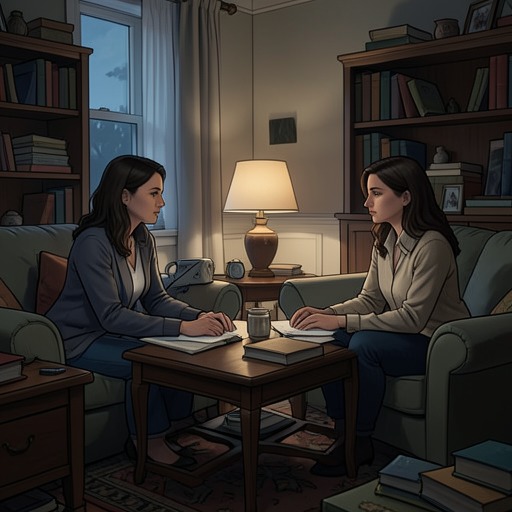
Elizabeth Zott and Avery Parker’s journey from mistrust to acceptance
Lessons in ChemistryElizabeth Zott and Avery Parker’s relationship moves from guarded suspicion to an offered place in the family. Its decisive turn comes when Parker reveals that she is Calvin Evans’s biological mother and Elizabeth answers not with a claim over Calvin, but with the truth of her love for him and an invitation to belong. The relationship brings biological kinship into contact with a family formed through love, memory, and recognition.
Suspicion and an unexpected offer
When Avery Parker meets Elizabeth, she says that she and her foundation have asked Elizabeth there to offer her a job and that they have long admired her work. Elizabeth is not ready to accept this explanation. After Wilson leaves, she tells Parker she knows why she was summoned and asks how long Parker has known him. Her suspicion focuses on Wilson, not Parker herself, but it makes the offer feel like something Elizabeth must investigate rather than simply receive.
That wariness matters because the encounter is also the approach of a revelation Elizabeth cannot anticipate. Parker’s stated purpose is professional, while the history that draws the two women together is personal: a search for a son lost to adoption and the family Calvin built with Elizabeth. Their first exchange therefore places the possibility of trust beside Elizabeth’s instinct to test appearances. Parker must tell her story; Elizabeth, in turn, must decide what that history means for her own relationship with Calvin.
The history behind Parker’s search
Parker recounts that, ten years after her baby was taken from her, a nurse from the home for unwed mothers contacted her when she was twenty-seven. The nurse sought money in return for the truth: the baby had not died, as Parker had been led to believe, but had been put up for adoption. The child’s adoptive parents later died in an accident, his aunt died as well, and he was sent to All Saints in Iowa. Parker identifies that discovery as the beginning of her quest to find her son, then tells Elizabeth plainly that the son was Calvin.
The revelation makes Parker’s connection to Elizabeth intimate without making it simple. Parker is Calvin’s biological mother, but she has spent most of her life not knowing what happened to him. She says she still does not know what his adoptive family was like, whether the bishop’s account of his life was wholly false or partly true, or what brought him to Hastings. The search has recovered Calvin’s identity as her son, but not the lived history that would have let her know him. Elizabeth possesses that missing intimacy: she loved and shared a life with the man Parker was trying to find.
Grief becomes testimony
Parker explains that she and Wilson had stood only a few graves away when Calvin was buried. She had come to bury her son for the final time and speak to Elizabeth, but Elizabeth left before the service ended. Parker’s account reveals how distance and incomplete knowledge shaped their earlier near-encounter: Parker wanted to believe someone had loved Calvin, yet had not heard that love spoken by the person who knew him best.
Elizabeth responds by collapsing beneath the burden of that misunderstanding. She insists that she loved Calvin with all her heart, remembers him as brilliant, loving, kind, and interesting, and describes their bond through the language of chemistry. The statement is more than a defense of her place in his life. It gives Parker what she had come seeking at the graveside: evidence that her son had been deeply loved. Elizabeth’s grief, previously held within herself, becomes testimony shared with Calvin’s mother; she lays her head on Parker’s shoulder and sobs as she has never done before.
Within the lab, Six-Thirty watches Parker hold Elizabeth. The dog understands the embrace as a permanent bond. That perception makes the scene’s change visible without erasing what neither woman can recover: Parker did not know Calvin as an adult, and Elizabeth cannot give her the lost years. Their closeness begins instead in their shared attachment to him and in Parker’s care for the woman who mourns him.
Recognition beyond blood
The novel has already questioned whether family can be reduced to biological descent. Walter Pine learns that Amanda is not his biological daughter, yet the test results do not alter his certainty that she is his child. Madeline Zott similarly describes a family photograph of Calvin’s funeral by including Elizabeth, Six-Thirty, herself still inside her mother, and Calvin in the coffin. When Reverend Wakely struggles to fit families onto a family tree, Madeline’s answer points beyond the plant-like branches of ancestry toward human and animal bonds. These episodes prepare the ground for Elizabeth’s response to Parker: blood establishes a connection, but does not alone determine who belongs.
Parker says she would like to be part of Elizabeth and Madeline’s family, addressing Elizabeth formally as Miss Zott. Elizabeth asks her to call her Elizabeth and tells her that she is family. She then explains that Madeline understood this earlier: on the family tree, it was Avery, not Wilson, whom Madeline had placed. The gesture makes Madeline’s earlier understanding consequential in the present. Parker is not welcomed as a replacement for anyone, nor does her biological motherhood displace Elizabeth’s shared life with Calvin. Instead, Elizabeth recognizes Parker as Calvin’s mother and as someone Madeline has already made room for. Their reconciliation does not restore the past; it creates a bond in which Calvin’s remembered life and Parker’s recovered kinship can both be held.