Elizabeth’s home laboratory
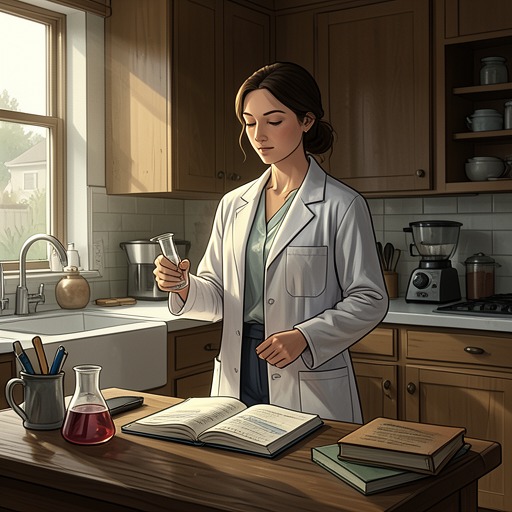
Lessons in ChemistryElizabeth’s home laboratory is a research workspace built inside Elizabeth Zott’s kitchen after Calvin Evans’s death. Its creation turns a familiar domestic room into a purpose-built scientific environment: cupboards and counters give way to laboratory shelves, sinks, burners, and a fume hood. The transformation is at once practical and consequential. Elizabeth constructs the laboratory during her pregnancy, completes it with Six-Thirty’s help, and later identifies it to Dr. Mason as her own work.
From kitchen to laboratory
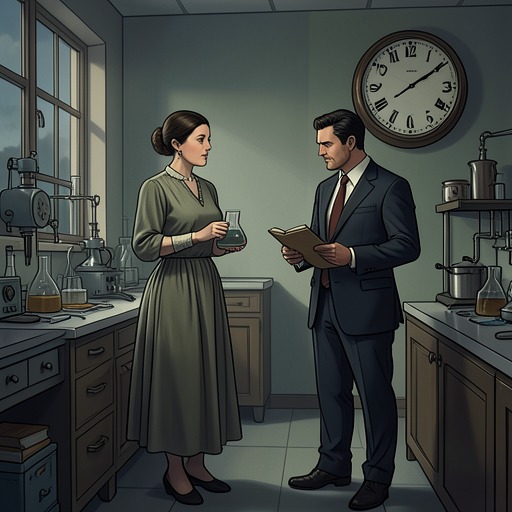
At two in the morning, about three months after Calvin’s death, Six-Thirty finds Elizabeth in the kitchen wearing a nightgown and galoshes, with all the lights on and a sledgehammer in her hand. She starts by striking the cupboards. The destruction continues for two hours, interrupted by careful attention to hinges and nails; afterward, she carries the boards and hardware into the backyard. The scene makes the conversion literal: before the laboratory can take shape, the kitchen’s existing arrangement has to be dismantled.
Elizabeth soon turns the damaged room into a plan for work. She points out where the shelves and centrifuge will go, then uses a tape measure with Six-Thirty’s assistance, asking him to hold one end while she measures across the kitchen. Her instructions are specific and practical, and the dog is included from the beginning as a participant in preparing the room. The laboratory is not simply placed in a spare corner; its dimensions and equipment are fitted to the kitchen itself.
Equipment and improvised materials
The transformation takes about four months. When it is finished, shelves run the length of the kitchen and hold chemicals and standard glassware alongside objects assembled or repurposed for laboratory use: empty mayonnaise jars, nail files, medicine droppers, glass rods, a hose from the backyard, and tubing found in an alley behind a local phlebotomy lab. The mixture records both the range of the setup and the resourcefulness with which Elizabeth equips it. The room’s scientific function depends not only on acquired laboratory apparatus but also on finding new uses for things already at hand.
The former utensil drawers now contain acid- and puncture-resistant mitts and goggles. Metal pans beneath the burners are intended to aid alcohol denaturation. Elizabeth buys a used centrifuge and cuts a window screen into four-by-four wire flats. She empties her favorite perfume to make an alcohol burner, using part of a lipstick container fitted into the cork of Calvin’s old thermos bottle as its stopper. Wire hangers become test-tube holders, while a spice rack is converted into a suspension structure for liquids. These details show how completely ordinary kitchen storage and household objects are redirected toward experimental work.
The refitting extends to the room’s fixed surfaces. Elizabeth removes the Formica countertop and ceramic sink, makes a plywood template, and takes it in pieces to a metal fabrication company, which produces a fitted stainless-steel replacement. One microscope and two used Bunsen burners stand on the new counters. One burner comes from Cambridge, where it had been given to Calvin as a memento; the other comes from a high-school chemistry laboratory shedding equipment because of limited student interest. Above the double sinks, hand-lettered signs distinguish WASTE ONLY from H2O SOURCE. The laboratory therefore carries both Elizabeth’s own improvisations and equipment with histories connected to other institutions and to Calvin.
A working space within the household
The fume hood is a prominent feature of the completed laboratory, and Elizabeth assigns Six-Thirty a role in its operation. When her hands are full, he is to pull the chain; she also tells him he will need to learn to press its large button. The arrangement makes the dog’s assistance concrete rather than incidental: he helps measure the room and is given tasks associated with a specific piece of laboratory equipment.
The laboratory’s presence changes how visitors encounter the home. When Harriet Sloane visits, she finds Elizabeth exhausted with newborn Madeline and notices that the kitchen no longer looks like a kitchen. She points to the centrifuge, and Elizabeth identifies it. As Harriet tries to make coffee, the fume hood interrupts the route to the stove and makes the altered room impossible to overlook. Elizabeth then uses the stainless-steel counter, distilled water, a flask, a tube, metal stands, and a burner to heat water. The laboratory is not merely an ambitious plan or a collection of stored apparatus: the visit shows its equipment incorporated into activity in the kitchen.
Construction, independence, and significance
After Madeline’s birth, Dr. Mason surveys Elizabeth’s commitments, including the baby, rowing, freelance work, and research, and describes the laboratory as decent. When he asks whether Calvin built it, Elizabeth answers that she did, during her pregnancy. She gestures toward Six-Thirty as her helper. This exchange establishes both the laboratory’s origin and the distribution of labor behind it: Elizabeth designed and built the workspace, while the dog contributed practical assistance.
The laboratory’s significance lies in the specificity of its conversion. The domestic kitchen is not simply decorated to suggest scientific purpose; its counters, sinks, drawers, burners, ventilation, and storage are altered or assigned new functions. At the same time, the room remains part of the household in which Elizabeth cares for Madeline and receives visitors. The laboratory brings scientific work into that domestic setting without concealing the effort required to make it possible: a night of dismantling, months of construction, carefully adapted materials, and equipment gathered from used, discarded, and personally meaningful sources.