Family beyond biological lineage
Lessons in ChemistryFamily beyond biological lineage is the novel’s account of kinship as a lived bond rather than a fact settled by descent alone. Biology matters to characters searching for their origins, but it cannot by itself confer love, define identity, or limit who may belong. Parenthood, shared grief, care, and deliberate recognition repeatedly prove more decisive than a family tree’s lines.
Kinship beyond biological proof
Walter Pine’s discovery that he was not Amanda’s biological father gives the idea its clearest practical test. His ex-wife had long suggested that he was not Amanda’s father by birth, though he had assumed she said so to hurt him. Their different appearances did not persuade him: many children do not resemble their parents, and he understood his bond with Amanda as something deep and permanent. When paternity testing became available, he supplied a blood sample. Five days later, the result established that he and Amanda were biologically unrelated; he had learned the result only three weeks before telling Elizabeth Zott.
The test changes what Walter knows, but not what he feels or does. He expected to feel cheated or devastated, yet the result left him nonplussed because it did not alter his relationship with Amanda. He continued to regard her as his daughter and himself as her father, loving her wholeheartedly. His story does not deny biological difference; it denies that difference has the authority to cancel a practiced and cherished parent-child bond. His reflection that he had not planned to become a parent, yet became a devoted father, further separates family from intention or genetic certainty: the relationship is real because it has been lived.
That conversation also gives Elizabeth and Walter a vocabulary for their own connection. As they search for a name that describes the people who matter to one another without relying on marriage or birth, Elizabeth settles on kin. The word marks the beginning of their unusually candid friendship: two people who have each been wronged recognize that their common experience is enough to establish a bond. The scene links family in the parental sense to a wider form of chosen relation, while keeping the specific circumstances of each relationship distinct.
Family trees and the limits of descent
Madeline Zott’s investigation of her father’s origins shows why biological ancestry still matters. Faced with unanswered questions about him, she takes an interest in the names and connections recorded in family trees. Harriet Sloane cautions her that such trees can encourage people to feel important through ancestors they have never met, and that the pursuit can invade privacy. Her warning does not resolve Madeline’s questions; it sets the limits of what a list of relatives can tell her. Madeline still wants to know who her father was, and the family tree cannot supply that knowledge by itself.
Madeline also refuses to treat her father as belonging only to a finished past. When Reverend Wakely explains that the past may be the most sensible place to begin in seeking information from All Saints, she insists that her father remains her father. Her response distinguishes the historical task of finding facts from the continuing emotional relation those facts concern. Calvin Evans is absent from her life, but that absence does not make their relationship unreal or reduce him to a name in a record.
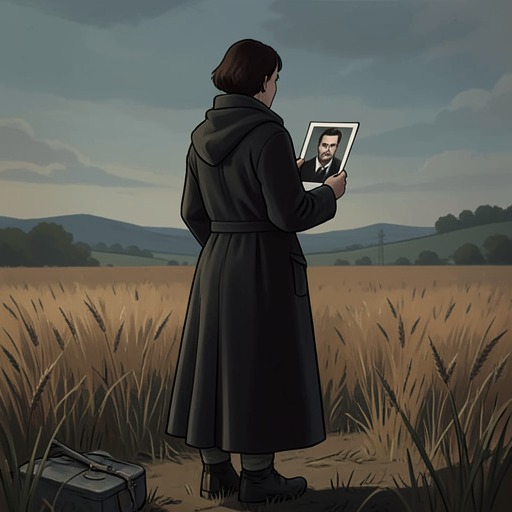
A family photograph makes Madeline’s understanding visible. The image is a clipping from Calvin’s funeral: Elizabeth’s back and Six-Thirty appear as they watch the burial, while Madeline explains that she was inside her mother and her father is in the casket. She understands the image as a family picture because it gathers the people and histories that constitute her family, including a father she never met and a life that began before she was born. Reverend Wakely recognizes the limits of representing people through tree-like branches: people are animals, not plants, and their relationships cannot be fully contained by a diagram of descent. Madeline recognizes that this is the point she had tried to make at school.
Recognition, care, and belonging
The contrast between a family tree and Madeline’s photograph is not a rejection of origins. Madeline wants to know her father’s history, and her explanation of the funeral image depends on acknowledging Calvin as her father. But the photograph’s meaning also depends on more than biological connection: Elizabeth and Six-Thirty are present in the scene of grief, and Reverend Wakely is part of the remembered image as well. The family she identifies is made legible through shared loss and presence, not simply through the arrangement of names.
The same distinction governs Elizabeth’s welcome to Avery Parker. At their meeting, Avery says she would like to be part of Elizabeth’s family and hopes the request is not too bold. Elizabeth answers that Madeline understood Avery’s place in the family long ago: on the family tree, Madeline put Avery, not Wilson. The exchange makes belonging an act of recognition, and shows that the child’s understanding can precede the adults’ explicit acknowledgment. Avery’s place is not presented as a biological fact that automatically settles the matter; Elizabeth names her as family, and Madeline’s earlier choice has already made that connection meaningful.
Across these relationships, the novel does not replace blood kinship with a single alternative rule. Instead, it places descent alongside the evidence of attachment: Walter’s continuing fatherhood of Amanda, Madeline’s insistence that Calvin remains her father, the kinship Elizabeth and Walter name between them, and Elizabeth’s welcome to Avery. Family beyond biological lineage describes the space in which origin can matter without becoming destiny, and in which love and recognition make relations that genealogy alone cannot explain.