Hastings Research Institute
Lessons in ChemistryHastings Research Institute is both a research institution and a contested professional world: its projects depend on outside money, while the people doing the work contend with internal hierarchies over authority and recognition. The institute’s response to Calvin Evans’s death reveals its vulnerability to funders; Elizabeth Zott’s career there exposes how that vulnerability coexists with gendered rules and the denial of credit. Years later, the Parker Foundation’s takeover turns the institution’s private conflicts into grounds for formal change.
Funding and Research
After Evans dies, Hastings management worries that a newspaper account has left benefactors with the impression that his difficult personality prevented worthwhile achievement. The institute’s supporters include the army, the navy, pharmaceutical companies, private investors, and foundations. They are already considering whether to reexamine existing projects and rethink future grants. The episode makes Hastings’s dependence plain: research may be pursued in laboratories, but its continuation rests on those willing to pay for it.
Management responds by assembling evidence of Evans’s progress. His office is crowded with notebooks and equations, and he is due to present a paper in Geneva the following month. The planned presentation gives his work a concrete institutional horizon even as his death interrupts it. Hastings is not merely mourning a scientist; it is trying to persuade its supporters that the research they have funded remains valuable.
The institute also hosts Elizabeth’s work on abiogenesis, a project approved after a wealthy investor insisted on funding it. The investor had read an older paper by E. Zott from the University of California, Los Angeles, and had been trying to find its author because he saw possibilities for expanding the research. His intervention brings Elizabeth’s project into Hastings, but it also underscores how unusual projects can depend on the choices of wealthy individuals rather than on broad institutional recognition.
Elizabeth Zott at Hastings
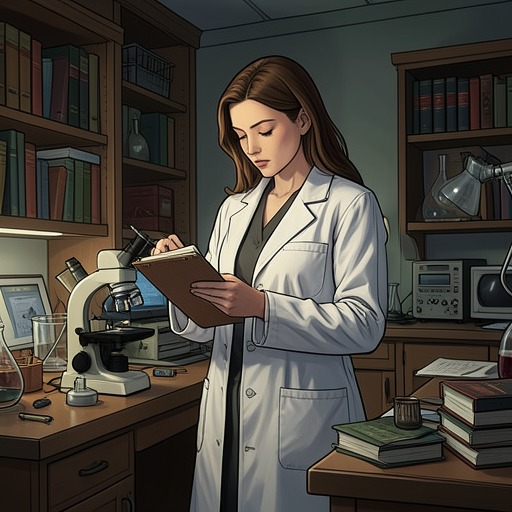
Elizabeth is described within Hastings as an innovator whose contributions have gone unrecognized. Management receives recurring complaints about her: she voices her opinions, insists that her name appear on her own papers, and refuses to make coffee. These grievances expose a workplace in which ordinary expectations about women’s conduct sit alongside scientific work. Her progress is difficult to dismiss, although the institute itself cannot settle whether it belongs to her or to Evans.
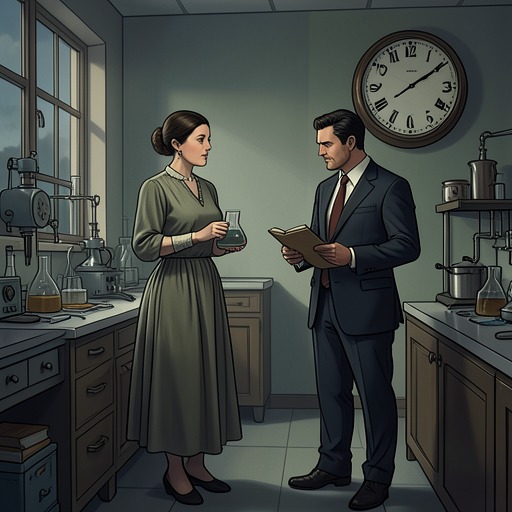
When Dr. Donatti pushes a termination notice across a table, Elizabeth responds with confusion at being fired. The evidence establishes the notice and her reaction, while showing Hastings as a place where her position is precarious. Later, the Chemistry Department marks her return with a lab coat presented as a welcome gesture. The coat bears only the initials E.Z. where her name had previously appeared as E. Zott; applause is followed by guffaws. What looks like a celebration thus carries a pointed reminder that she is being welcomed back into a department still capable of making her identity and standing the subject of a joke.
The conflict becomes explicit when Elizabeth confronts Donatti over her research. She accuses him of stealing it, publishing it as his own, and promises he will not get away with it. In an interview with Roth, she explains that Donatti knew she belonged in the field and knew she was onto something, but took the work nonetheless. She says she quit the same day. Hastings has therefore been not only the setting for her scientific labor but also the place where an institutional superior’s appropriation of that labor drives her departure.
Credentials and Professional Standing
Elizabeth’s account of her education further complicates how Hastings and the scientific community define legitimate expertise. She tells Roth that she has no undergraduate degree and has never claimed to have one; her admission to Dr. Meyers’s graduate program rested on self-study. Her statement distinguishes the record of her formal credentials from the scientific work she has actually performed, including her research at Hastings.
By January 1962, Elizabeth’s celebrity has not translated into offers from universities, research laboratories, or the National Institutes of Health. Her résumés receive no response, and doubts about her academic credentials persist in the scientific community. The problem is sharpened by Life magazine’s account of her: Dr. Meyers and Dr. Donatti are quoted as saying she is not really a scientist. The issue is not simply whether the institute has work for her; public judgments by prominent chemists help determine whether other institutions will consider her at all.
When Elizabeth later returns to Hastings, the prospect is framed as a chance to continue her abiogenesis research. At a meeting in Evans’s old laboratory, a representative says the institute needs an inventory from every lab and asks what Elizabeth would need for her research there. Wilson explains that her intention to resume research, announced on her final television program, makes Hastings a possible home for that work. Elizabeth replies that she can think of several better places. Her response preserves the distinction between being invited back and trusting the institution that once failed to protect or properly credit her.
Takeover and Institutional Change
The decisive change comes after the Parker Foundation acquires a majority share in Hastings. Wilson explains that the foundation took a closer look after Miss Frask’s letter in Life magazine prompted scrutiny of the institute. In the meeting that follows, Avery Parker presents Donatti with a termination notice. The stated grounds include mismanagement, faked test results, and plagiarism, linking the institute’s larger failures to the conduct Elizabeth had challenged.
The new owners also change who holds authority. Wilson tells Donatti that Miss Frask, previously dismissed as a secretary, is now head of Personnel and has been asked to find a new director of Chemistry. Avery Parker says the job will be offered to someone else. The reversal is specific: the person Donatti had treated as subordinate now has an institutional role in replacing him, while the director who had appropriated Elizabeth’s research is removed.
Hastings’s trajectory therefore runs from anxious dependence on benefactors to a change in ownership and leadership. Its laboratories contain important work, but the institute’s history turns on more than discovery: funders influence which projects proceed, departmental authority determines whose research is credited, and public assessments of credentials can follow a scientist beyond the workplace. The takeover does not erase Elizabeth’s earlier experience, but it establishes a new institutional response to the misconduct that helped drive her away.