Los Angeles Times
Lessons in ChemistryLos Angeles Times gives the novel a measure of how private loss and local events become public narratives. Its coverage first presents Calvin Evans through a funeral story that questions his scientific potential and Elizabeth Zott through an image and caption that misrepresent her knowledge of him; seven months later, the paper again places Six-Thirty at Calvin’s grave, this time in a story about mourning and a life-saving rescue.
Funeral Coverage and Public Reputation
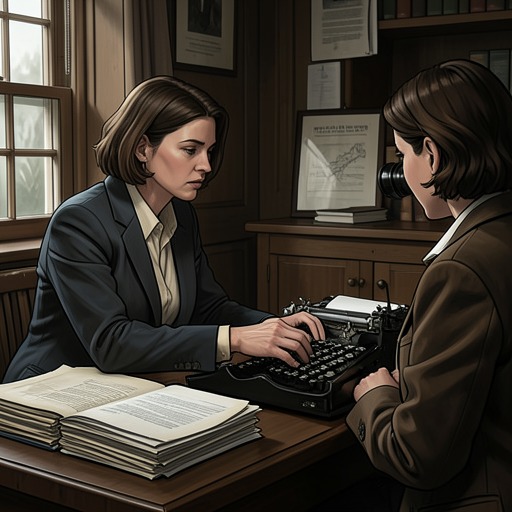
A reporter’s account of Calvin Evans’s funeral appears on page eleven. Its headline and framing suggest that Calvin’s difficult personality may have limited his scientific achievement. Beside the story is a photograph of Elizabeth and Six-Thirty standing in front of Calvin’s coffin, accompanied by a caption that implies Elizabeth barely knew him. Elizabeth responds to the article with distress, making the newspaper’s account a public affront as well as a record of her private grief.
The coverage also draws the attention of Hastings management. The institution’s innovators are ordinarily kept away from the general press, but Calvin’s appearance in Los Angeles Times alongside Elizabeth and the dog makes that separation harder to maintain. Management recognizes Elizabeth as an innovator, even while complaints about her conduct and refusal to perform expected office tasks accumulate; her scientific progress, whether attributed to her or to Calvin, is described as undeniable.
Six-Thirty’s Return to Page Eleven
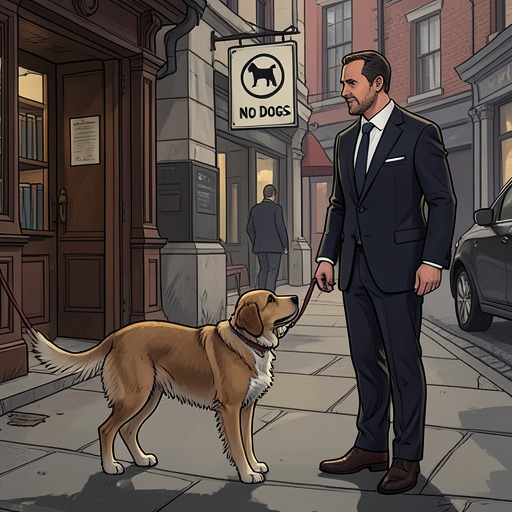
Seven months after the funeral photograph, Six-Thirty appears in Los Angeles Times again, sitting at the same spot on Calvin’s grave. The story follows a cemetery incident in which the dog saves a man’s life. The reporter photographs the scene and brings Six-Thirty home to Elizabeth, explaining that the animal is unharmed and that he intends to present him as a hero. The next day’s coverage joins the rescue to the dog’s continuing presence at Calvin’s grave, linking public heroism with mourning.
The article also reports that the cemetery dog ban has been lifted. That practical change gives the coverage a consequence beyond the newspaper page: the story records a shift in the rules governing Six-Thirty’s presence at the cemetery, where he has continued to visit Calvin.
Press Framing and Recurrence
The two appearances on page eleven create a pointed contrast. The funeral story reduces a complex relationship to a caption and uses Calvin’s character to qualify his scientific promise; the later story presents Six-Thirty as both bereaved companion and rescuer. In each case, the newspaper makes a scene legible to the public through a compact narrative, but the later coverage connects the dog’s grief to an act that changes the cemetery’s policy.
Los Angeles Times is therefore more than a passing mention in the novel’s account of public visibility. Its stories show how press framing can distort a private bond, attract institutional attention, and turn an individual act into a recognized event. The repeated placement of Six-Thirty on page eleven—first beside Calvin’s coffin, then at his grave—makes the newspaper’s pages an inadvertent record of loss and its aftermath.