Madeline Zott
Lessons in ChemistryMadeline Zott is the daughter Elizabeth Zott gives birth to after Calvin Evans’s death. Precocious in both size and reading ability, she grows up among people and memories that do not fit neatly into a conventional family tree. Her efforts to explain who belongs to her family—most memorably through a funeral clipping—make her more than a gifted child: she becomes the story’s clearest interpreter of kinship as something made through love, shared life, and care as well as biology.
Birth and naming
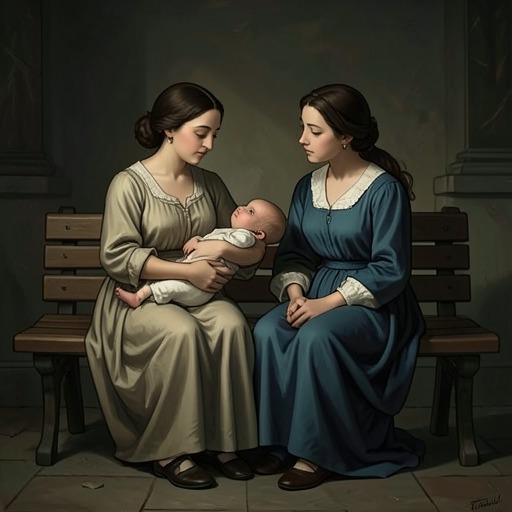
Elizabeth gives birth after thirteen hours of labor. Dr. Mason holds the infant up for her to see and remarks on the baby’s size, strong lungs, and possible future as a rower, connecting the newborn to Elizabeth’s strenuous rowing practice. Elizabeth has delivered without anesthesia. The scene’s practical details make the child’s arrival an arduous physical achievement as well as a new beginning for a bereaved mother.
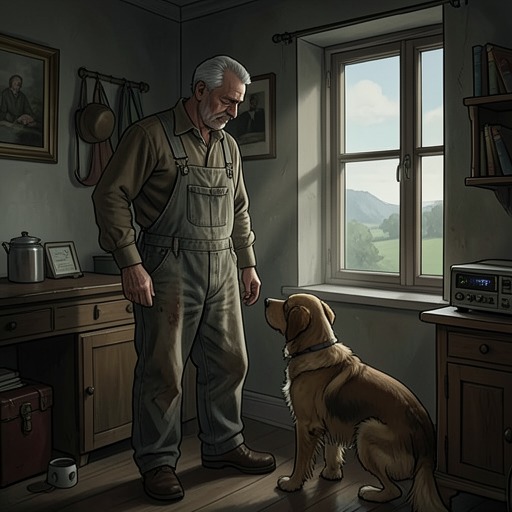
Six-Thirty is introduced to the baby as soon as Elizabeth brings her home. The dog, who has been anxiously waiting, recognizes that the bundle contains a girl; Elizabeth confirms it and smiles. The encounter places Madeline inside an existing household bond: before she can speak or understand family categories, she is welcomed by the companion who has shared Elizabeth’s life and grief.
Her first legal name is an accident. During the birth, Elizabeth confirms a choice of name, but the exhausted nurse writes Mad on the birth certificate. Elizabeth discovers the error only a few days later, when she finds the certificate among the hospital papers on the kitchen table. The official document has made the clipped form her daughter’s legal identity, and changing it is not immediately straightforward.
Calvin supplies the idea that resolves the problem, though he is no longer alive to meet his daughter. Thinking through possible names, he recalls the madeleine biscuit from the book Elizabeth read to him, Remembrance of Things Past. He connects the biscuit to Mad and suggests Madeline. The name thus carries a domestic object and a memory of shared reading into the child’s identity. Elizabeth adopts the suggestion, giving her daughter a name that joins the accidental beginning of Mad to a connection with Calvin.
A precocious and solitary childhood
By the time she is almost four, Madeline is larger than most five-year-olds and reads better than many sixth graders. These striking abilities do not bring her an easy social life: she has few friends, as do the antisocial mother and grudge-holding father to whom Elizabeth compares her. Elizabeth wonders whether she and Calvin might share a genetic basis for their family’s tendency to avoid people; Harriet answers by joking about an alleged I-hate-people gene. The exchange presents Madeline’s difference as both a family resemblance and a source of maternal worry, without reducing the child to either explanation.
A drawing Madeline describes to Elizabeth gives a compact picture of what occupies her attention. It includes Elizabeth and Madeline, Harriet, Six-Thirty, Elizabeth rowing, the family’s lawn mower, a fire, their car, and the recurring passage from sun to moon and flowers. The picture places relationships beside ordinary equipment, danger, movement, and the rhythms of the natural world. Madeline’s account treats these things as parts of a shared world rather than sorting them into adult categories of greater and lesser importance.
Her interests are notably unlike the toys Harriet expects a child to enjoy. Madeline prefers knots, books about war, and natural disasters; she has even questioned the downtown librarian about when Krakatoa might erupt again, how residents could be warned, and how many people might die. Harriet watches her study the empty branches of a school family tree, chewing her lip in a way that recalls Calvin. The resemblance prompts Harriet to wonder about inheritance, but her own experience of having four very different children complicates any simple faith that biology guarantees closeness. Her reflection—that families need continuing maintenance—anticipates the question Madeline’s school assignment will bring into the open.
The family tree and its missing branches
In the spring of 1960, Mrs. Mudford assigns the class an All About Me project and asks each child to have a parent fill out a family tree. The assignment presents family as a structure that can be set down on paper, with a child’s identity explained through branches of descent. For Madeline, whose father died before she was born and whose household includes important people and a dog beyond that diagram, the form raises a problem the assignment cannot easily accommodate.
At the library, Reverend Wakely helps Madeline look for information about All Saints after she explains that she is Mad Zott. Their exchange about how families relate to trees leads him to suggest that people belong to the animal kingdom, not the plant kingdom. Madeline immediately recognizes that this expresses what she has been trying to tell Mrs. Mudford. Her response shows that the assignment has not merely confused her: she has already been working out a different account of family, one that the tree metaphor cannot contain.
When Madeline brings a family photo to Wakely, the item is actually a clipping about Calvin Evans’s funeral. Its photograph shows Elizabeth and Six-Thirty from behind as they watch the earth cover the casket; Wakely, who had blessed it, is also visible. Madeline explains how it can serve as her family picture: Elizabeth is her mother, she herself was inside Elizabeth, Six-Thirty belongs in the picture, and her father is in the box. The explanation is literal and composed, but its facts make the loss in the photograph impossible to overlook. Wakely, experienced in consoling others, finds the child’s matter-of-fact account of grief difficult to bear.
The clipping reveals the difference between a family photograph and a family tree. The image holds together a mother, a daughter who was not yet born, a dog, a dead father, and the minister who presided at the funeral. It cannot display all these relationships in the way a conventional branching diagram might, yet Madeline knows how they belong together. Her choice does not erase death or pretend that all relationships are the same; it insists that the family can be pictured through shared history and attachment, not just ancestry.
Relationships and the meaning of family
Madeline’s understanding develops amid distinct forms of connection. She belongs to Elizabeth through birth and daily life, to Calvin through paternity and the memories Elizabeth preserves, and to Six-Thirty through the dog’s early welcome and place in the household. Harriet is sufficiently important to appear in Madeline’s drawing, while Wakely becomes a listener who takes her thinking seriously. These relationships do not all rest on the same basis, and her account does not require them to.
The novel also places Madeline’s family alongside Walter Pine’s experience. Walter has recently learned by paternity testing that he is not Amanda’s biological father. The result leaves his love unchanged: he continues to regard Amanda as his daughter. His experience gives explicit form to a possibility present in Madeline’s account—that biological facts matter, but do not alone determine who counts as family. Madeline’s own case is different: Calvin is her biological father, but his death means their relationship is carried through absence, memory, and the people who remain.
When Elizabeth later asks about an inappropriate family photo and the attached tree, she approaches the matter gently. The incident confirms that Madeline’s attempt to represent her family has reached the adult institutions surrounding her, where its unconventional form can be questioned. Yet the story does not present her understanding as a childish error to be corrected. Her conversation with Wakely has already established the reasoning behind it: people are not trees, and a family need not be reducible to a diagram of descent.
That principle receives its fullest expression when Avery Parker asks Elizabeth to let her become part of the family. Elizabeth answers that Madeline understood the matter long ago: it was Avery, not Wilson, whom Madeline put on the family tree. Avery is Calvin’s birth mother, but her place in the family is affirmed through recognition and acceptance, not simply through the biological fact itself. Madeline’s choice anticipates this ending. A child who once tried to make room for her dead father, her mother, and Six-Thirty in a single picture has already understood that family can include relationships conventional charts leave out.