Reverend Wakely
Lessons in ChemistryReverend Wakely is a minister formed by two kinds of evidence: the religious inheritance of a fifth-generation clergy family and the scientific questions that unsettle his belief in creation. His friendship with Calvin Evans begins in a dispute about religion and grows through years of letters; after Calvin’s death, Wakely’s imperfect but persistent care connects him to Madeline Zott and Elizabeth Zott. He remains a minister without claiming to have solved the conflict between science and faith, and his value to the family lies less in certainty than in his willingness to listen, question, and help.
Identity and Crisis of Faith
At Harvard University’s Divinity School, Wakely audited a chemistry course with the intention of understanding the scientific account of creation well enough to refute it. Instead, learning about atoms, matter, elements, and molecules made it harder for him to believe that God had created the world. The problem reached beyond private conviction: as a fifth-generation minister, he carried familial expectations, while science offered a demand for evidence that he rarely encountered in his future profession. His religious vocation therefore persists alongside a serious intellectual doubt; the evidence does not show him abandoning the ministry or arriving at a final reconciliation.
Wakely’s self-deprecation makes this unsettled position visible. He calls himself a terrible minister, first in response to his own shortcomings and later when Elizabeth describes him as a strange one. The repetition is comic, but it also marks a gap between the minister he was expected to be and the more questioning, uncertain person he has become. His doubts do not prevent him from offering ethical counsel or taking responsibility for others.
Calvin Evans and the Letters
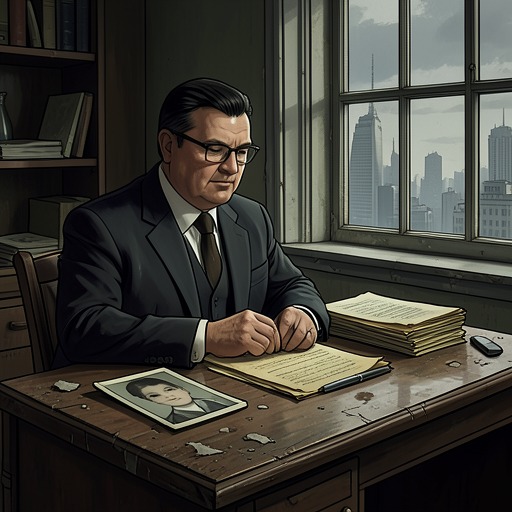
Wakely first encountered Calvin at a Harvard panel on RNA research. Calvin, the youngest panelist, said little during the technical discussion, until an audience question asked for an example of an ineffective collision that nevertheless had a large effect. Calvin answered with religion, then left. The remark stayed with Wakely, who wrote to him to explain that it had troubled him. Calvin replied, and the exchange continued through successive letters despite their disagreement.
Their correspondence moved from science and religion into personal matters. Wakely and Calvin discovered they were the same age and shared a love of water-based sports and sunny weather: Calvin rowed, while Wakely surfed. Neither had a girlfriend, neither enjoyed graduate school, and neither knew what life after graduation would bring. When Wakely mentioned following in his father’s footsteps, he asked whether Calvin was doing the same. Calvin replied emphatically that he hated his father and hoped he was dead. The letters thus carried both intellectual disagreement and disclosures of family pain, becoming a friendship Wakely describes as genuine even though the two men never met in person.
Wakely later tells Elizabeth that Calvin’s work had made him an admirer, though he had never met Calvin. He had attended Calvin’s funeral and wanted to find words that might help Elizabeth with her loss, but felt he had failed. His account resists turning admiration into intimacy: he was, as he puts it, a bit player in the funeral, yet the correspondence had given him a strong sense of Calvin. Elizabeth also tells him that he was the reason Calvin took a position at the Hastings Research Institute. That revelation deepens the consequence of their letters beyond their private friendship, though the evidence does not specify the precise role Wakely played in Calvin’s decision.
Helping Madeline Seek the Truth
Wakely enters Madeline’s search for her father through a question of names. At the library, he suggests Sioux City as a possible place to investigate, reasoning that a child might confuse Sioux with Sue and take the former for a girl’s name. The small suggestion gives Madeline a concrete direction in her family-tree research and shows him engaging with the assignment on her terms. When Madeline asks whether he can keep a secret, she whispers something to him; he whispers back, and their mutual surprise suggests a moment of shared confidence without disclosing its contents.
His involvement becomes more active when Madeline is distressed by the possibility that people lie. After leaving her in a park, Wakely calls All Saints, intending to demonstrate that not everyone lies. The irony is that he disguises his identity with an imitated British accent and presents himself as interested in making a sizable donation. His scheme invokes a memorial fund for someone who is not dead, and it brings in money. The episode makes his good intention inseparable from the deception he uses to pursue information: he wants to reassure Madeline, but does so by lying himself.
Wakely also responds directly to the social judgments Madeline encounters. When he learns at the park that Elizabeth is on television and has publicly said she does not believe in God, he tells Madeline that belief is a matter of freedom so long as it does not harm others. Later, at dinner with Madeline and Elizabeth, he rejects the stigma attached to being born outside marriage. He argues that the word illegitimate belongs to a social myth, not a meaningful judgment of a child, and affirms Elizabeth’s broader criticism of the ways culture, religion, and politics distort truth. His defense is personal as well as intellectual: he tries to make the family-tree inquiry less governed by shame and inherited labels.
Friendship with Elizabeth and Counsel in Grief
Wakely’s visit to Elizabeth’s home begins awkwardly. He arrives worried about Madeline, and when Elizabeth comes in, he introduces himself as a minister from First Presbyterian and apologizes repeatedly for disturbing her. He explains that Madeline is his friend and that Calvin had been a major influence on him. His rush of explanation reflects the difficulty of entering a bereaved family’s private space as someone who admired the dead man but had never known him face to face.
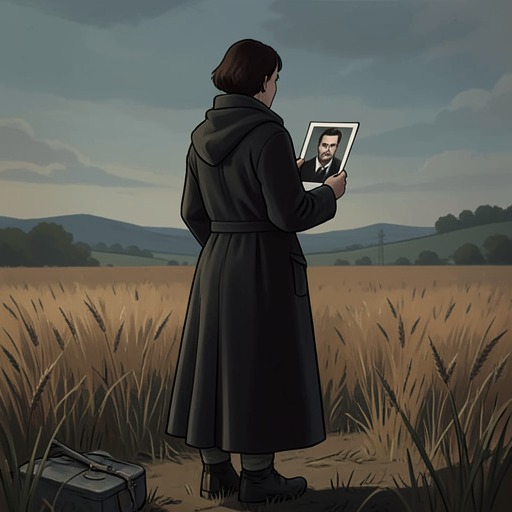
Their relationship becomes more candid on a chilly November evening, when Elizabeth tells him that she thinks about death a lot. Wakely says that he does too. Sitting together on the back step while Madeline watches television inside, they share the subject without making it a debate or pretending that either possesses an answer. Elizabeth confesses that she has read the letters between Wakely and Calvin, which had been among Calvin’s belongings. Wakely’s response is a sudden longing for his old friend, underscoring that the letters have survived as a tangible connection to someone both of them have lost.
As Elizabeth’s grief and depression leave her unable to find a way forward, Wakely tells her that she has never forgiven herself and that she must forgive Calvin and accept what happened. He acknowledges that, as a scientist, she searches for answers, but says that some questions have none; he invokes a prayer for serenity in accepting what cannot be changed. The advice does not resolve her grief, and the scene offers no sudden recovery. Its force lies in Wakely’s willingness to stay beside her and name the limit of explanation.
Narrative Role
Wakely occupies a productive tension between inherited religion and scientific inquiry. Chemistry first threatens the faith he expected to defend; Calvin’s scientific perspective then becomes the beginning of a friendship rather than a reason for estrangement. Later, Wakely neither condemns Elizabeth’s atheism nor treats Madeline’s birth as a moral failing. His ministry is defined less by doctrinal authority than by attempts to protect people from shame and needless harm.
His efforts are not uniformly wise: the deceptive call to All Saints exposes the distance between his stated commitment to truth and his chosen method. Yet that contradiction makes his care more human than exemplary. He can fail to find words at Calvin’s funeral, misjudge what will reassure Madeline, and still return when she is in trouble and sit with Elizabeth when grief has no answer. The novel’s portrayal of Wakely therefore makes faith less a settled explanation than a practice tested in relationships—with Calvin through letters, with Madeline through her questions, and with Elizabeth through the difficult work of acceptance.