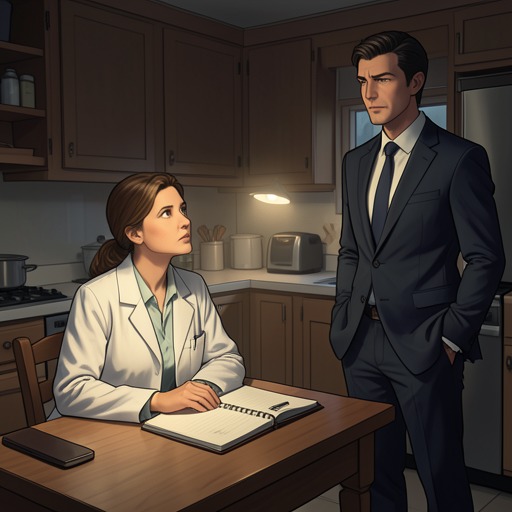
Sloane Attacks Harriet, and Elizabeth Broadcasts About Poisonous Mushrooms
Lessons in ChemistrySloane Attacks Harriet, and Elizabeth Broadcasts About Poisonous Mushrooms joins a private disclosure of domestic violence to a deliberately provocative television broadcast. Harriet Sloane arrives wearing sunglasses and tells Elizabeth Zott that Mr. Sloane threw a bottle at her after a series of grievances; Elizabeth responds with an embrace, then uses her cooking program to expose the violence and gendered injustice hidden beneath ordinary domestic life. The segment’s dark humor unsettles its audience, but the reaction around the broadcast makes clear that its implications extend beyond the studio.
Harriet’s Disclosure and Elizabeth’s Response
On Thursday morning, Elizabeth has just placed a note in Madeline Zott’s lunch box when Harriet sits down without taking off her sunglasses, despite the early darkness. The note applies the principle that matter can neither be created nor destroyed but can be rearranged to a child’s school-day problem: it advises Madeline not to sit beside Tommy Dixon. That small domestic exchange is interrupted by Harriet’s appearance, which immediately alarms Elizabeth.
Harriet describes Mr. Sloane as having been in a bad mood the previous night. She had thrown away his magazines; the Dodgers had lost; and he disapproved of Elizabeth encouraging a woman who wanted to become a heart surgeon. In that context, he threw an empty beer bottle at Harriet, causing her to fall. The account makes clear that the immediate cause was not a single disagreement but a husband’s violence set against his resentment of the choices and ambitions of women around him.
Elizabeth reaches for the telephone and says she will call the police. Harriet stops her, explaining that she does not expect the police to act and will not give Mr. Sloane the satisfaction. She also says that she struck back with her purse. Her refusal to involve the authorities is her stated decision; the narrative does not present it as a resolution of the danger or as evidence that the incident is trivial.
Elizabeth recognizes Harriet’s position through the memory of her own earlier encounter with the police, which brings back a familiar anger. Instead of pressing the call, she bends down and embraces Harriet. Physical affection is unusual between the friends, so the gesture marks a change in the immediate exchange: Elizabeth makes her support explicit, and Harriet answers that she would do the same for Elizabeth. Harriet then wipes her face, promises that things will be all right, and asks Elizabeth to let the matter go. Elizabeth does not.
The Broadcast
Five minutes after leaving the driveway, Elizabeth has already formed a plan. Three hours later, she opens her program by presenting a can of soup as a time-saving product. From his producer’s chair, Walter Pine initially reacts with relief because she appears to be using it. Instead, Elizabeth throws the can into a nearby garbage bin and recasts convenience food as a joke about feeding one’s family. The reversal shifts the segment away from an ordinary recipe before the audience has settled into its expected format.
At an easel displaying mushroom drawings, Elizabeth turns to poisonous varieties. She identifies Amanita phalloides, the death cap, and explains that its poison survives high heat and that the mushroom resembles a harmless straw mushroom. She describes how someone could claim mistaken identification if a death were investigated. The discussion is framed as cooking advice but is pointedly not ordinary instruction: the combination of domestic food and a concealed threat gives her a way to speak about danger inside the home without naming Mr. Sloane on air.
Elizabeth then proposes a stuffed-mushroom dish to share with a neighbor who makes life miserable for his wife, suggesting that such a man is already close to death and could be pushed further toward it. One audience member whoops and applauds; the camera also records several people writing down the name Amanita phalloides. The contrasting responses register the segment’s uneasy balance: it is presented as a joke, yet its details hold the audience’s attention as usable information.
Elizabeth clarifies that she is only joking about poisoning relatives, then redirects the joke toward husbands and children who fail to appreciate women’s work and employers who do not pay women the same as male counterparts. Laughter and applause follow her back behind the counter. The subject has widened from Harriet’s experience to a broader criticism of domestic expectations and workplace inequality. Elizabeth’s satire makes the act of cooking carry two meanings at once: a household task and a platform from which to challenge the conditions imposed on women.
Reaction and Immediate Aftermath
Walter’s response changes as the segment continues. Having first welcomed what he thought was a conventional use of soup, he watches Elizabeth discard the can and develop the mushroom material. The cameraman looks to him in confusion; Walter checks his watch, leaves the studio, and drives home. The episode records his departure without explaining his thoughts, so it remains a visible reaction rather than a fully stated judgment of Elizabeth’s choices.
The broadcast’s reach is suggested by the audience’s laughter, applause, and note-taking, as well as by its effect on dinner at home: no one in California touches their meal that night. These details make the segment more than a private exchange between Elizabeth and Harriet. The subject has entered viewers’ kitchens, where the language of food now carries the strain of the show’s joke and its criticism of women’s treatment.
Afterward, Rosa, the makeup woman, tells Elizabeth that Phil Lebensmal wants to see her at seven. Elizabeth is dismayed at the hour and remarks that he evidently has no children; she also asks whether Rosa has seen Walter and wonders if he is angry with her. Rosa says Walter left early and advises Elizabeth not to meet Lebensmal alone, offering to accompany her. The episode therefore closes with the broadcast’s workplace consequences still unresolved: Elizabeth has made her point in public, but an encounter with the person who wants to see her awaits.
Significance
The event’s force comes from the sequence linking Harriet’s disclosure to Elizabeth’s change of course. Harriet asks her not to make an issue of the assault, but Elizabeth cannot simply leave it behind. Rather than repeat the private account on television, she reshapes its anger into a performance that uses the show’s familiar ingredients—canned soup, mushroom illustrations, and the promise of a household meal—to expose how casually women’s labor and safety can be dismissed.
The program’s comedy is neither a straightforward recipe nor an uncomplicated threat. Its mushroom discussion gives viewers specific information, while its exaggerated suggestions and later disclaimer frame that information as satire. The audience’s mixed response, from laughter to careful note-taking, preserves the tension between the joke’s surface and the social grievance beneath it. The untouched dinners afterward supply a domestic counter-image to the cheerful premise of a cooking show: food has become difficult to approach once the show has made the power and danger embedded in household life newly visible.