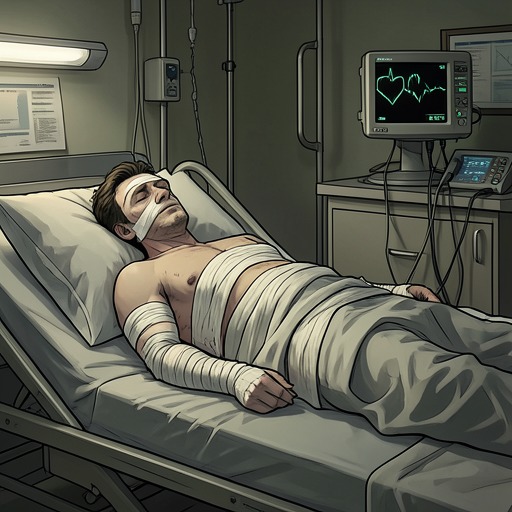
Benke Edwards
Let the Right One InBenke Edwards is a hospital worker whose routine work brings him into contact with death, but it does not make him immune to its disruptions. He transports the body of the notorious Ritual Killer to the morgue, expecting an ordinary task of storage and procedure. When the man unexpectedly revives, Benke’s composure and practical habits cannot protect him. His brief appearance turns the institutional handling of a corpse into a fatal encounter with someone who should be dead.
Work and View of Death
Benke has wheeled many people through the hospital corridors to cold storage: men and women of different ages and sizes, including children. The work has given him a particular awareness of how a body occupies a trolley. A child’s small figure can leave an unsettling amount of empty space beneath the sheet, an image that makes death feel less abstract to him. His experience is not presented as medical expertise so much as familiarity with what remains after a life has ended.
He considers himself something of a philosopher, perhaps because his job has exposed him to people stripped of their public identities. His conclusion is blunt: “Everything is in the brain.” The thought accompanies his work at the morgue, where the covered body is reduced, for the moment, to a shape being moved through corridors. The line also establishes the limits of his understanding. Benke has made a theory out of repeated encounters with the dead, but the man on his trolley will overturn the distinction on which that theory depends.
Transporting the Ritual Killer
This assignment is different because the dead man is also a public figure. Benke has read about him as the Ritual Killer, and police have photographed the body. Reporters wait outside the restricted hospital area, photographing the building; Benke expects the images to appear in newspapers with an indication of where the man fell. The attention belongs to the case and its notoriety, not to the anonymous labor of transporting the body. Under the sheet, Benke sees a human body like the others he has handled, while the press outside anticipates a story about a celebrity criminal.
The passage keeps both views in frame. To the public, the dead man is a subject for photographs and headlines; to Benke, he is a body that must reach cold storage while police pathologists complete their work. The sheet levels distinctions without erasing the conditions surrounding this particular death. Benke is thankful for the covering, and he thinks that people may be relieved the body has been taken away from public view. His task is practical, but his reflections show that he recognizes how a person can become an object of attention and, at the same time, an object to be moved.
An Anomaly in the Morgue
After the trolley bumps against a doorpost, Benke notices a stain spreading across the sheet. He initially treats it as a problem with a plausible physical explanation: blood inside the skull may have shifted and begun to drain when the trolley was jolted. When the fluid gathers on the floor, however, its appearance suggests plasma. The body is bleeding plasma, an event he recognizes as strange but assigns to experts to explain later. His immediate concern is still the mess and the task of covering it.
Benke folds gauze into a compress and tries to secure it to the damaged throat, where little undamaged skin remains for adhesive. The repair is improvised and untidy; he expects it might be criticized, but he wants to finish and go home. The moment reveals the habits that govern his response: he notices a real anomaly, considers an ordinary explanation, and deals with what is immediately in front of him. He does not yet understand that the problem is not simply an unusual bodily process that can be patched and left for specialists.
The Return and Benke’s Death
Benke’s shift ends, and he goes back to the morgue on his own time. He has not gone upstairs to get his coat and considers borrowing a spare pathologist’s coat if the work becomes messy. He also wonders what the hospital would do if he needed medical attention himself, since no procedure exists for this situation. The practical questions preserve the ordinary scale of his thinking even as the night’s events move beyond ordinary rules.
When he returns, the sheet is on the floor and the man is moving on the gurney. Benke first gasps at the sight, then recognizes that the man is conscious. The figure tries to rise and falls back, and Benke observes its movements before stepping close when it signals for him to approach. That decision follows from the evidence before him: the man appears to be trying to communicate. The encounter then reverses their positions. The supposedly dead patient seizes Benke and pulls him down; Benke tries to resist, but the revived man attacks him and kills him.
Benke’s fate completes the scene’s reversal of the routines that have defined him. He has spent his working life moving bodies that cannot act, relying on coverings, locked doors, codes, and ordinary procedures to organize the work. Here, the body moves, the procedure offers no answer, and Benke himself becomes the vulnerable person in the morgue. His calm, practical attention is not portrayed as foolish: it is precisely the competence of someone used to handling the dead. But that experience has no framework for a corpse that returns to action. His death makes the hospital’s boundary between the living and the dead fail at the very moment he is responsible for maintaining it.