Blackeberg
Let the Right One InBlackeberg is a purpose-built suburb where the promise of a respectable, protected life gradually becomes inseparable from secrecy and violence. Its planned buildings and familiar routes give Oskar a childhood geography of shelter, while the same streets and underpasses become sites of disappearance, investigation, and fear.
A Planned Suburb
Blackeberg is presented as a place designed rather than grown. Its earth-colored concrete buildings stand among green fields, and its original purpose was straightforward: to provide people with homes. A subway station and the idea of ordinary suburban respectability define the first associations attached to the name. The opening description also evokes coconut-frosted cookies and drugs, setting domestic familiarity beside a less comfortable possibility without explaining either away.
The suburb had existed for thirty years when the story began. Its origins are recalled through the image of a new settlement awaiting its occupants, as though an unknown territory were being opened. In 1952, families crossed Traneberg Bridge carrying children, household appliances, and functional furniture into the new buildings. The scene gives the place a collective founding moment, but also emphasizes how thoroughly it was planned in advance: this was not a neighborhood that had taken shape organically, but a built environment into which residents arrived.
That planned quality later becomes a source of unease. Lacke describes Blackeberg as if its buildings, paths, open spaces, and residents were all parts of a single design that had gone wrong. He imagines that the angles and arrangements were meant to be harmonious, but that some initial error left the whole place feeling wrong. His account is a character’s distressed perception, not an objective explanation of the suburb; still, it turns the original promise of careful planning into an image of a flaw embedded in the surroundings.
Concealed Arrivals and Unease
The suburb’s ordinary appearance also helps conceal arrivals that its residents and authorities fail to anticipate. In December, police locate the driver of a moving truck. His records preserve only a date, October 18, and a route from Norrköping to Blackeberg. He remembers a father and daughter, and that they had very little furniture: a couch, an armchair, perhaps a bed. Most strikingly, they insisted that the move take place at night. The driver had accepted the request as an unusual condition of the job; only after police informed him of subsequent events did he understand whom he had transported.
The retrospective account makes the nighttime move more than a practical detail. A father and daughter entered the suburb without being noticed, and the authorities were consequently unprepared for what followed. Blackeberg’s residential anonymity, where people move into buildings designed to house them, becomes a means of remaining unseen. The contrast is sharp: the suburb was established to make room for ordinary domestic life, yet a nearly empty truck arriving after dark becomes part of the story’s hidden history.
Everyday Routes and Shelter
For Oskar, Blackeberg is first of all the place where he has grown up. The courtyard inside the ring of buildings on Ibsengatan feels safer than the larger neighborhood because his enemies do not live there. He remembers having friends in the courtyard before school and describes it as a place where nothing bad had happened to him, even if that confidence needs qualification. His experience of the suburb changes as bullying intensifies: during fifth grade he becomes a target, and even friends outside his class call less often to ask him to play. The scrapbook he starts during this period belongs to the same geography of retreat; he returns to it inside the apparent protection of home.
The Lover’s kiosk and the route between it and his apartment register a later change in Oskar’s sense of safety. He goes there for a newspaper because he wants to follow reports of the killer being caught and collect articles for his scrapbook. On the walk home, he realizes that he had not been watching for someone who might hurt him. The discovery matters because he has crossed familiar Blackeberg streets without the vigilance that had previously shaped his movements. He runs home with the newspaper and tries to contact Eli, bringing a public report back into the private space of the apartment building.
Other familiar routes acquire different meanings as events accumulate. Oskar walks through the basement corridor toward Eli’s building and passes a stain on the floor without stopping to check it. The detail marks a break with the earlier Oskar he associates with humiliation and his Pissball. At the same time, the worn door and empty nameplate outside Eli’s apartment hold him on the landing: after coming so far, he hesitates before entering. Blackeberg’s apartment blocks are therefore not just background architecture. Doors, corridors, and stairways become thresholds between isolation and contact, safety and danger.
Sites of Disappearance and Investigation
The underpass near Blackeberg is one of the suburb’s most consequential locations. Gosta tells Lacke how a child broke the nearest streetlight by throwing a rock, hid inside, and waited. Jocke went into the underpass and did not come out. The next morning, there was a faint imprint of a body among the dead leaves. This account transforms a mundane passage beneath the streets into the last known place in Jocke’s disappearance and the starting point for Lacke’s grief and search.
The discovery of Jocke’s body draws further attention to the surrounding neighborhood. Newspapers emphasize the macabre circumstances, including children watching as the fire department saws into the ice. Lacke passes Blackeberg School, whose brick facade and broad steps seem oppressive to him, and avoids a dark shortcut behind the school because he can imagine the creature hiding there. He also considers how it attacked, recalling its fall from a branch about five meters above the ground. The school, path, trees, and underpass form a connected local landscape through which public news and private fear travel together.
Blackeberg’s institutional spaces also enter the investigation. Police apprehend the alleged ritual killer in a basement office in the suburb, while a later report says a member of the public helped them locate an apartment about fifty meters from the arrest site. Police enter the apartment and emergency technicians carry out a man whose identity has not yet been established. The close distances between office, apartment, and neighborhood make the case feel embedded in ordinary residential space rather than set apart from it.
Community, Danger, and Meaning
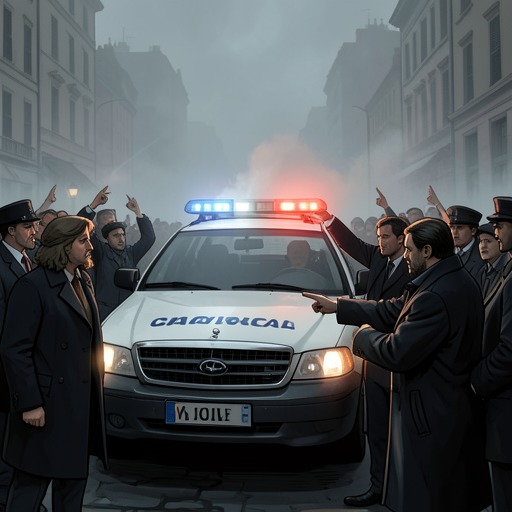
Blackeberg’s inhabitants do not share a single interpretation of what is happening. Lacke’s sense that the suburb itself is diseased gives voice to a broader unease, but other passages remain grounded in practical details: a patrol car in a courtyard, a bottle of T-Rod flammable liquid by a basement door, and a resident trying to infer what to do next. The same courtyard that once promised protection can become a place where police wait and a private decision has to be made.
The suburb is also where the consequences of violence become visible to people who were not present when it began. An ambulance carrying Virginia passes through the area with Lacke beside her, holding her wounded hand while a technician adjusts the saline tube. Elsewhere, Larry and Morgan travel toward Sabbatsberg as a police officer waits outside the greenhouses; the case continues to unfold beyond the immediate sites of the crimes. These journeys connect Blackeberg to the wider city without dissolving its local focus.
The place’s significance lies in this collision between planned normality and events that resist ordinary explanation. Its housing, subway, school, shops, and paths are the substance of daily life, not a remote gothic setting. Yet concealment, disappearance, and the arrest of a suspected killer take shape inside that familiar design. Blackeberg’s carefully arranged spaces promise shelter and order; the story repeatedly shows how fragile that promise becomes when danger moves through the same streets and buildings as everyone else.