Blood feeding
Let the Right One InBlood feeding connects the novel’s investigation of an unexplained killing with Eli’s dependence on blood. The evidence first appears indirectly, through the equipment prepared around a dead boy and a later theory that the killer sought blood; it becomes immediate when Eli feeds from a man who has mistaken her approach for affection.
From Suspected Motive to Revealed Need
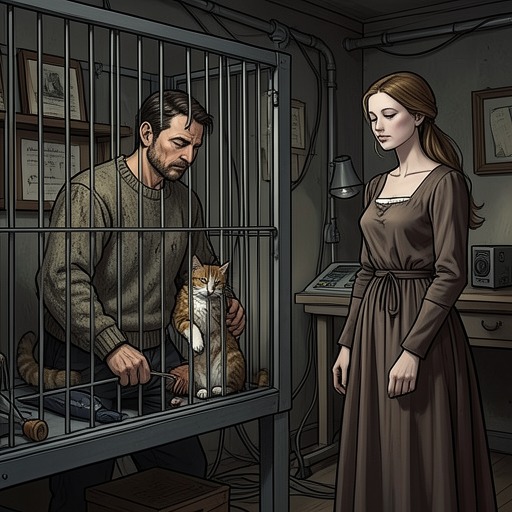
The early account keeps the purpose of the killing uncertain. After looking once more at the boy’s body, the killer lays out a knife, rope, large funnel, and five-liter plastic jug, then begins work with the rope. Later, someone distinguishes this death from an ordinary murder because the victim was found hanging in a tree. Another speaker proposes that the killer wanted blood and took it away. At this stage, blood feeding is not yet identified with Eli: it is a conjecture that gives the investigation a possible motive while leaving the person responsible and the meaning of the collected equipment unresolved.
Eli’s Feeding and Its Human Cost
The earlier suspicion that the killer sought blood becomes concrete when Eli approaches a man who does not recognize her as a threat. As he turns toward the restaurant, preoccupied with the new life he imagines beginning, he treats her closeness tenderly; only when she feeds does he understand that something is wrong. He cannot put the child he is carrying down, and the encounter ends with him collapsing among the leaves. The contrast between his hopes for an ordinary future and Eli’s urgent need for blood makes feeding both a survival act and a lethal violation of another person.
Afterward, Hakan finds the man beneath the underpass. Eli’s pink sweater has been left on the body, and Hakan recognizes the wound at the neck as the one she made to reach the blood. His discovery connects the earlier unexplained killing to Eli’s feeding, while the discarded sweater links the scene to her and to Hakan’s personal care for her. His baffled response to what has happened underscores the gap between knowing that Eli needs blood and understanding the violence through which that need is met.
The Unanswered Question
Hakan’s discovery does not make every part of the killing intelligible. He recognizes the neck wound as Eli’s means of reaching the blood, but his final bafflement concerns what was done to the man’s head—a separate detail for which this passage supplies no explanation. That unresolved question limits any neat account of feeding as a simple act of need: the scene links Eli’s dependence on blood to a death, while leaving part of the violence around it unexplained.
Blood as Evidence and Limit
Across these scenes, blood feeding is made legible first through material clues and only later through an act witnessed at close range. The knife, rope, funnel, and plastic jug suggest preparation for collecting blood; the later account of a victim found hanging and the theory that blood was taken turn those objects into clues, not proof of who used them. Eli’s feeding supplies a concrete instance of blood being sought, and Hakan’s recognition of her role ties that instance to the investigation’s concern. The connection is suggestive rather than exhaustive: the evidence establishes a pattern of blood-seeking and identifies Eli’s need, but it does not explain every feature of the deaths or settle Hakan’s final question about the man’s head.