Cats
Let the Right One InGosta’s cats are more than the unruly population of his apartment: when Virginia arrives, the household animals turn suddenly and collectively against her, transforming a shabby domestic interior into a scene of uncanny violence. Their attack exposes how little Gosta understands what is happening, forces Lacke into a struggle between protecting Virginia and fighting the cats, and continues into the stairwell as Virginia falls. The one cat that remains behind, a small gray animal with impaired hind legs, ends the episode in sorrowful isolation.
The crowded household
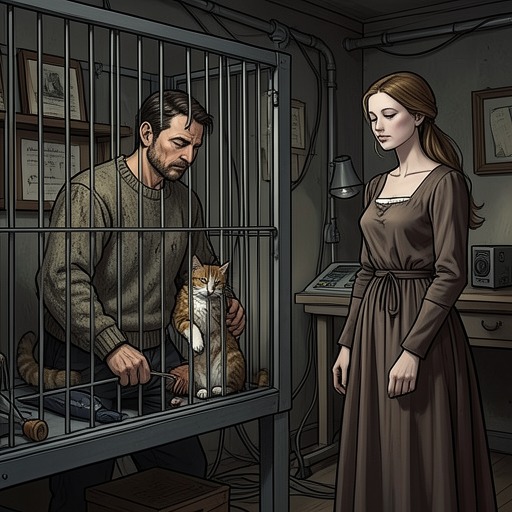
The cats fill Gosta’s apartment to an extraordinary degree. An orange carpet is so covered in cat hair that it seems made of it, and Lacke counts eighteen cats in the room alone. That number is not the total: cats also occupy other parts of the home, and more stream in from the bedroom and kitchen when the confrontation begins. Their presence is constant enough to shape the apartment’s atmosphere before they become a physical threat.
One of the animals is Miriam, a large gray-and-white cat lying flat on the floor and apparently too weak to lift her head. Gosta explains that she is soon to have kittens. Her pregnancy is visible in her belly, which later drags against the floor when she struggles to stand. She is therefore introduced as a vulnerable, heavily burdened animal; during the attack, however, she takes part alongside the others.
The exchange about the cats’ numbers and care shows a divide between Gosta and Lacke. Lacke asks what Gosta does with the kittens and suggests having the animals sterilized, but Gosta looks at him without understanding. The scene supplies no indication that Gosta has a plan to reduce or manage the growing population. Instead, the cats remain an enveloping part of his domestic life, a fact that makes their sudden movement as a group all the more striking.
The attack on Virginia
The cats’ response changes in stages. They begin hissing and spitting; then all those in the room stand, arching their backs and puffing out their tails as they look toward Virginia. Even Miriam clambers upright, pulls her ears back, and bares her teeth. The reaction spreads beyond the animals already present: cats pour in from the bedroom and kitchen, while the hissing intensifies until Lacke has to shout to be heard. Gosta, holding a bottle, can only stare and say he has never seen this happen.
A little black cat named Titania makes the first explicit physical attack, leaping onto Virginia’s thigh, digging in its claws, and biting. When Gosta reprimands Titania, Virginia bends to pull the cat away. That movement leaves her exposed: two others jump onto her back and neck. She screams, tears Titania from her leg, and throws the cat across the room; it strikes the edge of the table and falls at Gosta’s feet. Meanwhile, another cat clings to Virginia’s head and makes repeated dives at her forehead.
The assault quickly becomes a mass attack rather than a single animal’s aggression. Before Lacke reaches Virginia, three more cats have joined in. She punches at them, but they remain attached, tearing her flesh with their small teeth. Lacke thrusts his hands into the writhing mass across her chest and pulls at the animals, whose bodies slide over her tensed muscles. Her blouse is ripped as the cats continue to cling and bite. The contrast between their small size and the damage they inflict makes the ordinary household swarm frighteningly difficult to control.
Gosta and Lacke amid the swarm
Lacke tries to tear the cats away in a panic. The few he succeeds in removing take strips of Virginia’s clothing and leave deep cuts; most stay attached like leeches. He hears bones crack as he hits them, but removing one animal does not end the assault: another takes its place, climbing over the others. The room’s congestion has become a tactical advantage for the cats, whose numbers renew the attack even as Lacke tries to interrupt it.
Gosta turns against Lacke when he sees him hurting the animals. He strikes Lacke in the face and cries that Lacke is hurting them. Beside him, Virginia is still covered in mewling, hissing fur. Miriam drags herself across the floor, rises on her hind legs, and bites Virginia in the calf. Gosta notices and rebukes Miriam rather than treating the attack as part of the wider danger. His protective attention remains fixed on the cats even while Virginia is being mauled.
Lacke’s response hardens into violence. He kicks Miriam in her swollen belly, sending her against the radiator, and grabs Virginia’s arm. The scene does not describe the cats as acting on Gosta’s instructions; instead, his helpless bewilderment and subsequent defense of them sharpen the difference between the animals’ collective attack and his inability to explain it. For Lacke, the need to free Virginia overwhelms any restraint toward the animals.
The stairwell and the last cat
Virginia forces her way past Lacke and into the stairwell, with a cat’s trembling back pressed against his face for an instant as she passes. The cats’ hissing carries into the enclosed space. Lacke tries to reach her, but she relaxes and falls forward down the concrete stairs. Cats trapped beneath her howl as she rolls and bounces; the fall is marked by the sounds of breaking slender bones and heavier impacts.
A small gray cat with something wrong with its hind legs drags itself into the stairwell and sits on the top step, howling sorrowfully. At the bottom, Virginia comes to rest. The cats that survive the fall leave her, climb back up, and return to the hall to groom themselves. Their withdrawal is abrupt: the animals that moments earlier had formed a relentless attacking mass resume an ordinary act of grooming, while the human consequences of the fall remain.
The gray cat alone stays behind, mourning that it could not take part. Its final position gives the episode a starkly solitary ending. Across the scene, the cats move from background abundance to coordinated threat, then disperse into routine; the injured gray animal is the exception, left at the threshold between the violence and the household to grieve its exclusion.