Chinese restaurant in Blackeberg
Let the Right One InThe Chinese restaurant in Blackeberg serves both as a social hub for Lacke’s circle and as a portrait gallery of the people who gather there. Its ordinary rituals—beer, conversation, food, and teasingly observant pictures—give the regulars a recognizable collective life. That familiarity sharpens the unease of a Friday evening identified as the last time they will all be together: the restaurant holds a community in view just as it is about to be broken apart.
Setting and regulars
On Friday night, at a quarter to eight, nearly the whole group is present. Karlsson is the exception, staying home to watch the television quiz show Nutcrackers. The account treats his absence as unsurprising: he is imagined as the sort of person who might arrive after everything is over and announce how many answers he knew. The detail gives the gathering its informal, teasing texture while marking who belongs to this particular circle and who is missing from the table.
Lacke, Morgan, Larry, and Jocke sit at a corner table for six nearest the door. Their activities are modest but distinct. Jocke and Lacke discuss which kinds of fish can live in both fresh and salt water; Larry reads the evening paper; Morgan swings his leg in time to music different from the Chinese music playing softly through hidden loudspeakers. More or less full glasses of beer sit in front of them, while their likenesses look down from the wall above the bar. The scene is built from separate habits rather than a single group conversation: the restaurant accommodates company without requiring everyone to do the same thing.
The owner’s gallery
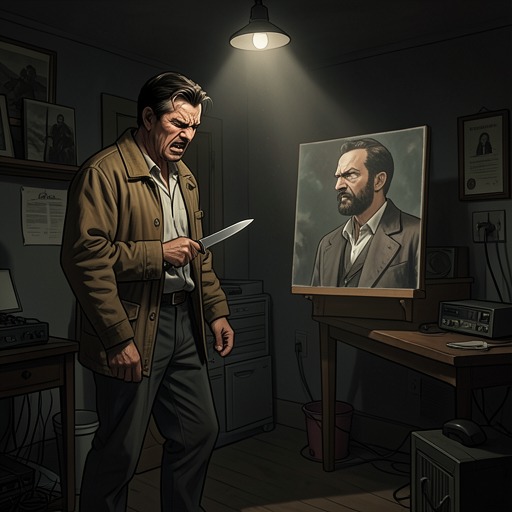
The portraits are the work of the restaurant owner, who fled China in connection with the Cultural Revolution because of his satirical caricatures of people in power. In Blackeberg, he has redirected that skill toward his regular customers. Twelve felt-pen sketches hang on the wall, tender in execution but pointed in their attention to physical irregularities. The men appear in close-up, their features exaggerated; Larry’s lined, hollowed face and enormous projecting ears make him resemble a friendly, starving elephant.
Jocke’s joined eyebrows become a rose bush and perhaps a nightingale. Morgan, pleased by his likeness despite not wanting to show it, is rendered with the sideburns and expression of a young Elvis, his head set on a small body holding a guitar. Lacke’s enlarged eyes intensify his worried, suffering look; the cigarette in his mouth sends smoke into a rain cloud above his head. The portraits do not merely identify the regulars. They translate recognizable faces into comic emblems, making the wall a record of how each person is seen by the owner and, through the owner’s pictures, by the group.
Virginia is the exception to the men’s close-up treatment: she is shown full-length in a sparkling evening gown, arms outstretched, with pigs gazing at her in bewilderment. At her request, the owner makes a duplicate, which she takes home. The image thus passes beyond the restaurant wall into Virginia’s private space, while preserving the scene’s mixture of affection, spectacle, and absurdity. Her portrait is both part of the regulars’ shared gallery and something she specifically chooses to keep.
Gathering, news, and separation
The restaurant’s ordinary sociability gives way to news when Larry lowers the paper, removes his reading glasses, and asks what might be going on inside a person like the man in the story. The headline reads CHILDREN IN SHOCK, above a photograph of Vällingby school and a smaller inset of a middle-aged man. Morgan points to the image and asks whether that is the man. The paper brings a disturbing public event into the group’s familiar setting; the friends respond together, first looking at the report and then considering the person pictured.
When the conversation turns to the man at another table, Lacke looks to Larry and Jocke. They make small gestures of assent, and Lacke gets up, approaches, and greets him. That brief movement—from the friends’ corner table toward a solitary diner—makes the restaurant more than a backdrop: it is the place where the group’s shared judgment turns into an individual approach. In a later restaurant scene, Morgan works his way through Four Small Dishes while mostly neglecting the rice beside him; Lacke leans forward to ask if he can have it, and Morgan offers sauce as well. The small exchange returns the setting to the everyday ease of food passed between companions.
Yet the Friday gathering is already marked by its ending. The narration makes clear that it will be the last night the whole group ever spends together: the next day, one of them will be gone forever, and one more portrait will survive only as a memory. The restaurant’s wall of likenesses makes that loss especially tangible. It has fixed the regulars in ink, but the people themselves cannot be held in place; after this evening, both the group and the meaning of its familiar gallery will have changed.