Danderyd Hospital
Let the Right One InDanderyd Hospital is a guarded medical institution whose rooms and corridors become part of the crisis surrounding Hakan and the aftermath of the case identified in the press as the Ritual Killer. The hospital holds Hakan under treatment and surveillance, but it cannot keep him there: his attempted escape turns a ward into the scene of an emergency. Elsewhere in the building, the night staff’s ordinary routines and the movement of bodies toward cold storage place that crisis inside a larger system of care, security, and investigation.
Setting and Night Routine
Late at night, the hospital’s scale is especially visible from its nearly empty entrance hall. Maud Carlberg sits at reception while the cafeteria and kiosk are closed and only occasional visitors pass through. She imagines herself as the sole guardian of the enormous building, although she knows that pressing a button would bring a night guard within three minutes. The gap between her private fantasy and the actual security arrangements gives the hospital two simultaneous characters: it is quiet enough to invite imaginative play, yet staffed and monitored even when it appears deserted.
Maud uses the long hours to invent a life for the next person who approaches her desk. She supplies an imagined profession, home, background, and perhaps an illness, then fits those details to the visitor. One example is a pilot with two dogs cared for by a neighbor and a strange fear involving little green figures in the clouds. The game does not alter the hospital’s work; it is Maud’s way of passing time at a post where she watches the public edge of a much larger institution. The imagined lives contrast with the people who arrive carrying urgent, often unknowable circumstances.
Hakan’s Treatment and Confinement
Hakan is kept in a room high above the ground, with trees visible outside his window. Doctors and nurses attend him, and at least one police officer is nearby. His isolation is practical as well as emotional: he thinks that he and Eli cannot reach one another, and he cannot see how to escape or make contact. The hospital’s height and constant supervision turn the window into both a view outward and a boundary he cannot readily cross.
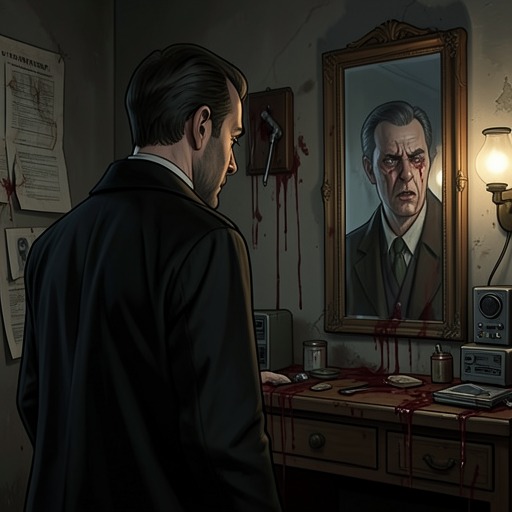
Treatment has restored some independence but leaves him dependent on equipment and care. After an operation on his throat, he can breathe without a respirator, yet he cannot swallow food normally and still has a feeding tube in view. Pulling it out would trigger an alarm. His vision is poor, and a plastic surgeon has transplanted skin from his back to his eyelid so that he can close his eye. These details make the room more than a generic place of recovery: Hakan’s limited mobility, impaired sight, and reliance on medical intervention shape what escape can mean for him. He contemplates it, but the conditions of his treatment make it seem almost impossible.
The guard assigned to his room is a young policeman brought in after hospital staff objected to having one of their own kept constantly on guard duty. A coded lock secures the door, and the officer’s confidence in that barrier helps explain why he falls asleep. The arrangement exposes a weakness within an otherwise layered system: medical staff, police presence, and a locked door are all in place, but the guard’s inexperience and fatigue leave the room vulnerable at a decisive moment.
The Attempted Escape and Emergency
When the guard wakes, he finds that Hakan is no longer where he expects him to be and sees him at the window. He runs for help, struggling to get out the words that an emergency has occurred and that there has been a murder; he also radios the station for reinforcements. A nurse leaves her office and goes toward the room. She has prepared herself for the possibility of a body inside, but instead finds an empty bed and movement at the window. She reaches for Hakan’s hospital gown as he is already partway out, but cannot stop him from going over the sill.
The sequence turns the hospital’s safeguards into part of the action. The coded door delays movement through the room; the guard must decide how to summon help; the nurse arrives in time to try to intervene but not to prevent the escape. Hakan’s room, previously defined by treatment and enforced stillness, becomes the point from which the institution’s control fails. The incident also changes the meaning of the window: it had framed his separation from Eli, but now becomes the route of his attempted departure and the focus of the staff’s response.
Corridors, Identification, and Aftermath
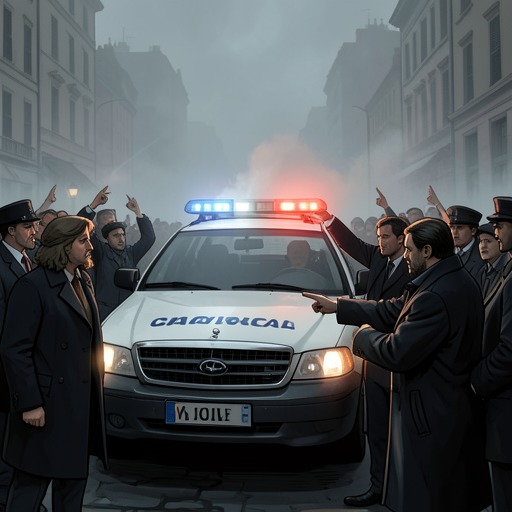
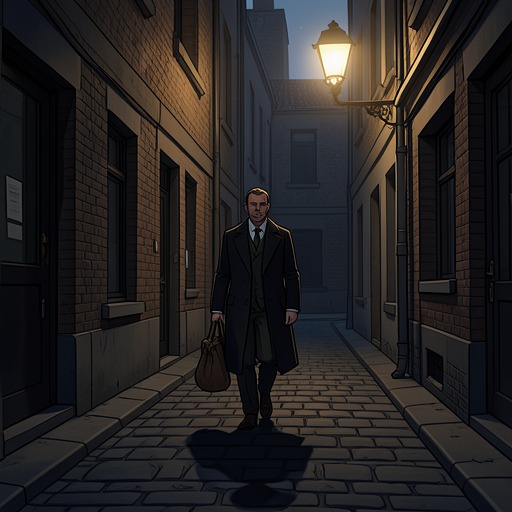
The hospital’s less public corridors carry the consequences of that event into the routines of death and investigation. Benke Edwards wheels a gurney through silent passages toward cold storage. The squeak of its rubber wheels is the only sound described; visitors are rare in this restricted area and, when present, are accompanied by staff. Benke has waited outside while Police photograph the body, while members of the press take pictures from beyond the restricted area. The narrative anticipates that the images will appear in newspapers with a dotted line showing the fall, converting a hospital incident into a public account.
On the gurney is the man the papers have called the Ritual Killer, now treated as a body awaiting the next stages of examination and transport. The label that made him a notorious figure does not travel with him as an identity the hospital can verify; under the sheet, he is reduced to the practical fact of a patient—or, now, a body—being moved through institutional space. That contrast makes the corridors a threshold between public spectacle and clinical procedure. The press watches from outside, while staff continue the work inside.
The investigation also unsettles the hospital’s apparent separation between cases. A pathologist who arrives early to examine the Ritual Killer’s body is confronted with a new case: remains tentatively assumed to be Benke Edwards, an assumption based on a wedding band engraved with Gunilla’s name. His coworkers know that Gunilla is Benke’s wife but cannot bring themselves to call her while the identification remains uncertain. The pathologist’s preliminary assessment of the remains prompts substantial mobilization by Police and a determination that the offender was exceptionally violent. In this way, the hospital is not simply a destination after the crisis. It is where treatment, guarded custody, uncertain identification, forensic judgment, and the circulation of news converge, each supplying a different account of what has happened.