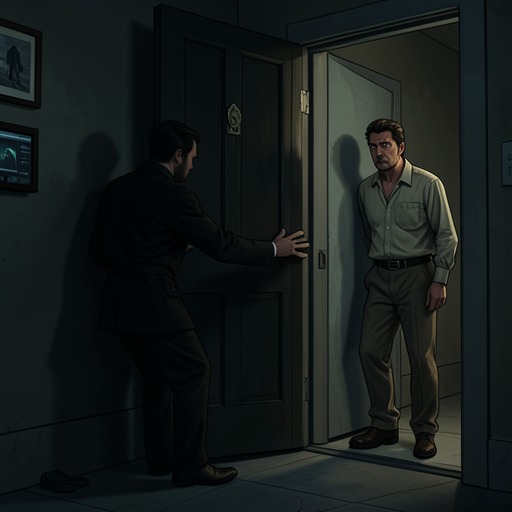
Eli buys blood from Tommy
Let the Right One InEli buys blood from Tommy by offering him money, making an urgent need into a transaction between two young people who do not share the same understanding of its stakes. Tommy accepts the exchange after questioning what Eli wants and how much blood she intends to take; he then watches her use a razor blade and drink from his arm. The scene joins money, secrecy, and bodily risk, while leaving the cost of the bargain deliberately unequal: Tommy can count the bills, but Eli’s need is a matter of survival.
The Offer and Its Conditions
Eli first asks to come in, and Tommy gives permission. She then insists that he say explicitly that she may enter. The pause gives the threshold its own importance: this is not an unannounced visit but an entry Tommy must authorize, a small domestic exchange that carries more weight for Eli than an ordinary invitation would. Her insistence also delays the transaction, making clear that the terms of her presence matter before the terms of the sale.
Once inside, Eli opens a case and lays three thousand-kronor notes on the floor. Their size against her small hands catches Tommy’s attention, but the amount alone does not explain what she is buying. When she names blood, he initially treats the proposal as implausible and says he does not have any. Eli answers that he does. The exchange moves from a strange display of money to a specific request, though Tommy still has to decide whether he will accept it.
Tommy tries to make the deal intelligible on his own terms. He asks what will happen if he agrees, and Eli requires him never to tell anyone. He looks from the money to his outstretched arm and asks how much she plans to take. Eli specifies one liter. When he questions whether that is a lot, she tells him that the blood comes back. The answers do not remove the danger or uncertainty, but they give Tommy concrete terms to weigh: the amount, the promised recovery, the secrecy, and the cash.
Tommy’s Negotiation and Decision
The money offers Tommy a reason to continue listening even as the request unsettles him. He asks Eli for the money, and she takes the bills out again. He proposes a split payment, three thousand at once and two thousand afterward. The conversation thus becomes a negotiation rather than a simple demand: Tommy tries to set the price and timing, while Eli remains focused on obtaining blood. The scene records the proposed arrangement but does not establish that the additional payment is later made.
Tommy’s decision is marked by attention to ordinary, countable details. He looks at his arm and the notes, asks how much blood will be taken, and hears Eli’s assurance that it will return. He then nods. That gesture precedes the feeding, but it does not make the participants’ positions equivalent. Tommy accepts a bounded exchange for money; Eli seeks something she cannot replace with money or food. The bargain is voluntary in the immediate sense that Tommy agrees, yet it is shaped by an imbalance in what each needs and what each risks.
The Feeding
Eli lowers the razor blade to Tommy’s arm. The narration stays close to his perception: he watches the blade and the lines of his own body as if the procedure were happening elsewhere, then reacts when it begins. He tightens his grip on the bills. The money remains present at the moment the transaction passes from discussion into action, binding the abstract price to the physical act without making the act feel ordinary.
After the blade falls, Eli holds Tommy’s arm and drinks directly from it. Tommy turns his head away and experiences the feeding as a loss of blood and control over his body. The account emphasizes his response rather than lingering on injury: his arm begins to feel numb, and his attention shifts to what is being taken from him. The exchange has therefore crossed a line that the earlier bargaining could only anticipate. The bills are tangible and still in Tommy’s hand; the blood, once given, is not an equivalent object that can simply be counted back to him.
Significance and Aftermath
The scene makes Eli’s dependence on blood visible through an exchange that borrows the forms of an everyday purchase. Tommy asks for a price, Eli names an amount of blood, and both discuss money and secrecy. Yet the apparent clarity of those terms cannot erase the difference between Tommy’s negotiable payment and Eli’s continuing need to feed. Their transaction offers immediate access to blood, while also making Tommy a keeper of a secret he has been expressly told not to share.
Elsewhere, Oskar offers Eli a Cube to try, and she accepts it to examine from every side. That earlier gesture presents exchange as curiosity and companionship; with Tommy, money changes hands in connection with a more dangerous need. The contrast helps locate the purchase within Eli’s relationships: she can receive an object as part of an emerging bond, but her hunger requires a bodily resource from another person.
A later scene shows Eli washing while Oskar moves boxes from her balcony to his, and she emerges with healed wounds and slightly intoxicated by alcohol in the blood. The text does not identify that blood as Tommy’s, so the scene cannot establish a direct physical aftermath of this particular purchase. It does, however, show blood’s continuing place in Eli’s life and the bodily effects of consuming it. Soon afterward, lying together, Eli asks whether Oskar would want to become like her. He says no, while expressing that he wants to remain with her. Set against Tommy’s bargain, that exchange distinguishes the immediate provision of blood from the larger question of sharing Eli’s condition: the purchase answers a need for sustenance, but it does not make that need the basis of Oskar’s commitment.