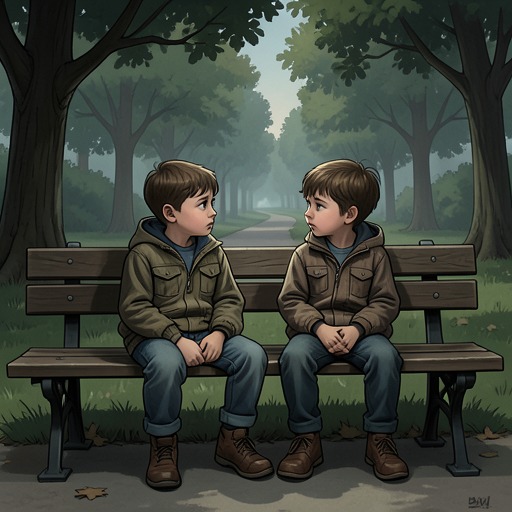
Eli makes Oskar experience her traumatic memories
Let the Right One InEli makes Oskar experience her traumatic memories by drawing him into a kiss that becomes an involuntary encounter with violence. The episode turns an effort at understanding into bodily witnessing: Oskar does not merely hear about Eli’s past but feels trapped inside a memory whose details remain with him after the kiss ends.
The Attempt to Make Oskar Understand
The exchange begins with Oskar trying to explain that he has been hurt and teased. Eli answers by connecting that pain to the desire to live, then holds out her arms, lays them against Oskar’s cheeks, and brings his face closer. Her request that he be her for a little while gives the kiss an explicit purpose: she is trying to communicate an experience that ordinary explanation cannot convey.
The gesture is tender in its physical closeness, but it is not a neutral invitation to listen. When Oskar tries to pull his head back and leave the kiss, Eli has anticipated his reaction. She cups the back of his head and presses his lips against hers, keeping him inside the memory. The scene therefore makes the transfer both intimate and coercive: Eli seeks recognition, but Oskar’s capacity to refuse the experience is overridden.
The Memory’s Violence
Inside the memory, Oskar finds himself bound to a table. A man in a wig watches him with clear blue eyes and an expression that seems almost loving, while another man crawls beneath the table carrying a knife and a bowl. Oskar understands what the second man is about to do before the assault is fully carried out. The contrast between the apparent friendliness of the watcher and the violence being prepared makes the scene especially disturbing: the victim is observed with something resembling affection even as he is subjected to harm.
The attack is rendered through Oskar’s bodily sensations rather than as a detached account. He cannot free himself or speak clearly through the rope in his mouth. He tries to scream, but the gag turns the attempt into an inarticulate cry. The pain seems to pass through his body like burning metal and fire, while his heart pounds against the table. The men’s calm actions and the victim’s helpless physical panic occupy the same moment; the memory gives Oskar no safe distance from either.
A different image interrupts the assault. Oskar sees Oskar’s mother at a stream, rinsing clothes, and runs toward a piece of cloth that has fallen into the water. He retrieves his sister’s shirt and lifts it toward the light, but water runs into his eyes and blurs what he sees. The memory then returns to the blue-eyed man and the bowl, which he raises to his mouth and drinks from. The abrupt shift to the stream does not resolve the violence; it breaks the experience into images of pain, running water, family, and the man drinking, before leaving Oskar to absorb the connection without explanation.
An Experience That Persists
When the memory releases him, Oskar recognizes Eli as the person who had been in his arms and identifies her as a boy and his friend. The recognition arrives amid physical distress rather than calm reflection: he feels sick and dizzy, frees himself from Eli’s arms, and sits on the couch, looking around to reassure himself that he is back and not in the place he has just experienced.
What unsettles him further is the memory’s vividness. Oskar can recall every detail—the funny man, the bowl, the pain—and experiences the scene as if it were real and had happened to him recently. The transfer thus leaves a consequence beyond the moment of contact. Eli’s past has become something Oskar remembers from within, even though he knows that he has returned to the couch and that the memory was not his own life as ordinarily experienced.
Apology and Recognition
Eli kneels before Oskar with her hands pressed against her stomach. Her hands tighten until the knuckles whiten, and her shoulders draw upward before she relaxes and apologizes. She says she does not know why she did it, asks to be excused, and calls the whole thing stupid. Her words acknowledge that the attempt to make Oskar understand has gone too far, but they do not undo the experience she has imposed on him.
Afterward, Oskar notices Eli’s resemblance to his own mother: Eli seems thinner, smoother, and younger, yet like a copy of her. He imagines that in twenty years Eli might look like the woman beside the stream, then recognizes the limit of that comparison: Eli will not grow into that appearance and will remain as she is now. The thought links the memory’s family image to Oskar’s changed perception of Eli, while underscoring how unlike an ordinary human future her condition is. Exhausted, with an incipient headache pressing at his temples, Oskar leans back as Eli stands.
Significance of the Scene
The episode changes the terms on which Oskar can know Eli. Before the kiss, her pain is something she tries to explain through their shared need to survive being hurt; afterward, he carries a detailed, bodily recollection of violence associated with her past. The movement from speech to touch and from touch to involuntary memory makes understanding an action with a cost, not simply an exchange of information.
The scene also holds intimacy and violation together without treating them as interchangeable. Eli’s embrace and kiss bring the two closer, but her decision to hold Oskar in place after he tries to withdraw makes the closeness frightening. Her apology and his exhaustion preserve that tension rather than settling it. The memory has been shared, but the way it was shared leaves Oskar shaken and leaves Eli confronting the harm caused by her attempt to be understood.