Forest and clearing near Blackeberg
Let the Right One InThe Forest and clearing near Blackeberg is a wooded space at the edge of a park path, but the narrative gives it several sharply different meanings: a concealed staging ground for Hakan, a site linked to a child’s death, and a place where Oskar’s fear gives way to a sense of belonging. Its recurring landmark, a hollow with a tree in the middle, joins these episodes without making the forest merely a passive backdrop.
Setting and access
The forest begins beyond a bend in the park path. Oskar recognizes it as the woodland he has seen on a map, a small act of orientation that makes the route feel at once familiar and newly consequential. As he walks toward it, the bag he carries contains a gas canister and a knife. He tries to keep its contents from rattling: the path is not simply a walk into nature, but an approach made tense by the equipment and the care needed to conceal it.
The forest’s layout also gives it practical value. Hakan finds a position from which he can watch the path in both directions, then hides his equipment farther among the trees in a sheltered hollow. The path and hollow serve distinct purposes: one exposes approaching passersby to observation; the other keeps the equipment out of sight. The location’s danger therefore develops from its arrangement, rather than from any supernatural quality attributed to the woods.
Hakan’s preparations
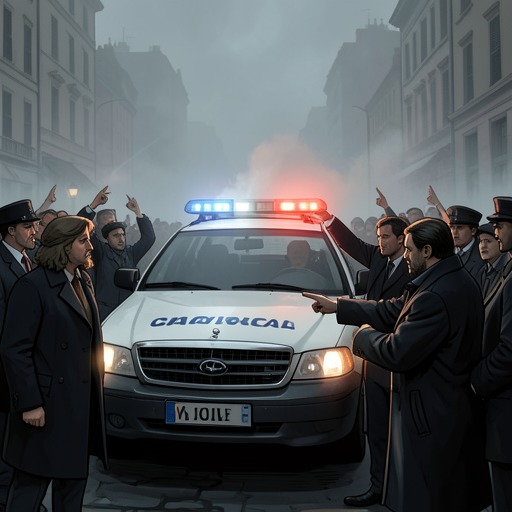
Hakan waits beside the path for someone he considers a suitable target. When an older man approaches with a dog, he weighs the complications and rejects the encounter. The episode establishes that the forest is populated and traversed, not wholly isolated: ordinary people can pass through it, interrupting the plan. Hakan’s watch position gives him a view, but not control over who appears or when.
A child then turns onto the path, walking home from school with a schoolbag. The sequence ends in an emphatic refusal. The evidence does not explain the refusal at length, but its placement gives the moment weight: Hakan’s preparations have brought him into proximity with a child, while the sudden rejection marks a limit on what he will do in this encounter. The forest thus becomes the setting for a choice as well as a concealed operation.
The hollow and the reported crime
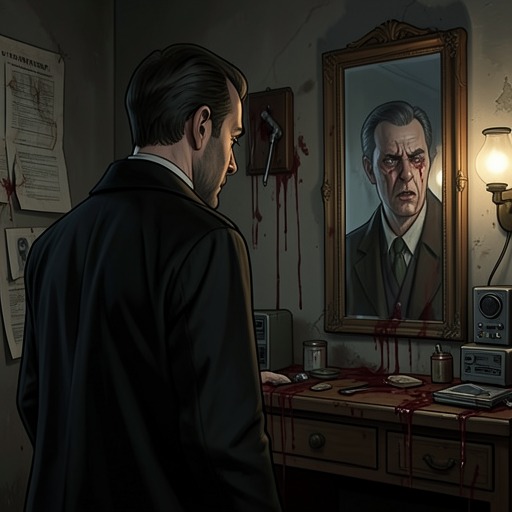
A later newspaper report describes a boy’s body found in the woods, in a hollow with a large tree in the middle. A sixteen-year-old girl discovered the body at around eight in the evening and contacted the police; the report says she was in extreme shock. The article gives little information about how the boy was killed, but includes a photograph of the wooded crime scene, where police tape marks the area.
The hollow described in the report closely corresponds to the protected hollow in which Hakan had left his equipment: both are set among trees and identified by a tree in the middle. That repeated landmark creates a strong spatial connection between Hakan’s preparations and the reported crime scene, although the account here does not spell out every step linking them. For Oskar, the photograph makes the sparse report more unsettling. He has collected similar cases in his scrapbook and anticipates the candles and messages of mourning that may soon appear at the site. His thought that the coincidence might mean something turns the hollow from a location in a news image into a possible clue.
Oskar’s changing sense of the woods
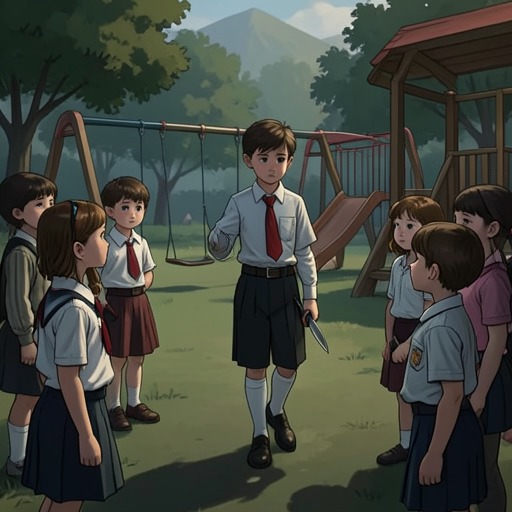
The forest also frames Oskar’s private violence. After attacking a fallen tree that he has treated as the image of Jonny, he wipes the remaining blood from his knife and walks home. The trees, which for years had seemed threatening and associated with enemies, now appear to draw back as he passes. The change is immediate and specific: although darkness is gathering, he feels no fear and no anxiety about the next day, and expects to sleep well.
That new ease does not amount to a simple reconciliation with the place. Oskar returns to the edge of the yard and sits by the sandbox to calm himself before going indoors; he also plans to obtain a better knife because he intends to repeat the act. The forest has become a refuge in his perception at the very moment that his conduct there is turning into a pattern. Its significance lies in this tension: it shelters concealment and violence, holds the trace of a public tragedy, and offers Oskar a temporary release from fear. The familiar trees do not make his actions harmless; they mark how radically his relation to danger has changed.