Gosta
Let the Right One InGosta is a reclusive, heavily burdened cat owner who becomes a reluctant witness to Jocke’s disappearance. His home is crowded with animals, many of them disabled by congenital conditions, and his account of a child waiting in the underpass gives Lacke and Larry a reason to investigate what happened to their missing friend. Gosta’s importance lies in the tension between what he believes he saw and how difficult he finds it to tell anyone.
Home and the Cats
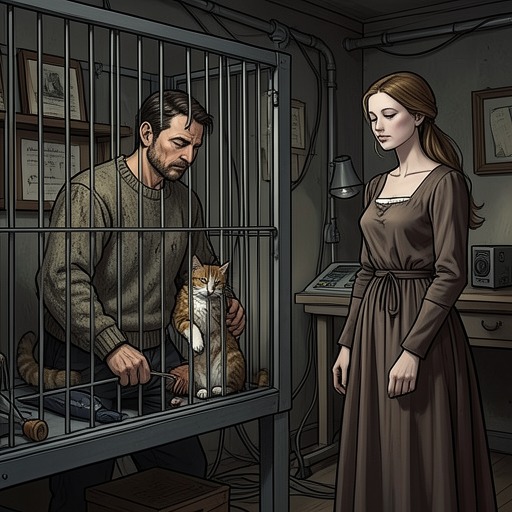
Gosta’s apartment reeks of cat urine, but its disorder is also a living community that he loves. Giselle purrs on his lap while Bibi and Beatrice wrestle on the floor. Manfred sits at the window with his nose against the pane as Gustaf tries to get his attention; Mans, Tufs, and Cleopatra occupy an armchair. Elsewhere, Karl-Oskar misses a jump to the windowsill and falls backward, blind in one eye. Lurvis waits by the mail slot, ready to attack advertising, while Vendela watches from the hat shelf, her deformed right front paw hanging between its slats. Other cats eat or laze in the kitchen, sleep on the bed, or shelter in cupboards and closets they have learned to enter.
The scale of the household makes Gosta’s devotion concrete: twenty-eight cats live in the apartment, and he loves them all. Yet their conditions also show the cost of the arrangement. After pressure from his neighbors led him to stop letting the cats outside, no new genetic material entered the population. Most kittens were stillborn or died within days, and about half the adult cats had congenital defects, including blindness, deafness, missing teeth, and motor damage. The apartment is at once a refuge Gosta maintains for them and a closed environment in which their vulnerability continues.
What Gosta Saw
Gosta believes he witnessed the beginning of the violence against Jocke, though he is careful, when speaking to others, to qualify what he actually saw. In his account, a child knocked out the streetlight nearest the underpass with a rock, then hid inside and waited. Jocke went into the underpass and never came out. The following morning, Gosta noticed a faint imprint of a body in the dead leaves. He concludes that Jocke is dead, even though he did not see the killing itself or directly witness what happened after Jocke entered.
In private, Gosta revisits the scene while speaking to Giselle. He insists that Jocke is dead and that he knew him, but recognizes that no one else knows what he believes because they did not see what he saw. The conversation gives his certainty an uneasy shape: he is convinced of the outcome, yet the evidence available to him is a child’s presence, Jocke’s disappearance, and the trace in the leaves. He asks his cat whether she saw it too, making the animal a listener to a knowledge he has not yet been able to share with people.
Reluctance to Report the Disappearance
Gosta’s certainty does not translate into action. He says he cannot go to the police because he expects questioning, a crowd, and a demand to explain why he did not speak up sooner. He imagines the scrutiny of a light shone in his face. His account of the delay is imprecise: he thinks the event was three or four days earlier and cannot say what day it is. The lapse is not presented as indifference to Jocke; Gosta says he knew him and that he is dead. Rather, Gosta is caught between the pressure to report what he believes and his dread of the attention and questions that reporting would bring.
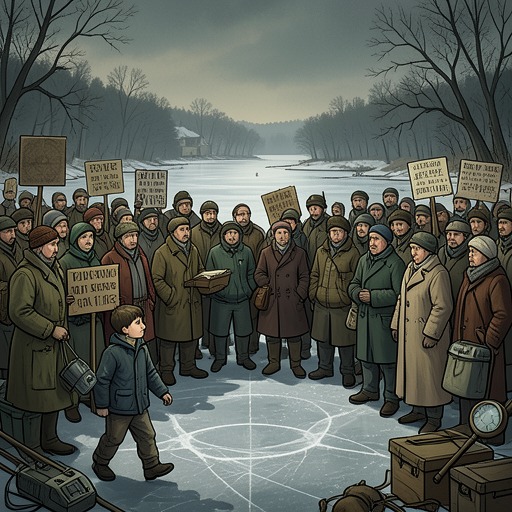
When he finally enters the gathering attended by Larry, Lacke, and others, Gosta is a startling presence. Larry has spoken with him outside the apartment buildings but has never seen him come inside; Morgan calls him the Stinkbomb. Gosta looks shaken, squints, and moves as though his body might come apart if he makes the wrong move. The narration leaves open whether he is very drunk or sick. When asked what brings him there, he offers Jocke’s name and says that he is dead.
Testimony and Consequences
Gosta first tells the group that he has not been able to make himself act, then qualifies his claim by saying that he did not exactly see the killing, although he knows what happened. As he relates the child’s attack on the streetlight, the wait in the underpass, Jocke’s entrance, and the mark in the leaves the next morning, Lacke covers his face and whispers that he knew it. Larry responds by placing a hand on Gosta’s arm and proposing that they go look. The account moves Gosta from isolated witness to participant in the search, and his evidence gives the group a concrete place and sequence to pursue.
Later, when Gosta is again among the group and already quite drunk, he asks whether they know what has happened. After they say they do not, he tells them that Jocke has been found that day. The update marks a change in the status of the disappearance: what Gosta had privately treated as a death and then reported to Lacke and Larry has become a confirmed discovery. Across these encounters, Gosta remains hesitant and uncertain about the precise limits of his own observation, but he does not withdraw his central claim that Jocke is dead.