Humiliation
Let the Right One InHumiliation is not merely an insult imposed on Oskar; it is a way of denying his right to take up space, speak, and act. The schoolyard scenes show how the bullies make an ordinary gesture or task into grounds for control, while Oskar’s understanding of their pursuit exposes the unequal rules governing the encounter. His movement from fearful calculation toward resistance gives humiliation both its force and its limits.
Existence Made Offense
The novel traces Oskar’s humiliation to an ordinary classroom moment: he raises his hand because he knows an answer. The gesture is a declaration that he is present and has something to contribute, but the narrative presents that claim to existence as precisely what his tormentors will not permit. They attach reasons to their treatment of him, including judgments about his appearance, yet these explanations do not account for its underlying logic. In the scene’s stark formulation, the problem is not any one characteristic but Oskar’s existence itself. Humiliation works by turning the victim’s presence into an apparent offense and then treating punishment as justified.
That distinction matters because it separates the bullies’ stated excuses from the pattern the narrative reveals. Their criticisms may make the harassment sound like a response to particular traits; the deeper account instead shows how such reasons can serve as cover for a more basic denial. Oskar is not offered a fair standard he could satisfy. Even the act of demonstrating knowledge draws attention to him, and attention itself becomes dangerous. The classroom gesture therefore provides a compact image of the larger dynamic: what should establish participation in shared life is recast as a transgression.
The Pursuit and Its Rules
The narrative describes a contrast between the bullies’ experience of the chase and Oskar’s. They are carried along by the pursuit; he experiences himself as its prey. The difference is not just one of emotion. It determines how he assesses danger. Capture does not necessarily bring relief: once they have caught him, the chase’s excitement may give way to punishment carried out as an obligation. Oskar therefore worries that yielding too soon could give them more time and attention for the punishment. His fear includes a calculation of how the bullies’ behavior may change at each stage.
This understanding shows humiliation operating as a continuing threat rather than a single public embarrassment. The possibility of being caught shapes Oskar’s choices before the encounter ends, while surrender carries its own risk. The bullies control not only what happens to him but also the terms on which he tries to anticipate it. His awareness is acute, but it cannot make the situation equal: he must plan around their appetite for pursuit and their ability to prolong his punishment.
The Sandbox Encounter
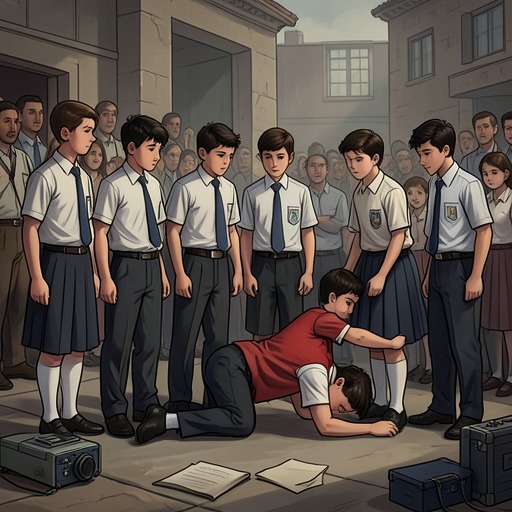
A later schoolyard episode gives that logic a concrete setting. Jonny tells Oskar to clean up the rocks scattered in the sandbox. Oskar stands still, unsure what to do, while the bell is about to ring; he recognizes that Jonny is not concerned with the sandbox itself. Johan will not help, leaving Oskar with a time-consuming task imposed on him as part of the familiar pattern. The demand turns a shared play area into a place where an arbitrary command can claim his time and leave him isolated.
As Oskar approaches the edge of the sandbox to empty some rocks, Jonny, Micke, and Tomas appear with long, thin hazel branches. Jonny points with one branch at a rock. The encounter converts the earlier demand into an immediate confrontation: Oskar has been assigned cleanup, but the rocks also become part of the group’s show of authority. The sequence binds a mundane task to a threat of punishment without making the task’s completion its real purpose. As in the classroom, an ordinary action becomes the pretext through which Oskar is reminded that others claim the right to direct him.
Resistance and the Limits of Shame
In this encounter, Oskar’s fear remains, but it no longer determines his response by itself. Once he has made up his mind, he feels a streak of calm and considers enduring the bullies’ attack in order to get an opportunity to strike Tomas with a rock. Jonny lashes him across the thigh, and Micke restrains his arms. Stated without graphic emphasis, the episode is a moment of coordinated intimidation; its significance also lies in the decision Oskar has made before the bullies take control of his movement. He is no longer thinking only about how to escape the encounter. He is willing to act against the group, although the attempt comes at a cost and does not erase the imbalance of power.
The call for Oskar not to let them continue, followed by advice to use stones and sticks more boldly than he dares, introduces resistance as something that can be urged and learned. The evidence does not identify the speaker in these brief passages, so the importance rests on the intervention itself: Oskar is addressed as someone capable of responding, not merely enduring. The shift is not a simple victory. The scene retains the reality of the threat even as it opens a possibility beyond submission.
Humiliation thus links several scales of the novel’s schoolyard experience: the raised hand that asserts presence, the pursuit that keeps Oskar calculating, and the sandbox command that becomes a confrontation. Across them, the bullies’ control depends on making Oskar’s ordinary existence seem to require permission. His emerging resistance challenges that premise, not by making him instantly safe, but by changing his position from an object of their pursuit into someone who can choose to answer it.