Jimmy
Let the Right One InJimmy, Jonny’s older brother, is presented as both a protective presence and an enforcer of family loyalty. He offers Jonny companionship, help, and a treasured link to their absent father; later, after Oskar burns their father’s belongings, Jimmy joins Jonny in confronting Oskar at the school pool. His role makes the brothers’ closeness consequential: care for Jonny becomes entangled with retaliation against someone they regard as an enemy.
Identity and Family Circumstances
Jimmy is older than Jonny and, for a time, one of the people Jonny most likes to spend time with. Their relationship has its own conditions: Jonny prefers his brother’s company when Jimmy’s more threatening acquaintances are not around. In an earlier incident, men from Råcksta came looking for Jimmy and used Jonny to deliver a menacing demand for money. Jimmy received Jonny’s message without surprise. Later, money disappeared from their mother’s wallet, followed by an angry scene. The account connects Jimmy to a risky social circle and financial trouble, though it does not establish that he personally took the money.
The family’s financial situation changes when their father, who works on an oil rig off the coast of Norway, begins sending regular child support and additional money to make up for earlier absences. Their mother speaks warmly of him, sometimes emotionally when she is drunk. Jonny’s home life has also changed with the arrival of a younger sibling and his mother’s new relationship; Jimmy is no longer home as often, and Jonny senses that there is less room for him in the family. Against this background, Jimmy’s return to spend time with Jonny carries a particular weight: he is a brother whose presence is less constant, but whose attention still matters to him.
Protection and the Family Album
At a pizzeria on Blackeberg’s main square, Jimmy notices the bandage over Jonny’s ear and asks what he intends to do about the person who hurt him. Jonny says he does not know. Jimmy offers to bring some friends and deal with the problem, but Jonny declines. Jimmy then makes his own position clear: he will give Jonny one more chance to decide what to do, but if there is another incident, he will go after the boy himself. The offer is not simply abstract sympathy. Jimmy makes a fist across the table, and Jonny bumps it; Jonny experiences the gesture as reassurance that somebody cares about him.
Jimmy’s next gesture offers a different kind of support. He has brought a thin photo album in a plastic bag, which their father left with him after a visit the previous week. The pictures show Jonny and Jimmy as young children, their mother, and their father with the children at play. One image shows their father pushing them on swings; another has Jimmy, about nine years old, beside him in an oversized cowboy hat, holding a plastic rifle. The album gives Jonny material with which to imagine a fuller version of a father he has met only twice since the man left when Jonny was four. The few pictures at home had offered little sense of him; these images let Jonny construct a more substantial family memory.
Jimmy says their father expects the album back and asks Jonny not to show it to their mother, explaining that their father may have taken it when he left. Jonny promises by repeating their fist-bump gesture. Their exchange makes the album more than a keepsake: it is a loaned connection to their father, entrusted from one brother to the other and protected by a private promise. Jimmy’s care appears here not as a grand declaration but as the act of sharing something he knows will matter to Jonny.
From Solidarity to Retaliation
Jimmy’s protective stance hardens after Oskar burns property belonging to Jonny and Jimmy, including the things they had from their father. In the aftermath, Johan speaks with Jimmy and Jonny while the brothers consider what to do. Jimmy rejects Johan’s involvement, making clear that the response is a matter between the brothers. His reasoning is anchored in the destruction of their father’s belongings, not merely in the damage to property: the loss has struck at the material record of their family and at the bond Jimmy had just extended to Jonny through the album.
The contrast with the pizzeria scene is sharp. There, Jimmy offers help but gives Jonny room to refuse it; later, he presents the brothers’ retaliation as something already set apart from outside advice. The protective promise has not disappeared, but its meaning has shifted. Rather than shielding Jonny from violence, Jimmy becomes part of a response that carries their grievance toward Oskar. The narrative shows how a gesture of loyalty can become the basis for shared escalation without suggesting that the brothers’ affection is false.
The Pool Attack and Narrative Role
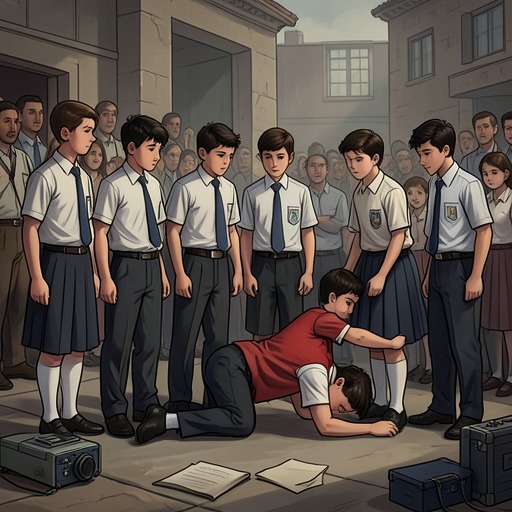
At the school pool, Jimmy takes an active role in the attack on Oskar. He approaches with Jonny, orders the other boys out of the water, and uses a stiletto to control the space and keep them away. Oskar is left alone in the pool while the other boys gather at the shallow end. Jimmy and Jonny then close in on him. Jimmy holds Oskar’s head and lays out the threat: Oskar must remain underwater for five minutes, or Jimmy will take out one of his eyes. The terms turn the assault into a forced test, with Jimmy controlling the threat and Jonny participating beside him.
Jimmy’s actions place him at the point where the brothers’ private bond becomes public violence. Earlier, the fist-bump meant that Jonny was not alone; at the pool, Jimmy’s alliance with Jonny helps leave Oskar isolated, watched by frightened classmates who do not intervene. The same capacity to stand beside his brother that made Jimmy a source of comfort now sustains an attack on someone else. The evidence here records the threat and the brothers’ actions as the scene reaches its crisis; it does not by itself establish what happens to Jimmy afterward.
Jimmy is therefore neither only a caring sibling nor only a bully’s accomplice. His shared history with Jonny, his effort to give him a sense of their father, and his insistence on defending him are concrete forms of attachment. Yet that attachment is governed by an increasingly punitive idea of loyalty: when Oskar harms Jonny or destroys the brothers’ family keepsakes, Jimmy answers by helping impose violence. His character links ordinary adolescent kinship—the meal, the photographs, the promise—to the coercive group action at the pool, showing how solidarity can protect one person while making another more vulnerable.