Kvarnviken Bay
Let the Right One InKvarnviken Bay is both a physical destination at the foot of the slopes near Blackeberg and a recurring boundary between safety and exposure. Its frozen surface becomes the scene of an assault and the discovery of a body; its dark water draws Oskar toward danger even when he is alone. Yet the bay is also familiar terrain, crossed by sled and skis and associated with fishing beside his father. The place holds menace and everyday life together rather than resolving into either one.
Setting and approaches
The route down to the bay passes Ghost Hill, whose name gives the surrounding landscape an ominous charge. In one scene, Oskar and his teacher walk a few paces in silence before reaching the hill leading down to the water. She breathes in the pine-forest air and explains a covenant as a private union between two people, independent of whether they are a boy or a girl. Oskar listens close beside her, their coats touching, as the girls’ voices approach and threaten to reclaim her attention. The conversation makes the descent toward the bay a setting for confidences as well as a path through the landscape.
The terrain changes sharply with the season. Snow, forest, and a steep downhill run connect Ghost Hill to the bay; farther below, lights from the Kvarnviken boat club mark the shore. Near the water, an opening in the ice is identifiable by small, straggly trees. These details make the bay legible as a real place with routes, landmarks, and hazards, not simply a generalized landscape of winter darkness.
The assault on the ice
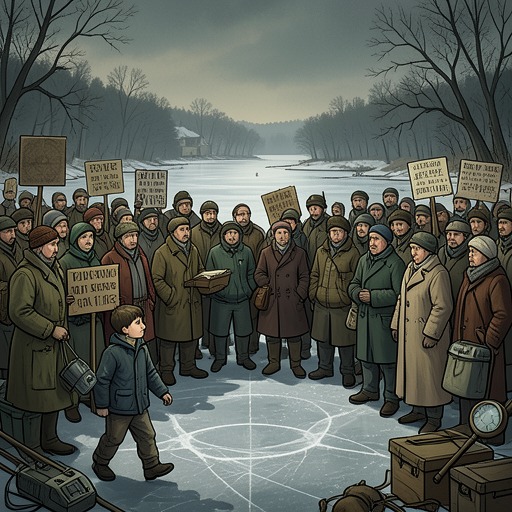
The bay’s frozen surface becomes dangerous when older boys drag Oskar backward toward a hole used for sauna bathing. His heels cut twin tracks into the snow, while the stick he drags between them leaves a shallower line. Far away, he sees tiny figures and screams for help, but the opening in the ice is only a few steps away. When he twists suddenly, Micke loses his grip; still held by Jonny, Oskar swings the stick into Jonny’s shin. The ice turns the assault into a struggle for footing and escape, with the tracks recording the direction in which the boys have pulled him.
The danger is visible from farther out on the bay, but not immediately understood. Fernando Avila, supervising children on the ice, counts his group and notices bodies gathered near what appears to be an opening. He sees a stick swing and a boy fall, then hears a howl. After checking his younger charges, he starts toward the group; the older boys seem capable of managing themselves, while his own children need his attention. That divided responsibility delays his response to the violence but also brings him close enough to hear a child’s scream from his group.
Discovery and rescue
Avila blows his whistle twice, sharply, and the children’s screams stop. He herds them toward shore, calling the one boy who remains behind out of curiosity to join the others. Once they are on land, he tells a woman from the hospital to call the police and an ambulance: there is a body frozen into the ice. The bay is no longer only the setting of an immediate threat to Oskar; it has disclosed a death that calls for emergency services.
Avila counts the children on shore and realizes that one is missing. The boy who had run into the head is still on the ice, sitting with his face in his hands. Avila glides back, lifts him by the armpits, and carries him to shore as gently as a fragile package. The rescue gives the scene a second, distinct consequence: amid the evidence of violence and death, a frightened child has to be physically brought away from the ice. The bay’s open surface lets Avila see the group, but distance, divided attention, and the frozen body make that view incomplete until he reaches the shore.
Ghost Hill and the return to the bay
Later, Oskar goes alone to Ghost Hill on his Snow Racer, despite having stayed home from school with a cold. He passes through China Park and then a hundred meters of dark forest beyond the last park lights. At the top of the descent, the Ghost House—a black wall beside the hill—seems to him to forbid entry and claim the place for unseen others. The imaginative threat follows the physical slope down toward the bay: Oskar grips the steering wheel as the sled gathers speed, afraid that closing his eyes could send him off the road and down the steep ground toward the shack.
At the bottom, he seems to drive into a transparent, sticky barrier stretched across the path. It clings to him, stretches, and bursts as his momentum carries him through. The lights glitter over Kvarnviken Bay. Oskar looks toward the spot where he knocked Jonny down the previous morning, then turns and sees the Ghost House for what it is: an ugly shack made of sheet metal. He repeatedly pulls the sled uphill and descends again, continuing until his face is a mask of ice. The sequence brings the bay back into view after the assault, but changes the immediate action from escape under attack to a solitary, repeated descent. The imagined barrier and the ordinary shack sit together in the scene: fear is experienced as physical resistance, then the threatening house is reduced to its material appearance.
The pier, water, and ordinary life
A separate approach to the bay follows an unplowed road toward Lagaro and the summer houses. Oskar skis behind his father’s moped, tracing and crossing its tracks. On the long hill down to the old steamship pier, the moped slows while Oskar travels faster; he has to brake so the rope will not slacken and then jerk when the moped accelerates again. At the pier his father brakes, but Oskar is still moving at full throttle. For a moment he considers dropping the rope and continuing over the end into the black water; instead, he angles his mini-skis outward and stops a few meters from the edge.
Thin pieces of ice have begun forming by the shore, bobbing in the small waves. Oskar wonders whether the ice might become solid enough to walk across to Vato, though he cannot remember whether a channel toward Norrtälje is kept open. The uncertainty measures the gap between the present winter and the several years since the bay last froze in that way. In summer, the same pier is a place where he fishes for herring: loose hooks and a lure can yield a couple of kilos if he has patience, though he usually catches ten or fifteen fish. That is enough for dinner for him and his father, with the smallest fish going to the cat. The contrast between possible crossing, dangerous water, and shared food makes the bay part of both Oskar’s exposure to risk and his ordinary life with his father.