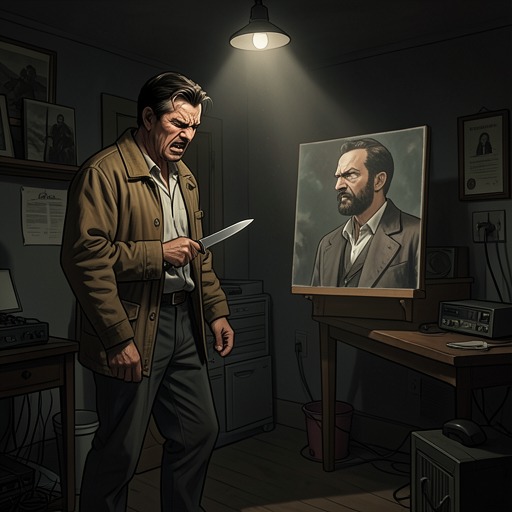
Lacke and Jocke’s friendship
Let the Right One InLacke and Jocke’s friendship is presented as Lacke’s one exceptional bond in a life where the word friend means little when applied casually. Jocke is not merely someone he misses after a disappearance: he is the only person among Lacke’s acquaintances whom Lacke had truly counted as a friend. That singularity gives the loss its force. With Jocke gone, Lacke is left not only with grief but with uncertainty about the death, and with no body to make the loss publicly and finally recognizable.
A friendship measured by its rarity
Lacke’s memories distinguish liking someone’s company from regarding that person as a friend. Virginia is the only person he likes being with in the present, yet Jocke occupies a different place in his account of his life: Jocke had been good, and was the one friend among all his acquaintances. The distinction does not diminish either connection; it shows how narrowly Lacke uses the language of friendship. Jocke’s importance is established not through a catalogue of shared adventures, but through Lacke’s insistence that there was only one person who met this standard.
That insistence also makes the loss difficult to absorb. Lacke recognizes how easily other people use the word friend, whereas his own experience has made the category scarce and specific. Jocke was not interchangeable with the people around him. When he disappears, the absence removes the only relationship Lacke identifies in those terms, leaving him with a sense of deprivation that ordinary social company cannot answer.
News of Jocke’s death
The news reaches Lacke through Gosta, who says that Jocke is dead and that he saw the killing happen. Larry remains beside Gosta, keeping a hand on his shoulder in encouragement, while Lacke asks how Gosta knows. The exchange turns the friendship’s private significance into a crisis shared by the group: the people present now have to respond both to the report of Jocke’s death and to the account of someone who witnessed it.
Larry approaches Lacke and expresses sympathy. Lacke waves him away defensively, but does not let the conversation end with condolence. He asks whether they are going to find the person responsible. The others avoid his gaze; Larry nearly says that doing so will be difficult, perhaps impossible, but stops. Morgan then puts an arm around Lacke and promises that they will get the culprit. The assurances cannot undo the loss or establish what happened beyond Gosta’s testimony, but they show the group trying to meet Lacke’s demand for action rather than leave him alone with grief.
Grief without a body
Later, Lacke returns in thought to the fact that Jocke’s body is missing. For him, the absence is not a minor practical detail. A funeral should take place, and there should be a corpse that can be seen and recognized as his friend. Without that confirmation in material form, the death remains at once known and difficult to accept: Gosta has said he witnessed it, but Lacke is denied the ordinary act of facing the body and acknowledging that Jocke is dead.
The missing body therefore prolongs the loss in a particular way. Lacke is not simply mourning a friend whose death has been settled; he is also confronting an absence that offers no ritual conclusion. His eyes fill with tears as he thinks of Jocke and of the injustice that this one friend has been taken from him. The grief is inseparable from the need for an explanation and from the need for a recognizable farewell.
Explanation, suspicion, and the meaning of the bond
Lacke accepts that Gosta is not lying or inventing the story, yet the reported killing still seems meaningless to him. He reaches for drugs as the only reasonable explanation available to him, imagining that Jocke may have become involved in drug-related dealings and crossed someone who then killed him. This is Lacke’s attempt to impose a cause on a death that has arrived without a body and without a satisfying account. His suspicion remains conjecture, not a revealed answer; the evidence gives the reader Lacke’s effort to understand, rather than confirmation of what Jocke may or may not have done.
His question about why the killer had to take Jocke makes the emotional stakes plain. Lacke is not responding as a detached observer weighing a case. He is trying to reconcile violence and apparent senselessness with the singular value of the person lost. The friendship’s importance is thus made visible through the shape of Lacke’s response: his resistance to consolation, his demand that someone be found, his tears, and his search for a cause. Jocke’s death leaves the one friend Lacke acknowledges with neither a proper farewell nor a reason he can trust, and the gap between what he knows and what he can explain becomes part of the loss itself.