Morgan
Let the Right One InMorgan is one of the regulars who gather around the Chinese restaurant in Blackeberg, a man whose joking irreverence sits alongside a stubborn sense of loyalty. He is not presented as a leader or a man with a settled career: he works intermittently at an auto scrap yard, and his role becomes clearest in small acts of speech and companionship. When Jocke disappears, Morgan’s humor does not erase the seriousness of the loss. He insists that the group continue to speak of Jocke as a person, not reduce him to a body, and his later actions show that the banter among the regulars is also a form of attachment.
Identity and Social Position
Morgan belongs to a loose circle that includes Lacke, Larry, Jocke, Karlsson, and Gosta. The men meet at the Chinese restaurant in Blackeberg, where their conversations unfold around beer, food, newspapers, and the concerns of ordinary life. Their circumstances are uneven. Larry has taken early retirement, Karlsson describes himself as the only one with a real job, and Morgan works off and on at an auto scrap yard. That intermittent employment places him among the group’s financially insecure members, rather than outside its troubles as a detached observer.
His manner is physically relaxed and socially quick. At the restaurant he swings his leg to music that is not the music playing over the speakers; elsewhere he leans back with his legs apart and his hands knitted behind his head. Those gestures accompany a habit of taking the conversational initiative, especially when Karlsson arrives and the familiar teasing begins. Morgan’s ease is not the same as indifference. The narrative repeatedly sets his jokes against moments when he notices another person’s distress or challenges the group’s evasions.
The Restaurant as a Social World
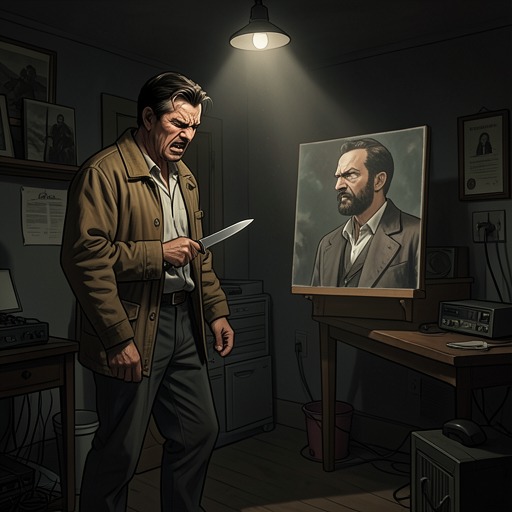
The regulars’ portraits on the restaurant wall give their gatherings a visible, affectionate record. The owner, a former satirical caricaturist, exaggerates the men’s features: Morgan is rendered with traits of the young Elvis, complete with sideburns, a guitar, and a small figure posed like a performer. Morgan likes the picture more than he lets on. Its playful transformation makes him briefly larger than his ordinary circumstances, while the fact that he conceals his pleasure preserves the guarded, joking manner he shows among his friends.
The restaurant is also where the group’s talk can turn from familiar teasing to genuine unease. When an unfamiliar man sits alone and rapidly orders several whiskies, Morgan registers the intensity of the scene with a low whistle and a dry remark. He does not approach the man or claim to know what has brought him there; he watches with the others as the man drinks and pays. The moment establishes Morgan’s alertness to shifts in the room, but also the limits of his knowledge. He is an observer among companions, not an all-seeing interpreter of events.
That distinction matters as the group tries to make sense of Jocke’s absence. At first, Morgan and the others entertain the possibility that Jocke might simply turn up again. As the days pass, the missing friend becomes harder to keep at a safe distance through speculation. Morgan’s responses preserve both sides of the group’s life: its comic habits and the bonds those habits sometimes protect.
Jocke’s Disappearance and Loyalty
Morgan’s clearest defense of Jocke comes when Karlsson asks where the body is and begins to refer to Jocke as the deceased. Morgan raises a finger and tells him not to call Jocke that. The correction is brief, but it draws a firm boundary: uncertainty about what has happened does not give the others permission to turn their missing friend into an object or a settled conclusion. Morgan’s insistence keeps Jocke’s identity present at a moment when the group is beginning to speak as though the outcome were already known.
The restaurant conversations also reveal the strain Jocke’s disappearance places on Lacke. Morgan sees that Lacke has not been himself, has begun drinking more, and has no spare money for food. He responds at one meal by putting two fried shrimp into Lacke’s bowl and offering more. The gesture is small, not a solution to Lacke’s situation, but it gives practical form to Morgan’s awareness of it. He notices the change in his friend and offers what he can in the moment, even while the group continues to joke and argue about larger dangers.
Morgan’s loyalty is not sentimental or uncomplicated. When Lacke lashes out at Virginia and she leaves in tears, Morgan does not soothe him or excuse what has happened. He points out that Lacke may have lost her and directs him to go after her and tell her so. The rebuke is blunt, but its purpose is constructive: Morgan refuses to let Lacke treat a damaging outburst as though it cannot be answered. His response makes him a friend who can criticize as well as comfort.
Fear, Doubt, and the Group’s Limits
Lacke later recalls spending an hour with the regulars at the restaurant on Saturday night, trying to share his anxiety about what was happening. In Lacke’s view, the others wanted none of it. He felt that Morgan’s big talk did not translate into anyone being willing to act, and he left because he worried that the discussion could become a confrontation. This account is explicitly Lacke’s perception: it does not establish that Morgan understands the danger or that he dismisses it for a particular reason. It does, however, mark a gap between the group’s talk and its capacity to respond.
The gap gives Morgan’s earlier interventions their own limits. He can defend Jocke’s dignity, give Lacke food, and tell him to try to repair matters with Virginia, but none of those acts makes him the group’s organizer or guarantees that the regulars will face a threat together. The novel’s portrayal of him stays close to the scale of the evidence: a man whose quick humor and directness matter within his circle, yet whose resources and certainty are restricted. That tension prevents his comic manner from serving as proof that he is unafraid.
Virginia’s Crisis and the Journey to the Hospital
After Virginia has been attacked, Lacke is convinced that the same child who killed Jocke was responsible. He has not yet told the police this suspicion and plans to speak to Gosta first. Morgan’s own view is not given in that account. Later, after Lacke has been with Virginia and events have escalated, Larry calls Morgan with a summary of what Gosta has reported. The two arrange to meet at a subway station early Monday morning and go to the hospital together.
Their journey keeps the story grounded in the ordinary habits of the group even as the stakes rise. Morgan passes through the controls by waving a monthly pass that expired six months earlier, while Larry stops and uses a wrinkled coupon strip. Morgan laughs when Larry joins him, then challenges him for bothering to follow the rules in such a way. Their familiar teasing does not cancel the purpose of the trip: Larry goes over the account again, including Virginia, Lacke, Gosta, and the cats, and the two board a train for the city. Morgan listens as the story is repeated and looks out of the window while the train moves through the tunnel.
At the hospital, Morgan waits with Larry and Lacke. His chain-smoking is made concrete in the contrast between his already extinguished cigarette and Larry’s still-burning one. He paces in the parking lot, swears when water comes through a hole in his shoe, and asks Larry for money. These details do not turn him into a heroic rescuer; they show a companion who remains present through the aftermath while still carrying the signs of his own limited means.
Character and Narrative Role
Morgan’s importance lies in the friction between comedy and care. He mocks Karlsson, jokes with Larry, and makes irreverent observations, but he also objects when Jocke is spoken of as though his fate were certain, notices Lacke’s decline, and pushes Lacke to go after Virginia. When Lacke’s crisis becomes an emergency, Morgan travels with Larry to the hospital and stays there. His concern is expressed not through grand declarations but through correction, food, presence, and the willingness to listen again to a distressing account.
The novel does not present Morgan as having a decisive transformation or complete knowledge of the events around him. Instead, his character emerges through recurring choices within the group: when to tease, when to draw a line, when to challenge a friend, and when to accompany him. Even the final hospital scene keeps the register mixed. Morgan steps outside, vomits, wipes his mouth, and then turns to Larry to ask him to pay up. The ordinary and the awful remain side by side; his practical, comic voice returns without making the crisis disappear. In that unevenness, Morgan helps define the regulars’ shared world as both a source of human solidarity and a place where fear can leave people unsure what to do.