Oskar is whipped in the schoolyard
Let the Right One InOskar is whipped in the schoolyard after a brief refusal to obey Jonny turns a familiar demand into an ambush. The episode shows how the bullies turn an ordinary chore into a means of control: even when Oskar goes back to the sandbox and does what he was told, compliance does not protect him. The attack also brings Tomas into the violence, leaving Oskar with an injury he must decide how to explain at home.
The order and Oskar’s refusal
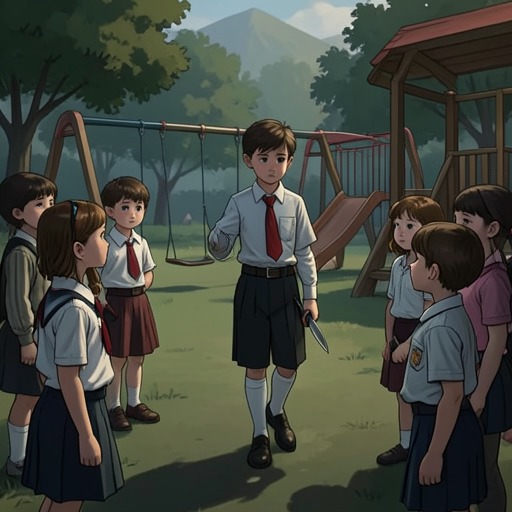
Jonny tells Oskar to clear away the rocks scattered across the sandbox. Oskar stands still, aware that the bell may ring before he can finish and that Johan will not help. At first, he cannot decide what to do. Then he rejects the order. The refusal arrives to him with the force of a newly discovered conviction: he imagines himself picking up the rocks only because Jonny demanded it, and decides against that image. A jungle gym in the sandbox, resembling the one in Oskar’s apartment courtyard, is also part of what he sees as he reaches his decision.
Jonny questions the refusal and insists that Oskar must do as he is told. Oskar repeats his answer more emphatically. The bell rings while Jonny is still looking at him. That small interval matters: Oskar has made a choice, but the scene does not show that the choice ends the bullying or changes the balance between them. His resistance is real, yet it leaves the immediate consequence unresolved.
The return to the sandbox
Oskar later goes out to collect the rocks. He expects the task to take about ten minutes and imagines telling the others about it the next day. In that anticipated version of events, Jonny would laugh and pat him on the head, calling him a good little Piggy. Oskar prefers that humiliation to what he imagines might otherwise happen; the expectation shows how narrowly he is calculating his options, not that he accepts the order as fair.
As he works, he turns cleanup into a private game. The large rocks become London and Paris, and the sandbox becomes a landscape devastated by bombs that he imagines himself helping to clear. The game absorbs his attention. When he reaches the edge of the sandbox to dump a load, Jonny, Micke, and Tomas are already there. They carry long, thin hazel branches, and Jonny uses one to direct Oskar toward a rock. The boys have waited for him. Their presence changes the task from solitary cleanup into a staged encounter in which Jonny controls what Oskar does next.
The attack and Tomas’s escalation
Tomas proposes that Oskar be whipped. Oskar recognizes the imbalance: there are three boys, they have branches, and he is alone. He considers using the rock in his hand against Tomas, but does not do so. He imagines that the school authorities might hear about the incident and understand why he had acted, yet that possibility does not become a plan he carries out. His hold on the rock gives way as the others take control of the situation.
Micke holds Oskar while Jonny strikes him with a branch. Oskar cries out and struggles, but cannot get free. At one point Jonny’s swing catches Micke as well; Micke objects, though he does not release Oskar. This brief interruption does not end the attack. It instead exposes a limit to the group’s control: even while participating in the assault, Micke reacts when he too is struck.
Tomas then steps forward and hits Oskar once in the face. The other boys’ response makes clear that this is a further escalation, not simply another part of the earlier blows: Micke reacts to what Tomas has done, and Jonny sounds angry. The distinction matters because Tomas, previously part of the group surrounding Oskar, now becomes a direct participant in the violence. The episode does not establish what prompted Tomas’s action beyond the immediate confrontation, and it does not show that the boys resolve their disagreement or face consequences at school.
Aftermath and significance
The boys leave Oskar in the sand. He stays there until he becomes cold, then gets up and checks his face in the outside toilets. In the mirror, he sees that his cheek is swollen and bloodied. He washes it; the bleeding has stopped, and the cut is not deep, though it runs across much of his cheek. The account records the injury as a concrete result of the attack without suggesting that the wound is more serious than Oskar finds it to be.
Oskar’s next concern is what to tell his mother. He settles on telling her the truth, imagining that she will be distraught, hug him, and share his distress. That imagined response places the schoolyard violence beside a relationship in which he expects comfort and protection. The episode ends with that expectation, not with his mother’s actual arrival or reaction, so the comfort remains anticipated rather than shown.
The incident’s central reversal is that returning to do the task does not make Oskar safe. His initial refusal briefly interrupts Jonny’s authority, but the later confrontation turns his renewed compliance into an opportunity for the group to isolate him. The rocks, first an unwanted chore and then pieces in Oskar’s imagined post-disaster game, remain part of the same space in which he is forced to submit to the boys’ control. By the end, the story has moved beyond a demand and its refusal: the attack has left a visible mark, and Oskar must carry its consequences into the private world of his home.