Oskar's mother
Let the Right One InOskar's mother is both a dependable source of care and a boundary against dangers Oskar cannot yet name or manage. Their ordinary routines—weekend visits to Oskar's father, tickets kept in a wallet, a familiar goodbye before school—give his childhood a pattern of security. But when he encounters Eli's frightening nature and later fears that he is becoming a vampire, that security does not translate into easy disclosure. His mother's significance lies partly in this gap: she remains close, even as Oskar struggles to let her see what is happening to him.
Identity and Family Life
Oskar's mother and Oskar's father divorced when Oskar was four. The separation did not end Oskar's relationship with his father: Oskar and his mother continued to go to his father's home on weekends and holidays. At first, those visits were a shared journey. The familiar road had been traveled many times with her, making her part of the repeated passage between two households rather than merely the parent who stayed behind.
The visits also register Oskar's growing independence. For the previous three years, he had been allowed to take the bus by himself. On the trip to his father's house, his mother no longer accompanied him to the stop at Tekniska Hogskolan. Oskar now carried his own prepaid subway-ticket book in a wallet; alongside it were twenty kronor for sweets and the notes from Eli. These small contents place an emerging private life inside a practical object she had helped make necessary. Her loosening supervision is gradual, measured in ordinary permissions rather than a declared break from childhood.
Protection and Oskar's Fear for Eli
Oskar understands his mother's protectiveness through the dangers she has tried to keep away from him. After what happened in Eli's basement, he thinks of Eli as having shown a true face, something of pure horror, and associates that horror with the familiar hazards his mother would warn him against: heights, fire, broken glass, and snakes. He wonders whether this is why he never wanted Eli and his mother to meet. In his view, his mother would recognize the danger and forbid him to go near Eli.
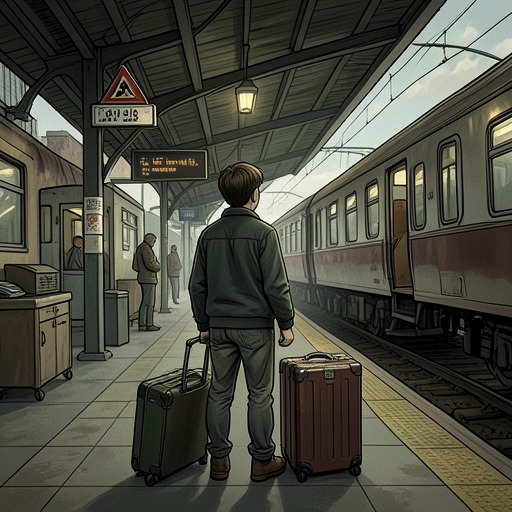
That thought reveals Oskar's fear, not a demonstrated judgment by his mother about Eli. She has not met Eli in the evidence of this episode, and Oskar's prediction cannot establish what she would actually do. Still, the imagined meeting clarifies the conflict between two forms of attachment: the protection Oskar associates with his mother and the closeness he has formed with Eli. On the Saturday journey to Spillersboda, he is traveling toward his father's home while turning over the terror of what he has seen. He had not waited for Eli the previous Friday evening; his physical departure and his emotional withdrawal from Eli are bound together in that moment.
Absence, Inference, and the Need to Be Seen
At another point, Oskar presses himself against the front door and watches the stairwell through the keyhole. He hears the mailbox open and finds advertising flyers, including an offer for ground beef. After a pause, he sees a glimpse of a woman's hair and coat collar as someone passes; he recognizes her as his mother and concludes that she is delivering the advertising packets in his absence. The scene gives him only fragments—sound, paper, and a partial view—rather than a conversation or a clear encounter.
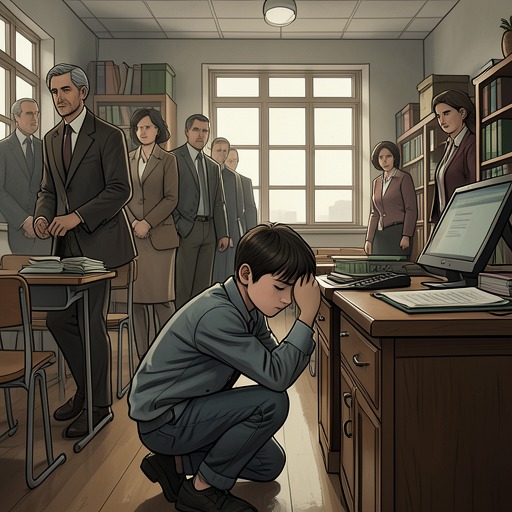
Clutching the flyers, Oskar crouches by the door with his forehead against his knees. He does not cry; the stinging urgency of needing to urinate seems to keep him from it. His repeated thought that he does not exist makes the episode less a statement about what his mother intends than a measure of his own isolation. Her apparent proximity does not reach him as reassurance. The contrast is sharp: a parent can be nearby, and even leave something tangible in her wake, while a distressed child still experiences himself as unseen.
Care During the Vampire Confession
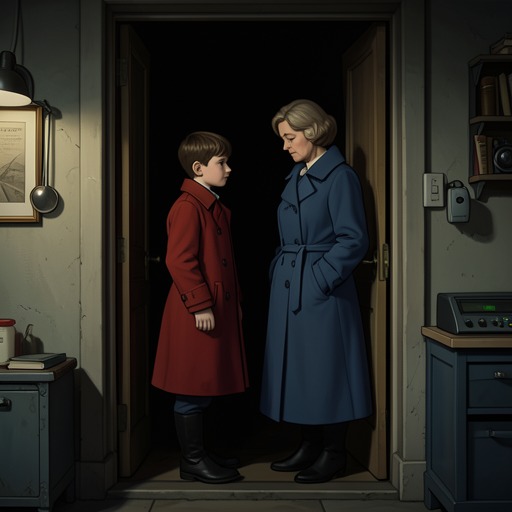
Later, Oskar's mother comes into his room while he is in bed, bringing the smell of perfume and the cold in with her. She asks about his father; exhausted and barely following the question, Oskar answers that things are fine. She pauses and sighs, then asks how he is really doing and whether she can do anything for him. Oskar says no. Her questions make room for a more truthful answer, but he does not immediately take that opening.
Eventually he tells her that he is going to become a vampire. Her response is not an attempt to argue him out of the claim. She tells him to get up, take off his clothes, and get into bed. The practical instruction is a form of caretaking at the exact point when Oskar has offered an explanation his mother cannot verify from the scene alone. The text does not show her understanding the supernatural situation; it shows her responding to the child before her, who is tired, troubled, and asking to be cared for.
When Oskar asks her to tell him a story, several emotions cross her face in quick succession: sadness, joy, worry, a small smile, and renewed concern. She says she does not know any fairy tales but offers to read one if they can find a book. Oskar tells her not to bother. The offer matters even though it does not become a story: she tries to meet an emotional request with what she can actually provide, while he retreats from accepting it.
Routine and Narrative Significance
The next morning, Oskar's mother wakes him at ten past seven, as usual. He gets up, eats breakfast, dresses, and hugs her goodbye at half past seven. He feels normal, though anxious and dreading the return to school after the weekend—an anxiety the narration presents as familiar rather than exceptional. The sequence gives her care a quiet, repeated form: waking him, sharing breakfast, and receiving the goodbye before he leaves.
Against Oskar's fear of becoming something monstrous, this routine supplies no grand explanation or resolution. Its force is smaller and more durable: even when he conceals the crisis, struggles to speak, or cannot accept an offered story, his mother's care continues through recognizable acts. The contrast between those acts and his inability to confide in her prevents her from becoming a simple answer to his distress. She is a loving presence, but Oskar's private experience remains partly beyond her reach.