Oskar’s bullying and growing resistance at school
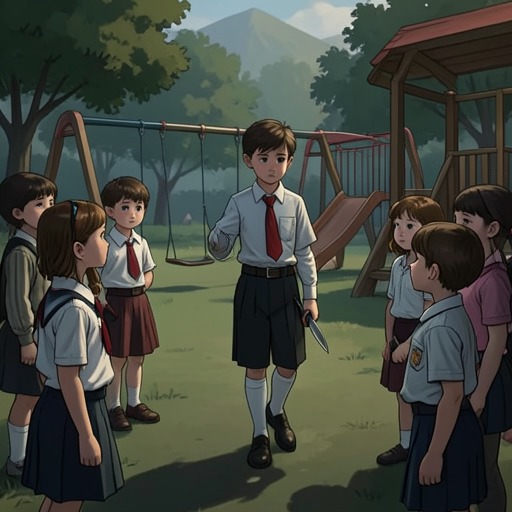
Let the Right One InOskar’s bullying at school is a pattern of humiliation and physical intimidation interrupted, but not ended, by adult authority. In the gym, Jonny, Micke, and Tomas hold back when Fernando Avila is present; outside that protection, they resume their attacks. The change in Oskar’s response—from walking on after a provocation to actively fighting back—marks a consequential turn, but the violence does not become simple triumph: after injuring Jonny, Oskar wants to apologize.
Authority and temporary protection
Fernando Avila’s gym class imposes an unusually strong order on a difficult, unruly group. Even when Avila is out of sight, the pupils line up at arm’s-length intervals. He enforces the standard with extra waiting, cancelled volleyball, or exercises, and the class knows better than to misbehave around him. A former fighter pilot who has entertained the boys with stories of aerial skirmishes and emergency landings, he commands their respect. Oskar shares that respect, though Avila’s stubbly gray hair, eagle nose, still-impressive physique, and iron grip do not suggest particular sympathy for a meek, somewhat chubby, bullied boy. His authority nevertheless has a practical effect: Jonny, Micke, and Tomas do not dare torment Oskar while he is nearby.
That restraint is conditional. As the class walks toward the gym, Tomas steps on Oskar’s heel, making his shoe slip off at the back. Oskar keeps moving rather than stopping to confront him. Since the whipping two days earlier, the boys have left him alone, but they have neither apologized nor acknowledged the harm. The visible wound on Oskar’s cheek seems to have satisfied them for the moment. The reprieve is not reconciliation; the qualification that it lasts only for now makes the threat of renewed bullying part of the scene.
The gym encounter and a first refusal
During a gym lesson, Oskar manages to clear the pommel horse and land without losing his balance after a rest. When Avila ends the lesson, Oskar puts the equipment away, patting the pommel horse as though it has finally allowed itself to be tamed. He intends to speak with Avila, but Jonny intercepts him before he reaches the door. A jump rope is looped over Oskar’s head and around his stomach while someone holds him in place. Jonny takes the rope’s ends and turns Oskar into the object of a mock ride, calling, “Giddy up, Piggy!”
When Jonny orders him to pick up the fallen rope, Oskar does so—but not in submission. He swings it above his head until the handles rattle, calls, “here it comes,” and releases it. The rope sails past Jonny, who reflexively raises his hands to protect his face, and strikes the wall bars behind him. Oskar has not attacked Jonny, but he has broken the script of the humiliation: an order designed to make him perform obedience becomes an opportunity to make Jonny flinch. He then runs down the stairs, his heart hammering, and goes into Avila’s office. Avila is speaking on the telephone in a language Oskar takes to be Spanish; the one word he recognizes is “perro,” meaning dog. Jonny walks into the changing room and speaks loudly while Oskar remains with Avila. The scene shows Oskar seeking an adult’s attention, although the supplied events do not establish what he tells him.
Humiliation beyond the classroom
The immediate encounter does not protect Oskar from another ordinary indignity. When he changes, his pants are missing. He searches the changing room and the toilets, but cannot find them. He walks home in his gym shorts as snow begins to fall, the flakes melting on his legs. The episode gives no named culprit, but its placement among the bullying incidents makes the missing clothing another concrete exposure of Oskar to humiliation. At home, he stops beneath Eli’s window, where the blinds are drawn and there is no movement; the snow on his upturned face offers a quiet contrast to the deliberate indignities he has endured at school.
The conflict later becomes physically dangerous on the ice. Jonny’s group drags Oskar backward toward a hole cut for bathing, while he has no firm footing and leaves tracks in the snow. Oskar screams for help as the open water draws near. When Jonny taunts him that someone might arrive in time to pull him out, Oskar twists sharply and throws himself sideways. Micke loses his grip, but Oskar is left dangling from Jonny’s arms. He swings the stick in his hand against Jonny’s shin; Jonny releases him, and Oskar falls onto the ice near the hole.
Resistance and its cost
Now standing at the edge of the hole with the stick in both hands, Oskar faces Jonny as he approaches and threatens to kill him unless he puts it down. Oskar waits until Jonny is a little more than an arm’s length away, then swings. Jonny ducks, but the heavy end of the stick strikes him squarely on the ear. He falls onto the ice, howling, with blood running between the fingers pressed to his ear. Micke backs away, protests that they were only having fun, and runs toward shore as Oskar advances with the stick swinging through the air.
Oskar stops and lowers the stick. He wants to apologize because he did not mean to hurt Jonny so badly, but as he crouches beside him, steadying himself on the stick, he sees Jonny before he can say sorry. The supplied scene ends at that interruption, not with a settled reconciliation. Oskar’s resistance has changed the balance of immediate power: the boy previously made to endure a noose-like rope and the threat of icy water can now drive Micke away and injure Jonny. Yet the impulse to apologize preserves the cost of that reversal. His growing resistance is real, but it does not erase the violence that produced it or make its consequences emotionally simple.