Oskar’s persistent bullying at school
Let the Right One InOskar’s persistent bullying at school is a coercive pattern in which ordinary visibility becomes a pretext for punishment. Jonny Forsberg and Micke Siskov use physical intimidation; Tomas Ahlstedt is feared for his greater capacity to prolong Oskar’s humiliation. The difference matters to Oskar, who repeatedly weighs not whether the boys will target him, but which form their attack will take and how he might endure it.
Pattern and Schoolyard Power
Oskar’s attempt to speak to a policeman offers a brief fantasy of being noticed for something other than his vulnerability. He has managed to say that he reads a lot, and imagines the officer returning after class, listening to everything, understanding him, and offering comfort. The fantasy is interrupted by Jonny, who calls him a snitch and drives a finger into his side. The accusation follows Oskar’s small bid to be heard, making his contact with an adult seem dangerous rather than protective. Yet the policeman’s car is still in the schoolyard, and Oskar calculates that Jonny will not dare attack him while the officer is nearby. Safety is temporary and depends on the presence of a witness.
The threat continues in the bathroom, where Jonny and Micke search for Oskar, call him “Piggy,” shake his stall door, and strike it until the lock begins to bend. Oskar stays curled around his legs, clenching his teeth to keep from screaming. He considers opening the door before they become angrier, even though he expects to be subjected to their customary humiliation. The narration makes the underlying logic stark: the insults about his body provide excuses, but Oskar understands the deeper offense to be his existence itself. Raising his hand in class and claiming to know something have already made him visible; in the boys’ order, even that ordinary participation is treated as a transgression. When the bolt cracks and Micke’s smiling face appears, the anticipated routine no longer feels like a game Oskar can safely submit to.
Compliance, Punishment, and the Failed Counterattack
At the sandbox, Jonny recasts the boys’ harassment as a complaint about protecting younger children. He thrusts his arm out toward the stones and tells Oskar that little children are meant to play there and that Oskar is wrecking the sandbox; Micke adds that children could trip and hurt themselves. Oskar accepts the accusation as an instruction. He gathers his things, returns to the sand, and starts removing the rocks, imagining that he is repairing a bombed-out world and rescuing survivors from ruined houses. His private game lets him make sense of the task, but it also keeps him occupied and unaware of the three boys approaching.
Jonny, Micke, and Tomas arrive carrying long, thin hazel branches. Jonny points at a rock with his whip and orders Oskar to pick it up. Oskar does so, imagining that if he tells them about the cleanup the next day, Jonny might laugh and call him a good little Piggy. Instead, Jonny says they have been waiting for him. The supposed concern for the younger children has functioned as a trap: Oskar has been made to gather the stones while the boys prepare to use the whips on him.
For a moment, Oskar sees a possible way to resist. Outnumbered and facing three whips, he considers throwing the rock at Tomas or striking him with it if he comes close. He is no longer simply hoping the attack will pass; he has decided that he could accept being whipped if it gave him the chance to hit back. But Jonny lashes his thigh, making him double over, while Micke comes up behind and pins his arms to his sides. Unable to throw the rock, Oskar is whipped across the legs. The shift from enduring torment to contemplating retaliation is real, but in this encounter the boys’ numbers and physical control prevent him from acting on it.
Injury, Concealment, and the Call to Resist
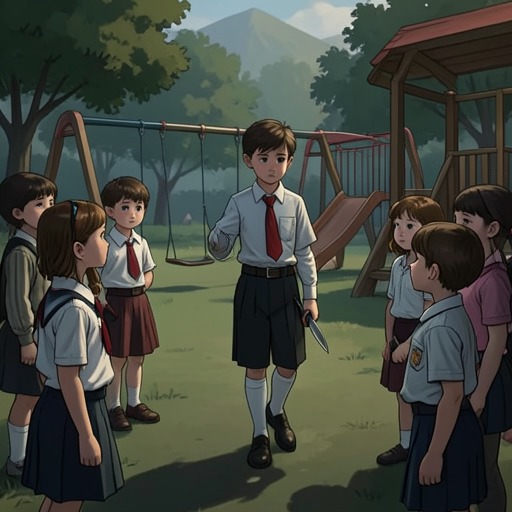
When Oskar next meets Eli, the violence has left a visible mark: Eli asks, “What happened to your cheek?” Oskar answers that he fell, disguising his injury rather than explaining it. He goes to the playground, sits on a swing, and Eli takes the neighboring one; for a while, they move back and forth in silence. The quiet offers Oskar company, but not yet an account of what the bullying has done to him.
Eli reaches for Oskar’s hand, then touches the wound. The contact brings Oskar a disturbing impression of someone older and harder beneath Eli’s skin, and Eli’s response turns the encounter toward resistance: “Oskar. Don’t let them do it. Do you hear me? Don’t let them.” Eli asks whether Oskar has ever struck back. The question gives voice to a possibility already glimpsed when Oskar considered using a rock against his attackers, but Eli’s insistence is not evidence that Oskar has yet escaped their control. It marks a change in what their shared silence can hold: the injury is recognized, and enduring the next assault is no longer presented as the only imaginable course.
Visibility, the Body, and Resistance
The episodes make bullying a contest over who is allowed to act and be seen. Oskar’s raised hand in class is later understood as a declaration that he exists and knows something; the boys turn that ordinary claim into grounds for punishment. The attacks then narrow his options physically: he curls up in the stall, bends under Jonny’s whip, and is held with his arms pinned before he can use the rock. The sequence moves from a social prohibition against speaking to bodily restraint, showing how the group enforces its power without needing a consistent pretext. Concern for children in the sandbox can become an order to collect stones; a supposed game can become a beating.
Against that pressure, the chapter gives resistance no easy or immediate triumph. Oskar’s thought of striking Tomas is a genuine break from passive endurance, but the boys’ numbers and force stop him. His lie to Eli conceals the wound, while Eli’s touch makes the injury—and the possibility of resisting its cause—impossible to leave wholly unacknowledged. The contrast between Oskar’s body being controlled by the bullies and his hand being held by Eli recasts contact: one kind of touch pins him in place; the other recognizes what has happened and urges him not to accept it as inevitable. The bullying remains unresolved in these scenes, but its pattern has become legible to Oskar and to someone who will not treat his suffering as ordinary.