Oskar's father
Let the Right One InOskar's father occupies a divided place in Oskar's life: he is a beloved, reassuring parent whose embrace makes Oskar feel at home, yet alcohol can make him seem frighteningly unfamiliar. Their relationship is marked by tenderness and ordinary domestic care, but also by Oskar's apprehension about drinking and their difficulty addressing painful subjects directly.
Identity and Oskar's View
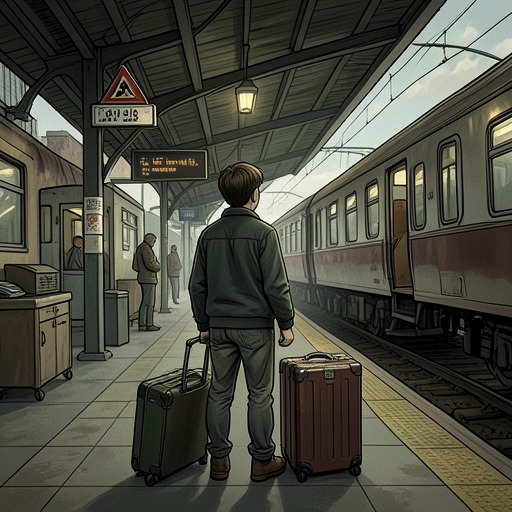
Oskar's mother describes Oskar's father as immature and unable to manage responsibility, though she also says kind things about him. That judgment is not Oskar's own summary of the man. When Oskar arrives in Södersvik, he sees his father waiting below the bus steps and falls into his outstretched arms. The previous week has made Oskar feel bigger, if not adult; in front of his father, that new sense of size disappears. The reunion makes their bond physical and immediate before either has to explain it.
Oskar experiences his father as an adult, in contrast to his mother's account of his immaturity. This difference does not resolve which parent is right; it shows how differently the father is understood within the family. For Oskar, his father's presence carries the authority and security of adulthood, while the mother's criticism remains part of the background against which he forms that attachment.
The father's worn Helly Hansen vest, repaired with Velcro, is associated with a familiar smell Oskar identifies simply as belonging to his father. Oskar presses his face against his father's chest and breathes it in. The detail gives their reunion a private vocabulary: before discussion or explanation, recognition comes through the closeness of the embrace and what Oskar knows as his father's smell.
Reunion and Unspoken Difficulties
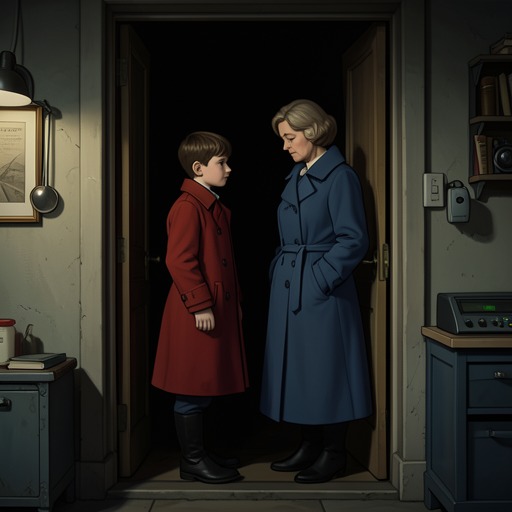
Oskar arrives at his father's home after a week in which events involving Jonny have changed how he feels about himself. His mother has told his father that he must talk with Oskar about what happened. Oskar himself is willing to discuss it, partly because he considers his father sufficiently removed from the situation that he would not interfere. The visit therefore carries an expectation of a difficult but possible conversation.
Instead, after clearing his throat and looking out over the water, Oskar's father asks whether Oskar has ice skates. He suggests they could use them if the water freezes in winter and says that he has a pair. The offer is caring and future-facing: it imagines a shared activity to come. But it also diverts the conversation from Jonny. Oskar's father does not begin the discussion his mother requested, even though Oskar had been prepared for it. In this exchange, practical companionship becomes easier to offer than direct engagement with the trouble between Oskar and Jonny.
Life in the Father's Home
The account of the visit presents care through small, concrete routines. On Saturday evening, Oskar clears the table while his father washes the dishes after a meal of roasted eider duck and potatoes. They have eaten nearly all of the bird and potato, using white bread to gather the remaining gravy from their plates. The scene establishes an ease between them in the shared work of clearing up, as well as the father's competence with a small repertoire of familiar dishes: pytt-i-panna, fried herring, and roasted seabird. The leftovers are already expected to become the next day's pytt-i-panna.
Oskar also has a room of his own at his father's house. It is barer than his room in town, where posters, pictures, and other things keep changing, but the fixedness of this room is precisely what he likes. It looks as it did when he was seven. The room offers continuity rather than novelty: a place whose unchanging appearance lets Oskar return to an earlier version of home. The father's household is not described as elaborate, but its meals, chores, and familiar room give their time together a settled form.
Drinking and Oskar's Fear
That domestic ease is vulnerable to the father's drinking. When Janne is visiting, Oskar anticipates that the bottle will be empty in about an hour and that his father will then pace in the kitchen before coming to Oskar's room. This is Oskar's expectation of a recurring sequence, not simply a fear of an unknown possibility. He expects his father to wake him, seek reassurance that Oskar loves him, speak about still loving Oskar's mother and about the wrongs he has suffered, and perhaps become angry. Oskar makes clear that his father has never become violent, but says that what he sees in his father's eyes is more frightening than anything else he has encountered.
To make sense of the change, Oskar imagines that alcohol brings out a separate being inside his father, as the moon brings out a werewolf. The comparison registers the distance between the sober parent who has just embraced him and the person Oskar expects to meet after the drinking. It does not erase his love for his father; rather, it gives shape to the fear that the familiar parent can become inaccessible while remaining physically present. Oskar waits in his room with a Bamse comic but cannot concentrate, feeling forlorn at the thought of being alone with this altered version of his father.
Oskar eventually leaves the house and walks toward the road, carrying his boots. He blames his father for the situation and imagines that his mother will not let him visit again. He also anticipates that his father will look for him and call his mother once he realizes he is gone. To prevent that response from becoming a catastrophe, Oskar plans to call from Norrtälje and say that he has returned to Stockholm, will sleep at a friend's house, and will go back to his mother the next morning. After throwing his boots into a ditch, he retrieves them and puts them in his pockets. His decision to keep walking gives him a limited sense of control: he chooses where he is going, while still planning a story that might spare his father and mother a more serious confrontation.
Attachment and Narrative Significance
Oskar's father is neither reduced to the mother's criticism nor protected from Oskar's fear. The contrast between the welcoming embrace and the anticipated drinking episode makes the relationship's instability part of its emotional truth. Oskar longs for his father's closeness, trusts the ordinary rhythms of the house, and values its familiar room; at the same time, he expects that closeness to be disrupted by a version of his father he cannot reach or predict with confidence.
Their later telephone exchange keeps that uncertainty in view. Oskar recognizes the caller as his father and answers. His father asks whether Oskar has told his mother about what happened, and Oskar answers without disclosing whether he has. The question returns to a subject that had already gone unaddressed during their time together. The silence that follows leaves the conversation unresolved: affection and contact remain, but neither father nor son turns the difficult matter into an open discussion.
As a character, Oskar's father helps define the difference between feeling loved and feeling secure. His gestures of welcome, shared meals, and proposal of skating make affection tangible; his drinking makes Oskar's homecoming uncertain. The novel presents the bond through these reversals rather than through a settled judgment of the father: Oskar can fall into his arms and still dread what may happen later that night.