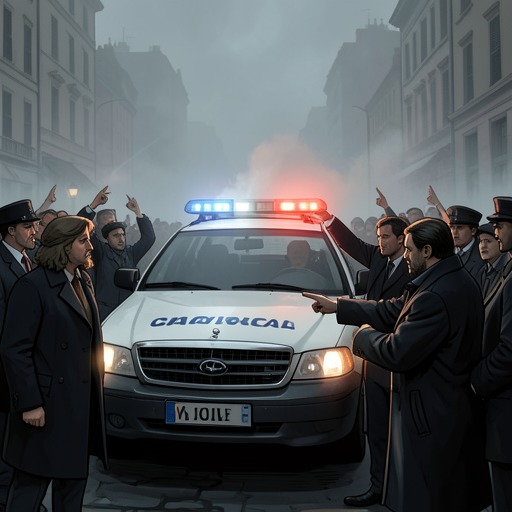
Police arrest the alleged “ritual killer”
Let the Right One InPolice arrest the alleged “ritual killer” in Blackeberg on Monday morning, turning a feared but unseen figure into a person held by police. The account, issued in a 16:45 bulletin from The Daily Update, makes the arrest sound decisive while withholding the details that would establish the suspect’s identity and explain what happened. Its central tension is therefore between public certainty that the killer has been caught and the official report’s explicit qualifications.
Background: Fear and Distraction
Before the arrest, suspicion had attached itself to appearance. People who resembled the phantom picture circulated by police were scrutinized by strangers; some even wondered whether changing their hairstyles would make them look more or less suspicious. The description had helped make the murderer imaginable, but it also spread fear well beyond any known suspect. In the report of the arrest, the label “Ritual Killer” carries the weight of that public image into the news bulletin, even though the account does not yet provide a positive identification.
That fear had already been displaced once by a more distant threat. On 28 October, a Soviet submarine ran aground outside Karlskrona, and news that “The Russians were here” spread through Oskar’s school by lunchtime. Children who had spent the previous week imagining the Vällingby murderer now turned to talk of the Soviet Union, rockets, and nuclear weapons. Oskar asked Johan whether the submarine could carry a bomb; Johan said it could, and Oskar considered the distinction between people dying and houses remaining standing. The shift does not explain the later arrest, but it shows how quickly the community’s attention could move from a local, hard-to-identify danger to a national and international one.
The novel also places that public alarm alongside ordinary conversation about missing Jocke and practical questions of safety. As Lacke drinks more and struggles to afford food, Larry asks about the nearest nuclear shelter and raises the possibility of a full-scale invasion. Morgan offers access to the shelter he has inspected, describing its gas masks, canned food, and Ping-Pong table. Such details keep the language of catastrophe close to everyday life. Against this broader atmosphere of fear, the arrest is not simply the end of one public anxiety: it is a new claim about what the police know, and what they are not yet saying.
The Arrest and the Bulletin
The bulletin dates itself precisely: 16:45 on Monday, 9 November 1981. It says the suspect was apprehended that morning in a basement office in Blackeberg, in west Stockholm. The location is specific, but the circumstances of the apprehension are not. The report describes neither a confrontation nor the process by which police tracked the man down, and it does not say what led them to that office. Its emphasis is on the fact of custody and on what remains unconfirmed.
The police spokesman, Bengt Larn, is asked whether the man is the same person police have been seeking. His answer begins with confidence: “Quite sure.” He immediately qualifies it, however, by saying that “Certain factors” complicate a positive identification at that time. The distinction matters. The police assert that they have found their suspect, but the bulletin does not present the identification as settled fact. The article’s headline-level description and the spokesman’s narrower formulation coexist, leaving the reader with a claim that is strong but not final.
When asked what those factors are, Larn refuses to elaborate: “Unfortunately I can’t go into further details at the moment.” The refusal preserves the gap rather than resolving it. The report gives no account of the evidence, the suspect’s name, or the reason identification is complicated. Its silence is especially consequential because the police have already placed the apprehension within the public story of the Ritual Killer. The reader is told enough to understand that a major step has been taken, but not enough to verify how the detained person fits the identity the public has imagined.
The Boy and the Unanswered Questions
The report adds that police found a sixteen-year-old boy with the suspect. It distinguishes his condition from the suspect’s: the boy is described as physically unharmed but in severe shock, and has been taken to hospital for further monitoring. The suspect, by contrast, is transported to hospital after his condition is described as critical. These two medical details establish that the arrest involved more than the detention of an alleged offender, while leaving the connection between the boy and the man unexplained.
The bulletin does not name the boy or say how long he had been in the basement office, what had happened there, or how police came upon the pair. It also does not state whether the boy can give an account of events. Those omissions make the boy’s presence an unresolved part of the news rather than an explanation of the arrest. His reported shock gives the discovery a human consequence, but the official account resists converting that consequence into a complete narrative.
Police are still searching the area for further information about the chain of events. That continuing search undercuts any impression that apprehension has closed the case: custody is a development, not a full reconstruction. The suspect’s critical condition, the complication surrounding identification, and the unknown circumstances of the boy’s presence all remain open at the bulletin’s end.
Significance and Narrative Effect
The arrest changes the public story from a search for a phantom to a report about a particular detained man, but it does not make the phantom’s identity transparent. The language moves between certainty and restraint: police have apprehended someone they believe is the person they sought, yet cannot confirm identification positively or discuss the factors that stand in the way. The headline description is therefore more conclusive than the details beneath it. That difference preserves suspense without suggesting that the arrest itself is false.
The form of the bulletin also makes information control part of the event. A spokesman answers direct questions, confirms custody, and declines further disclosure; the newspaper reports the boy’s condition and the suspect’s transfer to hospital, then notes the police search for more information. The result is a public announcement that supplies location, time, and immediate consequences while withholding motive, evidence, and sequence. What is revealed is substantial, but the account makes its limits visible.
In the novel’s wider movement between neighborhood fear and larger threats, this arrest offers no simple return to normality. Earlier, a police image had encouraged people to suspect strangers, while the submarine news redirected schoolchildren’s attention toward nuclear danger. Now the police announce an apprehension, yet the decisive question—whether the detained man can be positively identified—remains unsettled. The event brings the feared figure within reach of official custody while keeping the gap between a public label and a verified identity at the center of the story.