Public fear of the Vällingby murderer
Let the Right One InPublic fear of the Vällingby murderer is a changing collective response to an unsolved killing: first grief and anxiety, then rumor and suspicion, and finally a rush of attention toward a larger national crisis. Because no photograph identifies the killer, people supply images and explanations of their own. The novel follows that fear through newspapers, school talk, and ordinary conversation, showing how the threat is made to feel familiar even while the facts remain incomplete.
A murder without a visible perpetrator
The killing unsettles a community whose sense of place is strikingly detached from the past. Blackeberg’s apartment buildings have replaced forest, and the history available to schoolchildren amounts to disconnected traces of an old mill, a tobacco magnate, and buildings by the water. With no church among its nine thousand inhabitants, the suburb seems rational and free of historical ghosts. That modern confidence helps explain why its residents are unprepared for a frightening event that resists an ordinary explanation.
The first reports offer little detail about the victim’s death. A sixteen-year-old girl found the boy’s body in the woods and was described as being in extreme shock. A photograph shows police tape around a hollow and a large tree, but not the killer. Oskar recognizes the public ritual that may follow: candles, messages of grief, and a place made into a memorial. He has similar cases in his scrapbook. The scene is both a specific crime site and an image through which people will try to give the event a meaning.
When the Sunday papers return to the case with the headline “Victim of Ritual Murder?”, the coverage renews attention that had begun to fade. Flowers at the hollow have wilted, candles have burned down, and the police tape has been removed. The phrase “ritual murder” suggests repetition, so a single killing becomes a possible warning of another. People who have walked nearby contribute accounts of the forest as frightening or, conversely, calm and beautiful. Their conflicting impressions make the place itself seem uncertain, while the boy’s smiling photograph and the crime-scene image stand in for an explanation that is still missing.
From uncertainty to suspicion
The missing element is a likeness of the perpetrator. Without one, the killing seems to have happened without an identifiable agent, an absence that leaves room for speculation. Some people imagine the murderer as a foreigner and attach the possibility of ritual violence to prejudiced assumptions about people from elsewhere. These claims are not evidence about the crime; they show how readily public fear borrows existing suspicions when the facts provide no clear target.
That atmosphere changes when police release a composite sketch on Monday, October 26. A young girl has seen the suspect, and police take care in constructing the image. The resulting face is described as ordinary Swedish in appearance, yet ghostlike and vacant. The sketch gives the public something recognizable to search for, but it does not resolve the case. Men in the western suburbs who resemble the image are scrutinized by strangers and later wonder whether changing their appearance would make them look suspicious. The drawing turns uncertainty into a practice of watching, extending the case into the private self-consciousness of people who may have no connection to it.
The contrast between the speculative foreign suspect and the composite’s familiar appearance exposes how fear shifts to suit available images. Before the sketch, rumor offers a generalized outsider; afterward, an apparently ordinary face becomes a mask through which almost anyone might imagine danger. The public can recognize the picture without knowing the person behind it. The portrait supplies a focus for anxiety, not proof of identity or guilt.
Rumor at school and fear of a wider threat
By October 28, the children at school have moved between two alarming subjects: the Vällingby murderer and the news that a Soviet submarine has run aground. In the preceding week, pupils claimed to have seen the murderer or even to have been attacked by him. They have mistaken sketchy-looking passersby for the suspect. When an older man in shabby clothes takes a shortcut across the school grounds, children run for cover, while some boys prepare to confront him with hockey sticks. They let him go once someone identifies him as a local alcoholic. The episode shows how rumor turns an uncertain description into suspicion directed at whoever happens to pass.
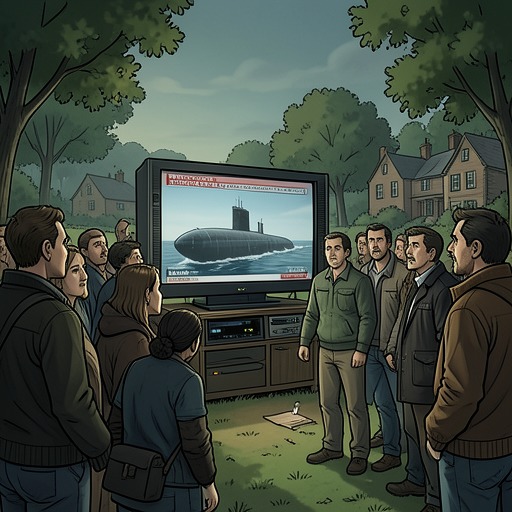
The submarine changes the scale of the children’s fear. They know little about the Soviet Union beyond fragments of jokes, hockey, space exploration, and the arms race. Oskar asks Johan whether the Russians have a nuclear bomb; Johan speculates that the submarine might carry one. Oskar wonders how such a weapon could be delivered, and Johan says it could be fired by rocket. Their exchange brings an international threat into the schoolyard, where the children try to understand it through the same hurried conjecture that had shaped their talk about the murderer.
The newspapers announce that the submarine has run aground outside Karlskrona and that its presence will soon make Sweden feel violated. Attention turns away from the suspect: men resembling the composite need no longer lie awake considering whether to alter their appearance. At a meal, Larry asks where the nearest nuclear shelter is and raises the hypothetical prospect of invasion; Morgan answers that his shelter has supplies and a Ping-Pong table. At another lunch break, Oskar imagines the consequence of a nuclear attack in stark terms: “The people die but the houses are left standing.” Fear has not disappeared. It has moved from a local, faceless murderer to a national danger made newly imaginable by the submarine.
Attention moves on
On Sunday evening, November 8, public interest in the police search of Judarn Forest is at its height. The evening papers can no longer rely on printing the composite sketch and had hoped to show an apprehended suspect. Instead, both use a photograph of a police officer handling a sheep. Expressen puts it on the front page. The image attracts attention through its dramatic composition, and the fact that the sheep belongs to the King brings the royal household briefly into the news. The court declines to comment, pointing instead to the announcement that the King and Queen are expecting their third child.
The sheep photograph marks the latest turn in a public story that has repeatedly substituted images and conjecture for knowledge of the murderer. The initial crime scene, the absent likeness, the composite sketch, and finally an unrelated but arresting photograph each organize attention differently. Against Blackeberg’s thin local history, newspapers and shared talk rapidly build a public memory of the killing—but that memory is unstable. It can intensify around a ritual-murder headline, disperse under the pressure of a submarine crisis, and settle temporarily on a photograph unrelated to the case. The fear remains consequential precisely because its object is never securely established.