The Murderer
Let the Right One InThe Murderer is the imagined identity Oskar Eriksson constructs to answer a life in which he feels vulnerable, humiliated, and unable to resist. At first, the role offers a private reversal: instead of being the person others can hurt, Oskar imagines himself as the figure who controls the danger. In the forest, however, that fantasy becomes a justification for attacking Jonny Forsberg. The concept therefore marks both a psychological refuge and a consequential crossing from imagined power into real violence.
Identity and Origins
Oskar’s fantasy grows out of his experience of bullying and his efforts to endure it. After avoiding punishment by playing the pig, he feels worse than if he had been punished. He understands that surrendering in this way costs him pride, but cannot bear the thought of physical punishment when it is imminent. His comparison with Robin Hood and Spider-Man makes the gap plain: fictional heroes can face danger and escape, while Oskar has learned to do what he must to survive. He sees his own submissive performance as a survival tactic, not a triumph.
That same day, Oskar seeks compensation by going to Sabis, the grocery store in Blackeberg, despite the chance of meeting Jonny and Micke. He fills his coat with chocolate bars and hides Swedish Cars against his body, then pays for a lollipop. Walking home with his head high, he recasts himself as a Master Thief rather than someone others can push around. The theft does not remove the vulnerability that prompted it; it gives him a role in which he can imagine outwitting those who make him feel powerless.
The role of criminal has earlier precedents. About a year before, Oskar was caught shoplifting at a Konsum. He dreaded the possibility that the guard would contact his mother, then intercepted a letter from the Police Authorities, District of Stockholm, forged her signature, and returned it to indicate that she had read it. The episode shows his combination of fear and resourcefulness: he does not confront authority openly, but tries to control what others learn about him. The later Murderer fantasy enlarges that private ingenuity into a more absolute and threatening identity.
From Private Game to Forest Fantasy
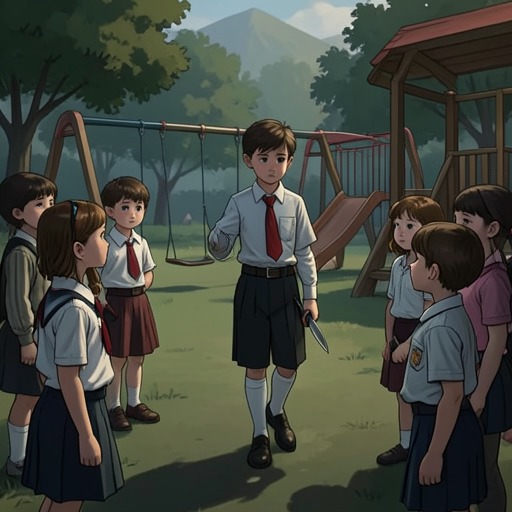
Oskar’s apartment courtyard has seemed safe, a protected space within the larger ring of buildings on Ibsengatan. He grew up there and once had friends, but the bullying became serious in fifth grade; by the end of that year, even children outside his class were calling less often to ask him to play. During that period he began keeping a scrapbook. The homeward walk that follows his theft is also a return to that private world, where he expects to spend time with the scrapbook. The contrast between the courtyard’s remembered safety and the forest’s later transformation helps explain how the Murderer role takes shape: the forest, once associated with danger, becomes a stage on which Oskar can reverse his position.
Before leaving, Oskar prepares carefully. He wraps his knife in newspaper to make a makeshift holster and conceals it at his side. He gathers the candy wrappers from his room so that his mother will not find them if she comes home before him, intending to hide them under a rock in the forest. He imagines himself as a killer who has already slain fourteen people without leaving evidence, and identifies Jonny as his next victim. The imagined record of undetected crimes gives the fantasy a methodical, almost procedural form: concealment and preparation make the game feel controlled before any confrontation begins.
As Oskar walks toward the forest, anticipation replaces the heaviness he had felt earlier. He sees the world through the eyes of a murderer as far as his thirteen-year-old imagination can manage: as a beautiful world under his control, trembling before his actions. The difference between an adopted viewpoint and a settled identity remains important. Oskar is imagining what it is like to be the Murderer, but the fantasy gives him a framework for approaching a real person and a real grievance.
Confrontation with Jonny
In the forest, Jonny is waiting near the top of a hill, apparently expecting another familiar encounter in which he can overpower and humiliate Oskar. Oskar approaches with the knife in his hand and with the role of the Murderer mediating how he understands the meeting. He no longer experiences himself as the boy Jonny expects to dominate; he imagines that Jonny is facing someone else, someone dangerous.
The confrontation turns the imagined scenario into an actual attack. Oskar strikes Jonny, who tries to escape and begs for mercy, but Oskar does not stop. The narration connects his actions to specific grievances: what Jonny did in the bathroom that day, a trick that made Oskar play knuckle poker, and the accumulated insults. These reasons make the attack intelligible as revenge without making it equivalent to justice. The imagined killer’s authority lets Oskar recast a history of humiliation as a sequence of offenses for which he can personally impose a response.
The episode does not establish, in the cited account, Jonny’s eventual fate. What it does establish is that Oskar’s play has ceased to be only a fantasy: he has used it to commit serious violence against the person he had named as his target. The Murderer is thus not simply a disguise for thoughts that remain safely imaginary. It is a role through which Oskar acts on anger that had been building under the conditions of bullying.
Aftermath and Significance
On the walk home, the forest that had felt threatening for several years seems like a home and a refuge. Oskar feels no fear of the dark or anxiety about the next day. The change in his perception echoes the earlier shift from the vulnerable boy to the imagined controller of the world: having acted in the role, he experiences the place associated with danger as somewhere that belongs to him. Back in the courtyard, he sits beside the sandbox to calm himself before returning home.
His thoughts also point toward repetition. Oskar decides that he will get a better knife, one with a guard so that he will not injure himself, because he intends to do this again. The conclusion that it was a good game carries a sharp tension: the word game preserves the framing through which he has made the violence bearable, while his plan to repeat it shows that the consequences exceed play. The Murderer’s imagined power offers immediate relief from humiliation, but it also gives revenge a structure, a target, and a prospective future.
As a concept, the Murderer exposes the unstable boundary between fantasy and conduct in Oskar’s response to bullying. The role does not emerge from confidence or public recognition; it is assembled privately from superhero comparisons, shoplifting, secrecy, and a rehearsed image of control. Its appeal lies in reversing the positions Oskar occupies in his ordinary life. Yet the forest encounter makes the reversal costly: the identity that first lets him imagine surviving danger becomes the means by which he inflicts it. The return to the courtyard cannot restore the earlier innocence of the game, because Oskar leaves the scene not only with a new sense of power but with the intention to repeat what he has done.