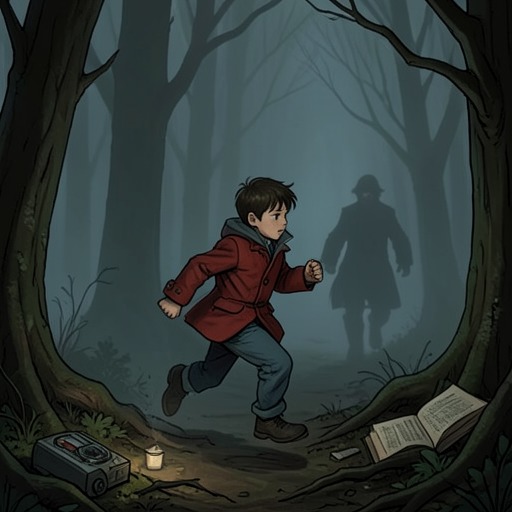
The archetypal Monster
Let the Right One InThe archetypal Monster is a description of how the Vällingby murderer came to signify more than an unidentified suspect: he became, in a British journalist’s account, the embodiment of evil familiar from fairy tales. The expression captures the public’s desire to give an unsettling, unresolved crime a recognizable face, while exposing the comforting fiction that identifying a monster can make the danger disappear.
From an Unseen Killer to a Public Image
The newspapers’ early account of the Vällingby murder offered readers a headline asking whether the boy had been the victim of ritual murder, alongside pictures of the victim, a hollow in the forest, and a tree. What it did not provide was a photograph of the killer. Without that likeness, the crime seemed to have happened without a visible perpetrator; the images fixed attention on the place and the victim while leaving the source of the violence absent.
The absence invited speculation. After police announced a major heroin seizure and the arrest of five Lebanese men, public conjecture about the murderer turned toward a foreign suspect, drawing on racist assumptions about Arabs, Muslims, and violence. When police released a composite sketch, however, it depicted a seemingly ordinary Swede with a ghostlike appearance and vacant gaze. The image redirected suspicion toward men in the western suburbs who resembled it, making the killer at once more imaginable and more difficult to identify reliably.
The Monster as a Shared Story
By Wednesday, 28 October, schoolchildren were circulating rumors that the Russians were present. The Vällingby murderer had already dominated their conversations for the preceding week; children claimed to have seen him, and some said he had attacked them. These shifting claims show how the figure of the killer expanded beyond the evidence of a single case, taking on the shape of whatever threat rumor could make immediate.
At the Sunday-evening police press conference, the British journalist described the search as a hunt for the archetypal Monster: a figure whose appearance and deeds seemed to embody the evil at the heart of fairy tales. The formulation links the suspect’s public image to a familiar narrative pattern. The monster is made recognizable not only by what he is said to have done, but by the promise that finding him will resolve the fear surrounding him.
News Spectacle and the Promise of Closure
The scale of attention had outgrown the police station’s conference room, which had space for forty people. Reporters from European newspapers and television stations arrived, and the failure to recapture the man during the day made the event more sensational. The conference moved to a larger room, where police leaders prepared to present a photograph of the suspect. The expectation of an image mattered: after days of an absent face and a composite sketch, a photograph seemed to offer a more definite answer.
That same evening, as public interest in the police search of Judarn Forest reached a peak, the papers had no new image of an apprehended suspect to publish. Both evening newspapers instead ran a photograph of a police officer handling a sheep, and Expressen placed it on its front page. The image’s physical drama drew attention in its own right, while the court declined to comment on the sheep, which belonged to the King. The episode shows how the search for a monster could make even an unrelated image into a substitute spectacle when the expected resolution did not arrive.
The journalist’s observation also identifies the cycle behind the expression: each time a monster is caught, people want to believe the danger has ended permanently. In the context of the press conference, that belief is exposed as a comforting expectation rather than a guarantee. The archetypal Monster is therefore both a figure of collective fear and a story through which the public tries to contain fear—by giving it a face, demanding its capture, and imagining that capture as final.