The boundary between life and death
Let the Right One InThe boundary between life and death is not presented as a single line that can always be identified by appearance or accepted without question. It is examined through Hakan’s awareness inside a body dependent on a breathing machine, Tommy’s skeptical response to a graveside ritual, and Oskar and Tommy’s attempt to interpret an autopsy report. Together, these episodes distinguish biological signs from social beliefs and leave open a narrow but consequential uncertainty about what can happen at the edge of death.
Consciousness and bodily dependence
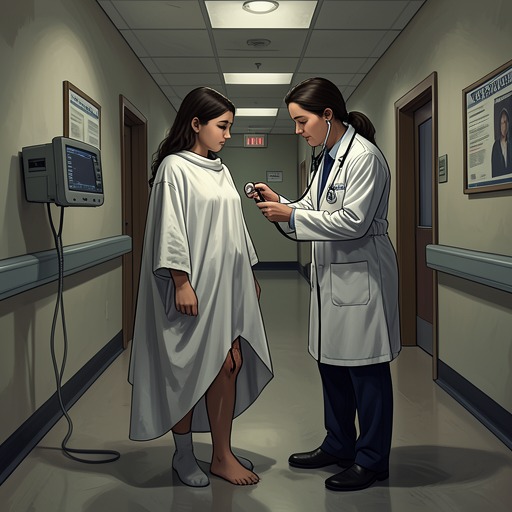
Hakan’s awakening makes the boundary first a problem of consciousness and bodily function. He registers a hiss and pressure against his back, then tries to work out whether he is still at the pool and whether he is awake. His chest seems to fill and empty in time with the sound. The machine, rather than his own command, is governing his breathing; the question of whether he is alive is therefore inseparable from his dependence on it.
His awareness persists while much of his body seems unavailable to him. He cannot make his eyes blink properly or open his mouth, and his attempts to command movement meet little response. Yet he can direct his thoughts toward one hand, close it into a fist, and feel his fingers against his palm. That limited sensation and movement give him evidence of a self still present, even as the rest of his body appears remote. The scene does not equate immobility with death: Hakan can think, remember, and act on the small range of movement that remains to him.
A tube and metal socket in his throat make that precarious state concrete. Hakan understands that the tubing is connected to the apparatus sustaining his breathing and that he could pull it out if he wanted to die. He recognizes the arrangement as having been set up for that purpose. At the same time, his recollection reaches back only to unscrewing the lid of the acid container; he assumes he poured it over himself according to plan and identifies his survival as the miscalculation. The gap between what he intended and what followed is stark: an attempted death has left him conscious, dependent on machinery, and able to contemplate ending the life that remains.
Death as ritual and absence
Tommy’s visit to his father’s grave presents death from the other side: not as a bodily threshold, but as an absence that ritual cannot undo. At the cemetery gate he checks the map and locates his father in section D, at Grave 104. His father’s remains were cremated and the ashes buried, a process Tommy regards as strange. His own memories of the funeral, nearly three years earlier, are indistinct: a coffin and a gathering of people alternating between crying and singing.
The cemetery is lit by small candles, with figures moving among the headstones. Tommy watches his mother carry a lantern toward his father’s grave and feels sadness, not only for himself or for her, but for the people gathered among the graves. They sit beside names and touch inscriptions, trying to remain close to those who are gone. Tommy finds the gesture embarrassing and thinks that death means a person is simply gone. Still, he walks over and crouches beside his mother while she lights the lantern. He avoids touching the letters in his father’s name while she is there.
They watch the lantern’s weak light shift across the marble before Tommy gets up to leave. His mother follows and puts her arm through his; he lets her, and they walk together beside Råcksta Lake, where ice is beginning to form. The scene holds two responses at once. Tommy rejects the idea that a grave can restore the dead, yet he stays beside his mother and accepts her touch. His repeated insistence that death is final expresses conviction, but the shared walk shows that the living still make forms of connection around that finality.
Autopsy evidence and the limits of certainty
A conversation between Oskar and Tommy turns the question from ritual to evidence. Tommy tells Oskar that an autopsy found no smoke in a woman’s lungs. Oskar infers that she had not been breathing. Tommy adds the detail that makes this finding difficult to reconcile with an ordinary account: the woman had managed to get out into the garden and run around before she died. If she was moving outside the burning place, the absence of smoke in her lungs seems to demand an explanation.
Oskar considers alternatives rather than immediately treating the case as proof of anything beyond the report. He proposes either that the examiners made a mistake or that the woman was running around despite being dead. He recalls reading about a murderer who tried to make a death look like a fire accident, but Tommy interrupts the account and returns to the autopsy finding. When Oskar asks whether the woman could have held her breath, he rejects the possibility himself, remembering that people cannot simply do that in the circumstances he has in mind. The exchange proceeds through inference and correction: each new detail narrows the ordinary explanations without eliminating uncertainty.
Tommy says he does not think the examiners made that kind of mistake. Oskar agrees that the possibility seems unlikely, but does not turn the report into a complete explanation. Tommy’s conclusion is that people like to think death is final. The qualification matters. Their statement is both a familiar certainty and an acknowledgment that the details they have discussed trouble it. Neither boy establishes what the woman’s movements mean; the account leaves the contradiction in view.
A boundary that remains unsettled
These episodes approach death through different kinds of evidence. Hakan’s awareness is direct but partial: he can think and move a hand while relying on a machine to breathe. Tommy’s father’s grave offers material signs and public ritual, but neither restores the person whose name is on the stone. The autopsy offers a medical finding, yet the reported movement before death complicates the assumption that bodily evidence will make the moment of death entirely legible.
The narrative does not collapse these distinct cases into a single rule. Hakan’s condition is a scene of survival after an intended death, the cemetery is a scene of grief and refusal, and the conversation about the woman is an unresolved problem of interpretation. Their juxtaposition makes the boundary feel both real and difficult to fix: death is treated as an irreversible absence, while consciousness, movement, and medical findings can leave observers unsure about precisely when that absence begins. The boys’ repeated conviction that the dead are gone is therefore not simply disproved; it is exposed to questions that their available evidence cannot finally answer.